Mold on Wood Floors: Remove It, Refinish, or Replace?
Out of the Mold Editorial Team
Our guides are research-backed and cite EPA, CDC, and peer-reviewed sources. Product reviews are based on hands-on testing, not manufacturer claims. Read our editorial standards.
Affiliate Disclosure: Out of the Mold is reader-supported. As an Amazon Associate, we may earn a commission when you buy through links on this page — at no extra cost to you. Our picks are based on independent standards, manufacturer specifications, and published research, not commissions.
Key Takeaways
- Surface mold on sealed hardwood costs $50–$300 to clean. Subfloor mold runs $4,800–$12,000+.
- The 48-hour rule: dry wet floors within 48 hours or mold colonization begins. A $50 fan rental beats a $15,000 remediation.
- Never sand cupped floors while still wet — it causes crowning. Wait until moisture content returns to 6–9%.
- Bleach doesn't work on wood. The EPA does not recommend it for porous surfaces. Use vinegar, H2O2, or Concrobium.
- Insurance caps mold at $1,000–$10,000 under most policies — far less than typical floor remediation costs.
Mold on wood floors is either a surface cleanup or a $15,000+ problem — the difference is whether it's reached the subfloor. Surface mold on sealed hardwood can be cleaned with diluted vinegar or Concrobium for $50–$300 in supplies. But if the mold has penetrated below the boards into the plywood subfloor, you're looking at board removal, subfloor treatment, and possibly full replacement at $7–$25 per square foot. The 48-hour rule applies: if water sat on your floors for less than 48 hours and you dry everything fast, you can usually save them. After 48 hours, mold colonization is underway and the decision gets harder.
Finding mold on hardwood floors feels like discovering termites — your mind immediately jumps to worst-case scenarios and five-figure repair bills. But here's what most panicked homeowners don't realize: surface mold on sealed hardwood is one of the easier mold problems to fix. The real question isn't whether you have mold on the floor. It's whether you have mold under the floor.
That distinction — surface mold vs. subfloor mold — drives every decision from here. A $30 bottle of Concrobium can handle the first scenario. The second can cost $4,800 to $12,000+ depending on how far it's spread. I'll walk you through how to figure out which you're dealing with and what to do either way.
Signs of Mold on Hardwood Floors
Some signs are obvious. Others are subtle enough that homeowners walk over them for months without realizing what's happening.
- Visible discoloration — Black, green, white, orange, or yellow spots or streaks on the floor surface. Sometimes just a slight darkening that doesn't clean off with regular mopping.
- Musty smell— The #1 early warning sign, especially if you can't see anything wrong. If your room smells damp and earthy, mold is growing somewhere. See our mold smell guide for how to track it down.
- Warping or cupping — Board edges rising higher than the center (cupping) or the center bulging above the edges (crowning). Both indicate moisture underneath.
- Soft or spongy spots — Press down on the floor. If it gives more than the surrounding area, the wood underneath may be rotting.
- Dark stains that won't clean— If a stain doesn't respond to cleaning products, it's likely mold that has penetrated below the finish.
- Buckling boards — Planks pulling away from the subfloor or popping up entirely. This usually means significant moisture and possible subfloor damage.
Surface Mold vs. Subfloor Mold
This is the most important assessment you'll make. Everything flows from it — the method, the cost, and whether you're hiring a pro.
| Indicator | Surface Mold | Subfloor Mold |
|---|---|---|
| Location | On the finish or top of the wood grain | Under the boards, in the plywood/OSB below |
| Cleans off? | Yes — vinegar or Concrobium removes it | Surface may clean but mold returns quickly |
| Floor condition | Boards are firm and flat | Cupping, warping, soft spots, or buckling |
| Moisture reading | Below 12% MC | Above 16% MC — mold territory |
| Smell | Mild or gone after cleaning | Persistent musty odor even after surface treatment |
| Typical cost | $50–$300 (DIY supplies) | $3,000–$15,000+ (professional remediation) |
The edge-board test:If you suspect subfloor mold, carefully pry up a board at the room's edge near a baseboard. Look at the underside and the subfloor surface. Dark staining on the plywood confirms mold below. A moisture meter reading above 16% on the subfloor means active growth conditions.
Klein Tools ET140 Pinless Moisture Meter
Klein Tools
$45–60
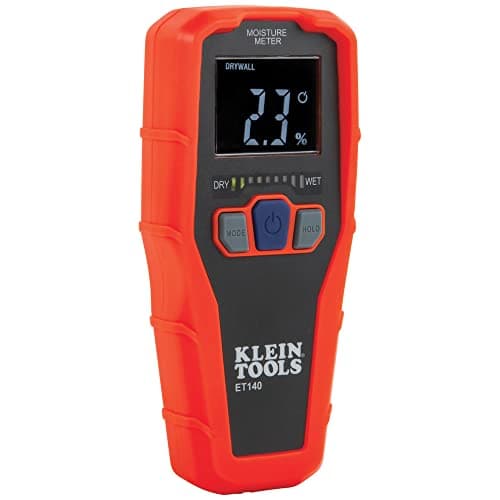
A professional-grade pinless moisture meter that detects hidden moisture in drywall, wood, and masonry without leaving holes. Uses electromagnetic sensor technology to measure moisture content up to 3/4 inch below the surface. Essential for identifying moisture problems before mold develops.
Pros
- Non-invasive pinless technology, no holes in walls
- Detects moisture up to 3/4 inch deep
- Visual and audible moisture alerts
Cons
- Less precise than pin-type meters on exact moisture percentage
- Battery not included
- Can give false readings on metallic or foil-backed surfaces
How to Remove Surface Mold from Wood Floors
For areas under 10 square feet with surface-only mold (the EPA's DIY threshold), this is a Saturday afternoon project.
- Ventilate the room.Open windows and run a fan pointing outward. You're going to disturb spores.
- Vacuum with a HEPA filter. Regular vacuums blow spores into the air. A HEPA vacuum captures particles down to 0.3 microns — mold spores are 1–30 microns.
- Clean with diluted vinegar or hydrogen peroxide. For sealed floors: spray undiluted white vinegar, wait one hour, scrub with a soft brush, wipe clean. For unsealed wood: use 3% hydrogen peroxide — vinegar can soak into unfinished wood and cause swelling.
- For stubborn stains: Concrobium then RMR-86. Concrobium kills and prevents but doesn't remove stains. RMR-86 removes stains in seconds but won't prevent regrowth. The best approach: RMR-86 first for the stains, then Concrobium for lasting protection. See our complete removal guide for more product options.
- Dry thoroughly. Run fans and a dehumidifier for 24 hours minimum. The target moisture content for hardwood is 6–9%. Anything above 16% is mold-risk territory.
- Re-seal if the finish is compromised.If the mold was under the polyurethane finish, you'll need to lightly sand the affected area and re-apply finish. Use a mold-resistant sealant or add mold-killing primer as a base coat.
Concrobium Mold Control
Concrobium
$10–15
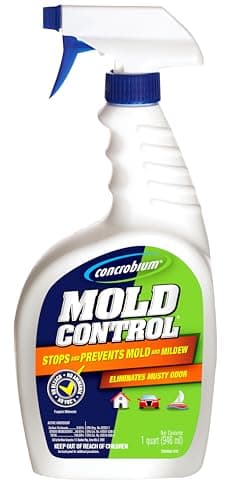
A patented, EPA-registered mold control solution that kills mold without bleach, ammonia, or VOCs. The tri-salt polymer formula crushes mold spores as it dries and leaves an invisible antimicrobial barrier to prevent regrowth. Safe for indoor use on virtually any surface.
Pros
- Non-toxic, no bleach or ammonia
- Kills mold and prevents regrowth
- Safe for use around children and pets
Cons
- Does not remove existing mold stains
- Takes longer to work than bleach-based products
- May require multiple applications for severe infestations
Important: Bleach does not work on wood. The EPA does not recommend bleach for porous surfaces — its high surface tension prevents it from penetrating to mold roots, and the water content actually feeds subsurface mold. This is the #1 mistake homeowners make. Stick with vinegar, hydrogen peroxide, or Concrobium for wood.
Mold Under Hardwood Floors (Subfloor Mold)
Subfloor mold is where costs escalate fast. The mold you see on the floor surface is often just the visible edge of a colony that's colonized the plywood underneath. Here's how it gets there:
- Plumbing leaks (most common — slow drips under sinks, dishwashers, toilets)
- Flooding or water damage that wasn't dried within 48 hours
- Vapor barrier failure in crawl spaces below the subfloor
- Condensation from temperature differentials (cold concrete slab + heated floor above)
- Overwatering houseplants — standing water seeps through board seams
DIY Subfloor Assessment
Before calling a pro, you can check yourself. Remove a board at the room's edge (near a wall, where it's easiest to pry up without visible damage). Use a moisture meter on the subfloor — readings above 20% mean active mold growth conditions. Visible dark staining on the plywood, a musty smell when the board comes up, or soft/spongy subfloor material all confirm the problem.
Professional Subfloor Remediation Process
For areas over 10 square feet, or any subfloor mold, hire an IICRC-certified remediation company. The professional process:
- Containment. Heavy plastic sheeting over doors, windows, and vents. HVAC turned off. Negative air pressure with HEPA filtration to prevent spore spread.
- Board removal. Hardwood boards pried up one by one. Contaminated material sealed in heavy-duty bags for disposal.
- Subfloor treatment. Concrobiumor borax solution (1 cup per gallon of water) applied, scrubbed, left 10 minutes, repeated twice. Bleach and RMR-86 remove stains but don't penetrate — Concrobium creates a subsurface antimicrobial barrier.
- Joist inspection. Check floor joists and crawl space for mold spread. Treat if contaminated.
- Drying. Industrial fans and dehumidifiers for 3+ days until moisture content drops below 16%.
- Clearance testing. Post-remediation air samples confirm spore levels are back to normal ($200–$400).
- Repair. Reinstall subfloor and flooring.
Timeline: minor cases 1–3 days. Complex subfloor jobs with joist involvement: 1 week or longer.
Mold on Plywood Subfloor
Plywood is more mold-prone than solid wood because it's made with organic adhesives that mold feeds on. OSB (oriented strand board) is even worse — its layered structure traps moisture internally.
For plywood subfloors with surface mold that hasn't compromised structural integrity: sand the surface with 80-grit sandpaper to remove the mold layer, then treat with Zinsser Mold Killing Primer and install a 6-mil polyethylene vapor barrier before re-laying flooring. This encapsulation approach seals remaining spores in place and blocks moisture from below.
When to replace instead: If the plywood is soft when you push a screwdriver into it, delaminating (layers separating), or sagging between joists, the structural integrity is compromised. Replace it. Subfloor plywood materials cost $2–$5 per square foot; with labor, full subfloor repair runs $35–$80 per square foot.
When to Restore vs. Replace Your Floors
This is the question that determines whether you're spending $2,600 or $12,000. Here's the decision framework based on actual 2026 costs:
| Path | When It Applies | Cost (200 sq ft room) |
|---|---|---|
| Clean only | Surface mold on sealed floors, caught early | $50–$300 (DIY) |
| Remediate + refinish | Mold in the wood grain but subfloor is sound. Moisture content back to 6–9%. | $2,600–$7,600 |
| Remediate + replace | Subfloor damaged, boards structurally compromised, or mold covers >25% of floor | $4,800–$12,000+ |
Restore When:
- Mold is surface-level or within the top layer of wood grain
- Moisture content has returned to normal (6–9%)
- Cupping is minor and boards have flattened after drying
- Damage is limited to a small area (under 25% of the room)
- Floors have sentimental or historic value
Replace When:
- Mold has penetrated through the boards (black staining visible on the underside)
- Boards are cupped so severely they've pulled fasteners from the subfloor
- The subfloor underneath is also compromised
- You have engineered hardwood or laminate (can't be sanded deep enough)
- Wood is soft, crumbly, or structurally deteriorated
Critical rule: never sand cupped floors while they're still wet.Wait until the moisture issue is fully resolved and the moisture content returns to 6–9%. Sanding wet cupped boards produces a flat surface temporarily, but once the moisture fully evaporates, the edges shrink and the center crowns — creating a new problem that's harder to fix. This mistake costs homeowners thousands in double-refinishing.
Does Insurance Cover Mold on Wood Floors?
The short answer: sometimes, but probably less than you think.
Covered:Mold from sudden, accidental events — burst pipes, water heater failures, frozen pipes, appliance malfunctions. If your washing machine suddenly sprays water across your hardwood and mold develops before you can dry it, that's typically covered.
Not covered:Gradual damage, neglect, long-standing leaks. A pipe dripping under your kitchen sink for months? That's maintenance, not an accident. Flood water? Standard homeowner's insurance excludes it entirely. Even NFIP flood insurance excludes mold — the biggest coverage gap most people discover too late. See our hurricane season mold guide for flood-specific insurance details.
The sub-limit trap: Even when mold is covered, most standard policies cap mold remediation at $1,000–$10,000 per occurrence — with a typical sub-limit of $2,500–$5,000. That cap is almost always insufficient for hardwood floor mold remediation, which runs $3,000–$35,000. Optional mold endorsements raise the cap to $10,000–$50,000+ for an additional $500–$2,000 per year. In humid climates, this add-on pays for itself fast.
Preventing Mold on Wood Floors
- Maintain humidity below 50%. A $10 hygrometer and a dehumidifier in moisture-prone rooms. The ideal range for hardwood floors is 30–50% RH year-round. Mold grows above 60% RH; active colonization starts above 75%.
- Fix leaks within 24 hours. Mold spores germinate within 12–24 hours on damp surfaces. Visible colonies appear within 48–72 hours. The cost of a $200 plumber visit to fix a slow leak is nothing compared to a $15,000 floor replacement.
- Install a vapor barrier under the subfloor. Especially in homes with crawl spaces. A 6-mil polyethylene sheet between the ground and the subfloor blocks moisture from migrating upward. Cost: $0.50–$1.50 per square foot installed.
- Use mold-resistant sealant. When refinishing or installing new floors, choose a polyurethane finish that includes fungicide. It costs the same as regular finish but adds a layer of protection.
- Ventilate crawl spaces and basements. Stagnant air under the house = moisture buildup = subfloor mold. Proper ventilation or encapsulation is the long-term fix.
- Clean up standing water immediately.Spills, pet accidents, overwatering plants — don't let water sit on hardwood for any length of time. Keep towels nearby in high-risk areas.
For more on general mold prevention across your home, see our complete black mold removal guide — the prevention section applies to every surface including floors.
Dealing With Mold Right Now?
Our step-by-step mold removal guide walks you through testing your home, choosing the right products, and knowing when a job is too big for DIY.
Read the Removal GuideFrequently Asked Questions
Can mold under hardwood floors make you sick?
Yes. Mold under floors releases spores into the room through gaps between boards, along baseboards, and around heating vents. Because these spores are at breathing height — especially for children and pets on the floor — exposure is more direct. The CDC links mold exposure to a 30–50% increase in childhood asthma risk. For medical guidance, see the CDC's mold and health resources.
How much does it cost to fix mold under hardwood floors?
DIY surface cleaning: $50–$300. Professional remediation for a contained area: $1,500–$4,000. A full room with subfloor involvement: $4,000–$15,000. Total floor replacement (remediation + new hardwood): $4,800–$12,000+ for a typical 200 sq ft room. Costs escalate 20–40% after major storms due to contractor demand. Always get at least three quotes. Our mold removal cost guide has more detail on pricing by severity.
Does homeowners insurance cover mold damage to floors?
Only if the mold resulted from a sudden, accidental event (burst pipe, appliance failure). Gradual damage, neglect, and flooding are excluded. Even covered claims are capped at $1,000–$10,000 for mold under most policies — far less than typical floor remediation costs. A mold endorsement ($500–$2,000/year) raises that cap to $10,000–$50,000+.
Can you sand mold off hardwood floors?
Sanding works for mold that's penetrated past the finish but hasn't reached the subfloor. Sand with 60–80 grit to remove the mold layer, then treat with a mold-killing primer before refinishing. Important: only sand after the wood has fully dried to 6–9% moisture content. Sanding wet wood causes crowning — a worse problem than the mold itself. Refinishing (sand + stain + finish) costs $3–$8 per square foot.
How long does it take for mold to grow under wet wood floors?
Mold spores begin germinating within 12–24 hours on damp surfaces. Active growth and hyphae formation happens at 24–48 hours. Visible colonies appear at 48–72 hours. By one week, colonies are well established and producing mycotoxins. This is why the 48-hour rule matters — getting everything dry within that window prevents colonization in most cases.
Frequently Asked Questions
Can mold under hardwood floors make you sick?
How much does it cost to fix mold under hardwood floors?
Does homeowners insurance cover mold damage to floors?
Can you sand mold off hardwood floors?
How long does it take for mold to grow under wet wood floors?
Related Articles
How to Remove Mold from Wood (Without Ruining It)
How to Get Rid of Black Mold: DIY Removal Guide
Mold in Carpet: How to Tell If You Should Save It or Replace It
What Does Mold Smell Like? How to Identify Mold by Smell
Mold-Resistant Paint: How It Works, When to Use It, and What It Can't Do
Best Mold Removal Products: What Works for Every Surface & Situation
Dealing With Mold Right Now?
Our step-by-step mold removal guide walks you through testing your home, choosing the right products, and knowing when a job is too big for DIY.
Read the Removal Guide