Mold-Resistant Paint: How It Works, When to Use It, and What It Can't Do
Out of the Mold Editorial Team
Our guides are research-backed and cite EPA, CDC, and peer-reviewed sources. Product reviews are based on hands-on testing, not manufacturer claims. Read our editorial standards.
Affiliate Disclosure: Out of the Mold is reader-supported. As an Amazon Associate, we may earn a commission when you buy through links on this page — at no extra cost to you. Our picks are based on real testing and independent standards, not commissions.
Key Takeaways
- Primer kills residual spores and blocks stains. Paint resists new growth. Most mold projects need both.
- Never paint directly over active mold — the colony continues growing underneath and pushes through within months.
- Surface prep matters more than the paint itself. Kill, remove, dry, clean, prime, then paint.
- Mold-resistant paint can't replace moisture control. Above 60% humidity, mold colonizes any surface eventually.
- Repainting high-moisture areas every 5–7 years refreshes antimicrobial protection.
Mold-resistant paint and mold-killing primer are different products that serve different purposes — and most mold projects need both. Primer (Zinsser) kills residual mold and blocks stains as a base coat. Paint (Rust-Oleum Perma-White) resists new mold growth on its surface for up to 5 years. Never paint over active mold — kill and remove it first, or the colony continues growing underneath.
The #1 mold painting mistake: someone buys a can of "mold-resistant paint," slaps it over moldy drywall, and assumes the problem is solved. Three months later, mold is pushing through the new paint layer and the surface looks worse than before.
Mold-resistant paint resists newmold growth on its surface. It does not kill existing mold. It does not seal mold under the paint. It's a prevention tool, not a treatment. Understanding this distinction is the difference between a lasting fix and wasted effort.
How Mold-Resistant Paint Actually Works
Mold-resistant paints and primers contain antimicrobial additives — typically one of four technologies:
- EPA-registered fungicides — Chemical compounds embedded in the paint film that kill mold spores on contact (used in Zinsser primer)
- Biostatic additives— Chemicals that prevent mold from feeding on the paint surface without killing it (used in most "mold-resistant" topcoat paints)
- Silver-ion technology — Nanoparticles of silver that disrupt microbial cell membranes (used in some premium formulations)
- Low-porosity formulation — Paint engineered with fewer pores for moisture to enter and less organic binder for mold to feed on
All of these work on the paint surface. None of them penetrate the wall to kill mold behind the coating. That's why the preparation process matters more than the paint itself.
Primer vs. Paint: When to Use Each
| Feature | Mold-Killing Primer | Mold-Resistant Paint |
|---|---|---|
| Purpose | Kills residual spores, blocks stains | Prevents new mold growth on surface |
| When to use | After mold removal, before topcoat | Final coat in high-moisture areas |
| Base | Oil-based (stronger adhesion) | Water-based (easier cleanup) |
| Stain blocking | Excellent (covers mold stains) | Minimal |
| Fumes | Strong (oil-based, needs respirator) | Low (water-based) |
| Duration | Permanent under topcoat | 3–5 years (Perma-White: 5-year guarantee) |
For most mold remediation projects, use both: Zinsser primer as the base coat (kills and seals), then Rust-Oleum Perma-White as the topcoat (prevents regrowth). This two-layer approach provides the most durable protection.
Zinsser Mold Killing Primer
Zinsser
$18–25
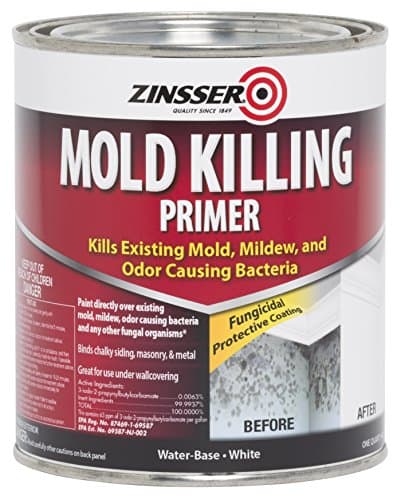
An EPA-registered fungicidal primer that kills existing mold, mildew, and odor-causing bacteria on contact. Creates a mold-resistant barrier on interior and exterior surfaces including drywall, wood, concrete, and masonry. Essential for mold remediation projects before applying topcoat paint.
Pros
- Kills existing mold on contact while priming
- EPA-registered fungicidal protective coating
- Bonds to all interior and exterior surfaces
Cons
- Strong odor during application, requires ventilation
- Water-based formula can raise grain on bare wood
- Must be topcoated with paint for lasting protection
Rust-Oleum Perma-White Mold & Mildew-Proof Interior Paint
Rust-Oleum
$25–35
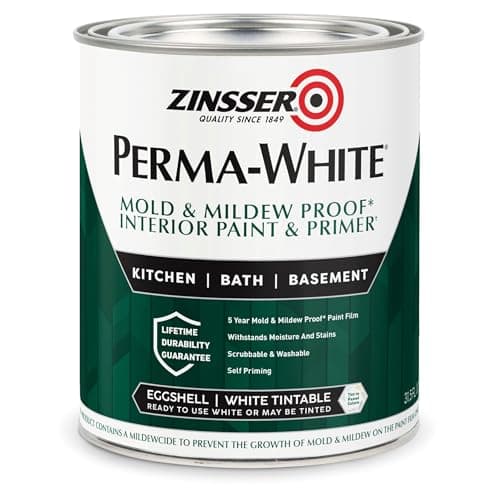
A self-priming, moisture-resistant interior paint with a 5-year mold and mildew-proof guarantee. The advanced acrylic formula resists moisture, dirt, and staining while providing a smooth satin finish. Ideal for high-humidity areas like bathrooms, basements, and kitchens.
Pros
- Self-priming formula saves time
- Guaranteed mold and mildew proof for 5 years
- Moisture-resistant, ideal for bathrooms and basements
Cons
- Limited to interior use only
- Available only in satin white finish
- Cannot be tinted to custom colors
Where to Use Mold-Resistant Paint
Mold-resistant paint is cost-effective in areas with chronic moisture exposure. It's overkill for dry interior rooms.
- Bathrooms — Ceilings and walls, especially around showers and above tubs. The ceiling is the highest-priority surface because steam rises.
- Basements — All walls and ceilings in below-grade spaces. Humidity consistently exceeds safe levels in most basements.
- Kitchens — Behind the stove and above the dishwasher where steam concentrates.
- Laundry rooms — Dryer exhaust and washing machine moisture create ideal mold conditions.
- Any previously remediated area — If mold was removed from a surface, that surface should be primed and painted with mold-resistant products.
Surface Preparation: The Step Most People Skip
Paint adhesion and antimicrobial performance depend almost entirely on how well you prepare the surface. Skipping prep is why "mold-resistant paint" fails.
- Kill all existing mold — Use Concrobium, hydrogen peroxide, or white vinegar. Do not proceed until the mold is dead.
- Remove loose mold and debris — Scrub with a stiff brush, wipe with damp rags, dispose in sealed bags.
- Assess the substrate— Press on the wall. If drywall is soft, crumbling, or spongy, cut out the damaged section and replace it. Paint won't fix structural damage.
- Dry completely — Run fans and dehumidifiers until moisture meter reads below 15% in wood or drywall paper. Painting over a damp surface traps moisture and guarantees mold returns.
- Clean the surface — Wipe with TSP (trisodium phosphate) solution to remove soap residue, grease, and remaining mold fragments. Rinse with clean water.
- Apply primer — One coat of Zinsser Mold Killing Primer. For heavy stains, use two coats. Let dry completely (1 hour in ventilated rooms).
Application Tips
- Coats: Two coats of topcoat paint over the primer for maximum protection. Allow full drying between coats (typically 2–4 hours for water-based paint).
- Method: Roller for large areas, brush for cutting in. Avoid spraying — atomized paint creates uneven antimicrobial distribution.
- Ventilation:Oil-based primer: open all windows, run exhaust fans, wear a respirator with organic vapor cartridges (N95 alone isn't enough for oil-based fumes). Water-based topcoat: open windows, standard ventilation is sufficient.
- Temperature:Apply between 50–90°F. Below 50°F, most paints don't cure properly and antimicrobial additives may not activate.
- Humidity: Keep room humidity below 50% during application and drying. A dehumidifier in the room helps paint cure properly.
What Mold-Resistant Paint Cannot Do
Setting realistic expectations prevents disappointment:
- Cannot kill active mold — Painting over live mold just hides it. The colony continues growing and pushes through the coating.
- Cannot replace moisture control — If the room stays above 60% humidity, mold will eventually colonize any paint surface, antimicrobial or not.
- Cannot prevent mold behind the wall — The coating protects the painted surface. Mold growing on the back of the drywall (from a plumbing leak, for example) is unaffected.
- Cannot last forever — Antimicrobial additives degrade over time. Plan to repaint high-moisture areas every 5–7 years.
- Cannot compensate for poor ventilation — A bathroom without an adequate exhaust fan will grow mold no matter what paint you use. Fix the airflow first.
For a complete guide to removing mold before painting, including product comparisons and spray selection by surface type, see our complete mold removal guide. For black mold removal, professional remediation may be needed before any painting begins.
Need Professional Mold Removal?
Get free, no-obligation quotes from licensed mold remediation specialists in your area.
Get Free QuotesFrequently Asked Questions
Can you paint over mold with mold-resistant paint?
No. Remove the mold first with an appropriate cleaner, then apply mold-killing primer (Zinsser) to neutralize any remaining spores. Only after the primer has fully cured should you apply mold-resistant topcoat paint.
What is the difference between mold-killing primer and mold-resistant paint?
Mold-killing primer contains fungicide that kills existing mold spores and creates a protective base layer. Mold-resistant paint resists mold growth on its surface over time. For best results, use both: primer first, then mold-resistant topcoat.
How long does mold-resistant paint last?
Rust-Oleum Perma-White guarantees mold and mildew resistance for 5 years. Zinsser primer provides lasting protection as long as it remains covered by topcoat. Repainting every 5–7 years in high-moisture areas is recommended.
Frequently Asked Questions
Can you paint over mold with mold-resistant paint?
What is the difference between mold-killing primer and mold-resistant paint?
How long does mold-resistant paint last?
Related Articles
Mold Removal Products: A Complete Guide to What Works and Why
How to Remove Mold from Your Bathroom Ceiling (And Keep It Gone)
Mold Killer Spray: Which Type Works on Which Surface
Best Mold Removal Products: What Works for Every Surface & Situation
Mold on Walls: How to Remove It (and When to Replace the Wall)
Does Bleach Kill Mold? The EPA Says No — Here's What Actually Works
Need Professional Mold Removal?
Get free, no-obligation quotes from licensed mold remediation specialists in your area.
Get Free Quotes