Hydrogen Peroxide for Mold: Does It Actually Work?
Out of the Mold Editorial Team
Our guides are research-backed and cite EPA, CDC, and peer-reviewed sources. Product reviews are based on hands-on testing, not manufacturer claims. Read our editorial standards.
Affiliate Disclosure: Out of the Mold is reader-supported. As an Amazon Associate, we may earn a commission when you buy through links on this page — at no extra cost to you. Our picks are based on independent standards, manufacturer specifications, and published research, not commissions.
Key Takeaways
- 3% hydrogen peroxide kills most mold species on non-porous surfaces — spray, wait 10–15 minutes, scrub.
- Never mix H2O2 with vinegar (creates corrosive peracetic acid) — use them sequentially instead.
- Bleach is counterproductive on porous surfaces like drywall and wood — its water content feeds mold roots.
- H2O2 doesn't prevent regrowth. For lasting protection, follow up with Concrobium Mold Control.
- For areas over 10 square feet or suspected black mold on porous materials, skip DIY and call a professional.
Yes, 3% hydrogen peroxide kills most mold on non-porous surfaces. Spray it on undiluted, wait 10–15 minutes (until the fizzing stops), scrub, and wipe clean. It works well on tile, grout, glass, and sealed countertops. It won't work on large infestations, deep porous materials like drywall, or anything over 10 square feet — those need commercial products or a professional. Never mix H2O2 with vinegar in the same bottle (creates corrosive peracetic acid). Use them separately if you want both.
Hydrogen peroxide is one of those products that's been sitting under your bathroom sink for years, and it turns out it's a legitimately effective mold killer. I've recommended it as a first-line treatment for small mold problems for one simple reason: it's cheap, non-toxic, and actually backed by real data.
But there's a lot of bad advice out there about H2O2 and mold. Some sites say it kills "all mold." Others say it's useless. The truth is more specific — and the specifics matter if you want to actually solve your mold problem instead of watching it come back two weeks later.
Does Hydrogen Peroxide Actually Kill Mold?
Short answer: yes, on non-porous surfaces, at 3% concentration or higher, with adequate contact time.
A peer-reviewed study published in the International Journal of Environmental Research and Public Health (PMC7823841) tested aerosolized hydrogen peroxide against six common mold species — including Aspergillus, Penicillium, and Alternaria. At 5% concentration, researchers achieved a 99.9% kill rate (3+ log reduction) in 71% of test conditions after 4 hours of exposure. Liquid application at 6% killed most strains with similar effectiveness.
One notable exception: Paecilomyces variotiishowed significantly higher resistance, achieving only a 1.9 log reduction under the same conditions. This is a less common household mold, but it's a reminder that no single product kills everything.
The mechanism is straightforward — H2O2 is an oxidizer. It breaks down mold cell walls through oxidation, and the fizzing action (that familiar bubbling when it hits organic material) physically lifts spores from textured surfaces like grout. That mechanical action is something bleach can't do.
The Right Concentration
Here's where most guides get lazy and just say "use 3%." That's fine for most situations, but there are actually three tiers:
- 3% (pharmacy grade) — The brown bottle from the drugstore. This is what you should use for DIY surface cleaning. It kills the majority of common household mold species on hard surfaces. Cost: $1–$3 for 32 oz.
- 5–6% (professional grade) — Used in aerosolized applications by remediation companies. More effective in the study data, but overkill for homeowner use and harder to find.
- 35% (food grade)— Industrial concentration. Must be diluted before use. Causes chemical burns on skin contact and respiratory damage if inhaled. Unless you're a professional, don't buy this. If you already have it, dilute 1 part 35% H2O2 to 11 parts distilled water to get approximately 3%.
How to Use Hydrogen Peroxide for Mold Removal
This is dead simple, but the details matter — especially the contact time, which most people cut short.
- Pour 3% H2O2 into an opaque spray bottle.This matters more than you'd think. Light degrades hydrogen peroxide rapidly — a clear spray bottle can cut its potency significantly within days. Use a dark or opaque bottle, or wrap a clear one in tape.
- Spray the moldy area until saturated.Don't mist it — drench it. You want the surface wet enough that the H2O2 stays in contact with the mold for the full contact period.
- Wait 10–15 minutes.You'll see bubbling — that's the oxidation reaction working. Wait until the fizzing stops completely, then give it another 5 minutes. Most people scrub too early. The CDC recommends at least 10 minutes of undisturbed contact for surface disinfection.
- Scrub with a stiff brush. Focus on grout lines and textured surfaces where spores embed. A grout brush or old toothbrush works for small areas.
- Wipe with a clean damp cloth and dry thoroughly. Leaving moisture behind defeats the purpose.
- Repeat if needed. Let the surface dry completely between applications. Two rounds handles most surface mold.
The Baking Soda Power-Up
For tough grout stains or caulk mold, mix 2 tablespoons baking soda with 1/4 cup 3% hydrogen peroxide into a paste. Apply it, let it sit for 30 minutes, then scrub. The combination creates a mild exothermic reaction that generates CO2 bubbles — adding abrasive and lifting action beyond what H2O2 does alone. This is a safe combination (unlike H2O2 + vinegar — more on that below).
Best and Worst Surfaces for H2O2
Hydrogen peroxide works great on some surfaces and poorly (or destructively) on others. Here's the breakdown:
| Surface | Effectiveness | Notes |
|---|---|---|
| Ceramic tile & grout | Excellent | Best use case. Fizzing lifts embedded spores from grout. |
| Glass & mirrors | Excellent | Streak-free, no residue. |
| Porcelain & stainless steel | Excellent | Safe for sinks, toilets, fixtures. |
| Sealed countertops | Good | Works on quartz, sealed granite. Avoid unsealed stone. |
| Concrete | Good | Surface mold only. Won't penetrate deep pores. |
| Painted walls | Fair | Test first — may lighten paint. Doesn't reach mold behind paint. |
| Drywall | Poor | Can't reach mold roots in porous material. See our bathroom ceiling guide for drywall approaches. |
| Wood | Poor–Fair | Surface only. Can lighten wood. Vinegar penetrates wood better. |
| Fabric & carpet | Use with caution | Will bleach colored fabrics. Test on hidden area first. See mold in carpet for carpet-specific treatment. |
| Natural stone (marble, limestone) | Avoid | Can etch and damage the surface. Use pH-neutral cleaners instead. |
Hydrogen Peroxide vs. Other Mold Removers
This is the question everyone actually wants answered: should I use H2O2, bleach, vinegar, or a commercial product? The honest answer depends on the surface and the severity.
| Factor | H2O2 (3%) | Bleach | White Vinegar | RMR-86 | Concrobium |
|---|---|---|---|---|---|
| Kill effectiveness | ~85% of species | Surface only | ~82% of species | Surface stains | Broad-spectrum |
| Porous surface penetration | Moderate | Poor | Best | Poor | Good |
| Stain removal | Good | Best | Poor | Best (15 sec) | None |
| Prevents regrowth | No | No | Somewhat | No | Yes (barrier) |
| Fumes / toxicity | Mild | Harsh | None | Strong | None |
| Residue | None (→ H2O + O2) | Chemical film | Faint smell | Chemical film | Invisible barrier |
| Safe for fabrics | Test first | No | Yes | No | Yes |
| Cost (32 oz) | $1–$3 | $3–$5 | $3–$5 | $15–$20 | $12–$18 |
The critical thing most guides get wrong about bleach: On porous surfaces like wood and drywall, bleach is actually counterproductive. The chlorine component stays on the surface and kills visible mold, but the water component soaks into the material and feeds the mold roots deeper inside. This is why mold often returns worse after bleach treatment on drywall or wood. Hydrogen peroxide and vinegar both penetrate porous surfaces more effectively.
My Recommendation: The One-Two Punch
Remediation professionals often use a two-step approach: kill first, then prevent. Use hydrogen peroxide (or Concrobium for porous surfaces) to kill the active mold, then apply a preventive treatment to stop regrowth. For stubborn stains on hard surfaces, RMR-86removes discoloration in seconds — but it doesn't prevent anything from growing back. For the full decision framework on which products to use at each stage of remediation, see our complete mold removal products guide.
Concrobium Mold Control
Concrobium
$10–15
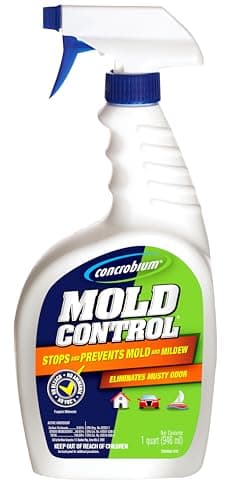
A patented, EPA-registered mold control solution that kills mold without bleach, ammonia, or VOCs. The tri-salt polymer formula crushes mold spores as it dries and leaves an invisible antimicrobial barrier to prevent regrowth. Safe for indoor use on virtually any surface.
Pros
- Non-toxic, no bleach or ammonia
- Kills mold and prevents regrowth
- Safe for use around children and pets
Cons
- Does not remove existing mold stains
- Takes longer to work than bleach-based products
- May require multiple applications for severe infestations
RMR-86 Instant Mold & Mildew Stain Remover Spray (1 Gallon)
RMR Brands
$25–35
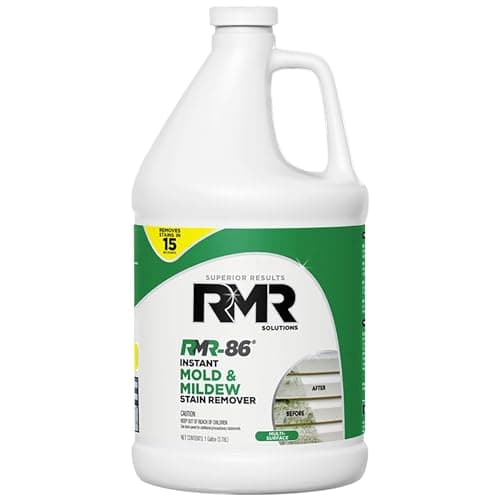
A fast-acting, commercial-strength mold stain remover that eliminates black mold stains on contact. The sodium hypochlorite formula penetrates porous surfaces to lift deep stains without scrubbing. Best used in well-ventilated areas with proper respiratory protection.
Pros
- Removes stains in as little as 15 seconds
- Works on wood, concrete, drywall, and tile
- No scrubbing required
Cons
- Strong bleach-based formula with harsh fumes
- Not safe for fabrics or colored surfaces
- Requires good ventilation and PPE
Hydrogen Peroxide for Black Mold
This gets its own section because "hydrogen peroxide for black mold" is one of the most searched variations — and the answer is more nuanced than a yes or no.
A 2013 study in the Journal of Occupational and Environmental Hygiene found that H2O2 can prevent Stachybotrys chartarum (the "toxic black mold") from growing and germinating on treated surfaces. That's encouraging. But certified mold experts caution that it doesn't eradicate established colonies embedded in porous materials.
Here's the thing that makes black mold different from other mold: Stachybotrys produces mycotoxins that remain harmful even after the mold is dead. An ERMI mold test can confirm whether Stachybotrysis present — at $200, it's worth the investment before attempting DIY on suspected toxic mold. Spraying anything on black mold — H2O2, bleach, whatever — can disturb the colony and send spore fragments and mycotoxin-laden particles airborne. Visible mold is often just the surface of a much larger colony inside the material.
Bottom line: H2O2 is fine for a small patch of dark mold on a hard surface (tile, glass, sealed concrete) where the area is under 10 square feet. For suspected Stachybotrys on porous materials, or anything larger than a 3×3 foot area, call a professional. The mycotoxin risk makes DIY treatment genuinely dangerous. For more on the decision between DIY and professional remediation, see our complete black mold removal guide.
When Hydrogen Peroxide Isn't Enough
H2O2 is a great first-line tool for small, surface-level mold problems. It's not a solution for everything. Upgrade your approach when:
- The mold area exceeds 10 square feet— That's roughly a 3×3 foot patch. Above this, the EPA recommends professional remediation with containment.
- Mold is deep in porous materials— Drywall, unfinished wood, carpet padding. H2O2 treats the surface but won't reach roots. For drywall, you often need to cut out the affected section.
- The mold keeps coming back— Recurring mold means the moisture source hasn't been fixed. No amount of cleaning solves a leak or humidity problem. Fix the cause first.
- Mold is in HVAC or ductwork — Use a mold fogger to reach inside ducts, or hire an HVAC mold specialist.
- You need to treat an entire room — For whole-room treatment, a Concrobium fogger disperses antimicrobial mist into every crack and crevice. Far more effective than spray-and-scrub at room scale.
Benefect Decon 30 Disinfectant Cleaner
Benefect
$30–45
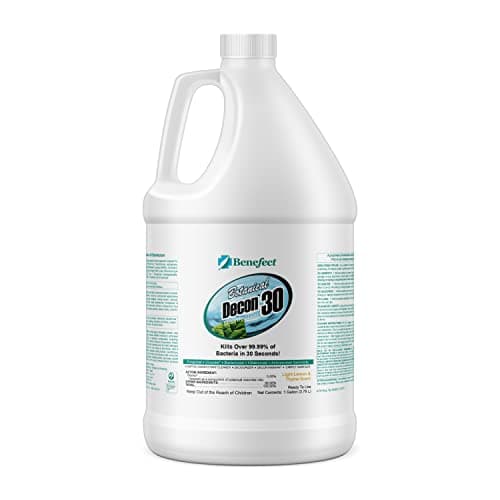
A botanical, hospital-grade disinfectant made from thyme oil that kills 99.99% of bacteria, fungi, and mold. Registered by the EPA as a broad-spectrum disinfectant with no synthetic chemicals, no rinse required, and no re-entry time. The go-to disinfectant for professional mold remediation companies.
Pros
- Botanical, hospital-grade disinfectant
- No rinse required, safe for food-contact surfaces
- Used by professional mold remediators
Cons
- Premium price compared to conventional cleaners
- Thymol scent may be strong for some users
- Not widely available in retail stores
Safety: What You Need to Know
At 3%, hydrogen peroxide is one of the safest mold treatment options. But there are a few things to be aware of:
Never Mix H2O2 with Vinegar
This is the single most important safety rule. When hydrogen peroxide and acetic acid (vinegar) are combined in the same container, they react to form peracetic acid — a corrosive compound that causes chemical burns, severe eye irritation, and respiratory damage. Even at low concentrations, peracetic acid fumes are significantly more dangerous than either ingredient alone.
The safe alternative: Use them sequentially, not simultaneously. Spray H2O2, let it work, wipe the surface clean. Then spray vinegar. This way you get the benefits of both without creating a dangerous reaction. Cleaning professionals endorse this sequential approach.
Also Never Mix With
- Bleach — Produces dangerous oxygen gas at high pressure.
- Ammonia-based cleaners — Creates hazardous fumes.
Ventilation and PPE
At 3%, H2O2 doesn't require special equipment. Standard precautions: open a window or run a fan, wear household gloves, and avoid prolonged skin contact. If you're treating a large area or using concentrations above 3%, wear an N95 respiratorand safety goggles. OSHA sets a permissible exposure limit of 1 ppm as an 8-hour time-weighted average for H2O2 vapor — relevant if you're fogging or using industrial concentrations.
Shelf Life and Storage
This is something almost nobody mentions: hydrogen peroxide loses potency over time. An unopened bottle lasts about 3 years from manufacture. Once opened, it degrades to roughly 6–12 months of effective life. Loss rate is about 0.5% potency per year when sealed.
Quick test:Pour a small amount on a cut potato or raw meat. If it doesn't fizz vigorously, it's expired and won't kill mold effectively. Replace it. Store in a cool, dark place in the original brown bottle.
Using H2O2 for Mold Prevention
One of hydrogen peroxide's best uses is as a preventive treatment — not just for active mold. A weekly spray routine takes 2 minutes and stops mold from gaining a foothold.
- Once per week, spray undiluted 3% H2O2 on shower walls, grout lines, window sills, and caulking.
- Let it sit for 5 minutes, then wipe or let it dry (it decomposes into water and oxygen — no residue).
- Combine with daily squeegee use on shower glass and running the exhaust fan for 15+ minutes after every shower.
This routine works well for bathroom ceiling mold prevention, shower mold, pink mold (Serratia bacteria), orange mold, and yellow mold prevention too. For long-term protection on surfaces that stay damp, apply Concrobium Mold Control after cleaning — it leaves an invisible antimicrobial barrier that H2O2 doesn't.
Frequently Asked Questions
What percentage hydrogen peroxide kills mold?
Standard 3% pharmacy-grade hydrogen peroxide kills most household mold species on non-porous surfaces. Higher concentrations (5–6%) show better results in lab studies but aren't necessary for homeowner use. Never use 35% food-grade H2O2 undiluted — it causes severe chemical burns.
Can you mix hydrogen peroxide and vinegar for mold?
Not in the same container — they form peracetic acid, a corrosive compound that burns skin and damages lungs. You can safely use them one after the other: apply H2O2, wipe clean, then spray vinegar (or vice versa). The sequential approach gives you combined disinfecting power without the chemical reaction.
Is hydrogen peroxide safer than bleach for mold?
At 3%, yes — significantly safer. H2O2 produces no harsh fumes, leaves no chemical residue (it breaks down to water and oxygen), and doesn't damage most surfaces. Bleach irritates eyes, lungs, and skin, and can damage fabrics, colored grout, and natural stone. Bleach also fails on porous surfaces where its water content feeds mold roots. The main advantage of bleach is superior stain removal.
How long should hydrogen peroxide sit on mold?
Minimum 10 minutes. Wait until the fizzing/bubbling stops completely, then give it another 5 minutes before scrubbing. Most people scrub too early. The CDC recommends at least 10 minutes of undisturbed contact time for effective surface disinfection.
Does hydrogen peroxide remove mold stains?
It removes some stains — it has mild bleaching properties that lighten mold discoloration on light-colored surfaces. For deep, set-in mold stains (especially on grout or concrete), a commercial stain remover like RMR-86 works much faster. H2O2 is better at killing mold than removing the visual evidence.
Dealing With Mold Right Now?
Our step-by-step mold removal guide walks you through testing your home, choosing the right products, and knowing when a job is too big for DIY.
Read the Removal GuideFrequently Asked Questions
What percentage hydrogen peroxide kills mold?
Can you mix hydrogen peroxide and vinegar for mold?
Is hydrogen peroxide safer than bleach for mold?
How long should hydrogen peroxide sit on mold?
Does hydrogen peroxide remove mold stains?
Related Articles
Does Vinegar Kill Mold? The Science, the Limits, and How to Use It Right
Does Bleach Kill Mold? The EPA Says No — Here's What Actually Works
Concrobium Mold Control Review: What It Does (and What It Won't)
How to Get Rid of Black Mold: DIY Removal Guide
Mold on Walls: How to Remove It (and When to Replace the Wall)
Best Mold Removal Products: What Works for Every Surface & Situation
Dealing With Mold Right Now?
Our step-by-step mold removal guide walks you through testing your home, choosing the right products, and knowing when a job is too big for DIY.
Read the Removal Guide