Does Vinegar Kill Mold? The Science, the Limits, and How to Use It Right
Out of the Mold Editorial Team
Our guides are research-backed and cite EPA, CDC, and peer-reviewed sources. Product reviews are based on hands-on testing, not manufacturer claims. Read our editorial standards.
Affiliate Disclosure: Out of the Mold is reader-supported. As an Amazon Associate, we may earn a commission when you buy through links on this page — at no extra cost to you. Our picks are based on real testing and independent standards, not commissions.
Key Takeaways
- White vinegar kills approximately 82% of mold species through acetic acid that penetrates porous surfaces — outperforming bleach on wood, grout, and drywall.
- Apply undiluted white vinegar, wait 60 minutes on porous surfaces, then scrub and rinse. Don't dilute it — half-strength drops the kill rate dramatically.
- Vinegar doesn't remove mold stains (use hydrogen peroxide or RMR-86 after) and doesn't prevent regrowth (apply Concrobium for a lasting barrier).
- Never mix vinegar with bleach (creates chlorine gas) or hydrogen peroxide in the same bottle (creates corrosive peracetic acid). Use them sequentially.
- Avoid vinegar on natural stone (marble, granite) — the acid etches the surface permanently. Use hydrogen peroxide on stone instead.
White vinegar kills approximately 82% of mold species and works better than bleach on porous surfaces like wood, drywall, and grout. The acetic acid in vinegar (5–8% concentration) penetrates porous materials to reach mold's root structure, unlike bleach which only kills surface growth. Apply undiluted white vinegar, wait 60 minutes, scrub, and rinse. Vinegar won't remove stains or prevent regrowth — pair it with hydrogen peroxide for stains and Concrobium for long-term prevention.
✅ Will Vinegar Work on Your Surface?
White distilled vinegar kills about 82% of mold species — and for most household mold, it outperforms bleach. The key difference: vinegar's acetic acid penetrates porous surfaces to kill mold at the roots, while bleach only cleans the surface. The EPA doesn't recommend bleach for mold on porous materials.
But that 82% number has important caveats depending on your surface, the mold species, and whether you need stain removal too. Below I break down the chemistry, the surface-by-surface results, and what to use when vinegar isn't enough.
How Vinegar Kills Mold (The Actual Chemistry)
White distilled vinegar contains 5–8% acetic acid. When you spray it on mold, the acetic acid does three things:
- Disrupts the cell membrane.Acetic acid is a weak organic acid, but it's strong enough to denature the proteins in mold cell walls. The mold cells lose structural integrity and die.
- Penetrates porous materials.Unlike bleach — which is 92–97% water with large chlorine molecules that sit on the surface — vinegar's acetic acid molecules are small enough to soak into wood grain, drywall paper, and grout pores. This lets it reach the hyphae (root structure) where mold actually lives.
- Creates an acidic environment.Mold prefers a pH between 3 and 7. Vinegar's pH of ~2.5 is below most species' tolerance range, making the surface temporarily inhospitable.
A study published in the International Journal of Environmental Research and Public Health confirmed that vinegar at 4%+ acetic acid concentration was effective against common household mold species including Aspergillus, Penicillium, and certain strains of Cladosporium. Research published in mBio by the American Society for Microbiology showed acetic acid can destroy even tough organisms like Mycobacterium tuberculosis — mold is considerably less resilient.
Where Vinegar Works (And Where It Doesn't)
The 82% figure is the species kill rate, not a surface success rate. Vinegar can kill those species, but whether it reaches them depends entirely on the material.
| Surface | Vinegar Effective? | Notes |
|---|---|---|
| Tile and grout | ✅ Yes | Kills mold in grout pores where bleach can't reach |
| Wood (sealed or unsealed) | ✅ Yes | Penetrates grain to reach hyphae; test on hidden spot first |
| Painted drywall | ✅ Yes (surface mold) | Works if mold hasn't penetrated through paint film |
| Unpainted drywall | ⚠️ Partially | Kills surface colonies but deep penetration may survive |
| Concrete (basement floors) | ✅ Yes | Acetic acid penetrates unsealed concrete well |
| Glass and countertops | ✅ Yes | Works but bleach also works fine here — no porous advantage |
| Fabric and upholstery | ⚠️ Partially | Kills surface mold; deep fiber contamination may need H₂O₂ |
| Carpet | ⚠️ Limited | Can't reach carpet backing/pad; H₂O₂ is better |
| Natural stone (marble, granite) | ❌ Avoid | Acid etches and damages stone surfaces permanently |
| Cast iron or aluminum | ❌ Avoid | Acid corrodes metal; use H₂O₂ instead |
The biggest limitation people miss: vinegar doesn't remove stains. It kills the mold colony, but the dark discoloration left behind is melanin pigment embedded in the material. You'll need a stain remover like RMR-86 or hydrogen peroxide for cosmetic cleanup after the mold is dead.
How to Use Vinegar for Mold Removal (Step-by-Step)
This process works on most household surfaces. For surface-specific variations, I'll note them in each step.
What you need
- White distilled vinegar (5% acidity minimum — check the label)
- Spray bottle (dedicated — don't reuse one that had other chemicals)
- Stiff-bristle brush or old toothbrush (for grout)
- N95 mask and rubber gloves
- Eye protection
Step 1: Don't dilute it
Pour undiluted white vinegar directly into a spray bottle. Diluting it drops the acetic acid concentration below the effective threshold. Some guides say to use a 1:1 water mix — that cuts your kill rate dramatically. Use it straight.
Step 2: Spray generously and wait 60 minutes
Saturate the moldy area so the vinegar can soak in. The 60-minute contact time isn't optional — that's how long the acetic acid needs to penetrate and kill the root structure. On non-porous surfaces, 30 minutes is usually enough. On wood or grout, give it the full hour.
Step 3: Scrub and wipe clean
Use a stiff brush to scrub the dead mold and loosen it from the surface. Wipe everything down with clean water and a fresh cloth. For grout, an old toothbrush works best for getting into the lines.
Step 4: Let it air dry completely
Don't towel-dry the area. Let air circulation evaporate any remaining moisture. The lingering vinegar smell dissipates in a few hours. If the area stays damp, you haven't solved the moisture problem — and the mold will return regardless of what you used to clean it.
Step 5: Address stains (if needed)
If dark stains remain after cleaning, the mold is dead but the pigment is embedded. Apply 3% hydrogen peroxide to lighten the stain, or use RMR-86 for stubborn discoloration on grout and tile. For wood, sanding may be necessary for deep stains.
RMR-86 Instant Mold & Mildew Stain Remover Spray (1 Gallon)
RMR Brands
$25–35
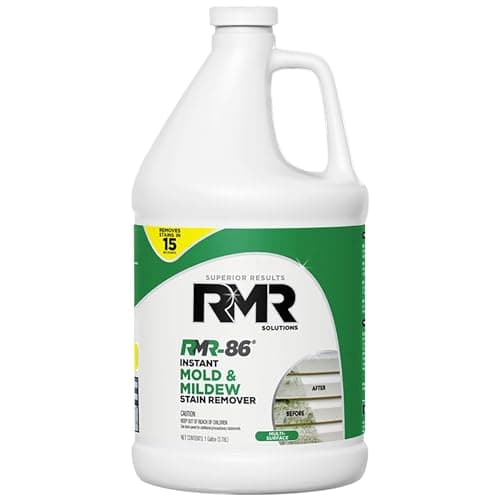
A fast-acting, commercial-strength mold stain remover that eliminates black mold stains on contact. The sodium hypochlorite formula penetrates porous surfaces to lift deep stains without scrubbing. Best used in well-ventilated areas with proper respiratory protection.
Pros
- Removes stains in as little as 15 seconds
- Works on wood, concrete, drywall, and tile
- No scrubbing required
Cons
- Strong bleach-based formula with harsh fumes
- Not safe for fabrics or colored surfaces
- Requires good ventilation and PPE
Vinegar vs Bleach: Why Vinegar Wins on Porous Surfaces
The bleach-for-mold myth persists because bleach gives the impression of working. You spray it, the mold discoloration disappears, the surface looks clean. But on porous materials, you've only bleached the stain — the mold colony underneath is alive, and you've just fed its roots a fresh dose of moisture.
The EPA explicitly states that bleach is "not recommended as a routine practice during mold cleanup." OSHA removed bleach from their mold remediation protocols in 2017. The science is settled on this one.
For a deep dive on exactly when bleach does and doesn't work, including the surface-by-surface breakdown, see our complete guide on bleach and mold.
| Factor | White Vinegar | Bleach | 3% Hydrogen Peroxide |
|---|---|---|---|
| Penetrates porous surfaces | ✅ Yes | ❌ No | ✅ Yes |
| Species kill rate | ~82% | ~60% surface only | ~99% at 5%+ conc. |
| Removes stains | ❌ No | ✅ Excellent | ⚠️ Moderate |
| Toxic fumes | Mild acetic acid smell | Chlorine gas risk | None |
| Safe around pets/kids | ✅ Yes (after drying) | ❌ No | ✅ Yes (after drying) |
| Cost per treatment | $0.50–$1.00 | $0.10–$0.30 | $0.30–$0.75 |
| Best for | Porous surfaces, regular maintenance | Non-porous surfaces only | Carpet, fabric, stubborn stains |
My honest recommendation: vinegar for porous surfaces (wood, grout, drywall), hydrogen peroxide for fabrics and stain removal, and Concrobium for anything you want to stay mold-free long term. Skip bleach entirely unless you're cleaning non-porous tile or glass.
When Vinegar Isn't Enough (And What to Use Instead)
Vinegar is a solid first option for small-to-medium mold problems. But it has real limits. Here's when you need to escalate:
The mold covers more than 10 square feet
The EPA sets 10 square feet as the threshold for professional remediation. At that scale, you need containment barriers, HEPA filtration, and proper protocols — not a spray bottle. Professional remediation runs $1,500–$4,500 in 2026 depending on scope.
It's Stachybotrys (toxic black mold)
That 82% species kill rate means vinegar doesn't handle everything. Stachybotrys chartarumis among the resistant species — its thick cell walls require stronger treatments. If you've got black, slimy mold on chronically wet drywall or ceiling tiles, follow our black mold removal protocol instead of reaching for vinegar.
The mold keeps returning within 2–3 weeks
If you clean with vinegar and the mold reappears quickly, either the treatment didn't reach the full colony, or (more likely) the moisture source is still active. A home mold test kit can help determine whether spore levels are still elevated after cleaning. But the real fix is finding and stopping the water.
You want to prevent regrowth
Vinegar kills mold but doesn't leave a protective barrier. For ongoing prevention, Concrobium Mold Control creates a tri-salt polymer coating as it dries that physically crushes mold spores trying to colonize the surface. Apply it after cleaning with vinegar and you get the best of both approaches.
Concrobium Mold Control
Concrobium
$10–15
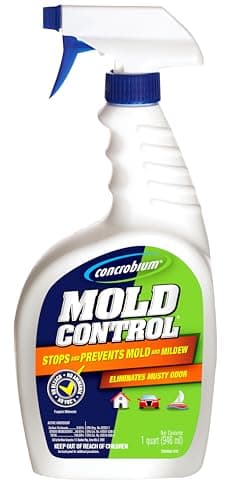
A patented, EPA-registered mold control solution that kills mold without bleach, ammonia, or VOCs. The tri-salt polymer formula crushes mold spores as it dries and leaves an invisible antimicrobial barrier to prevent regrowth. Safe for indoor use on virtually any surface.
Pros
- Non-toxic, no bleach or ammonia
- Kills mold and prevents regrowth
- Safe for use around children and pets
Cons
- Does not remove existing mold stains
- Takes longer to work than bleach-based products
- May require multiple applications for severe infestations
Surface-Specific Vinegar Guides
Different surfaces need different approaches. Here are the key variations:
Wood (floors, framing, furniture)
Vinegar is your best first option on wood. Spray undiluted, wait 60 minutes, scrub along the grain with a stiff brush. For finished wood, test a hidden area first — the acidity can dull some finishes. Deep mold that has penetrated below the surface may require sanding. See our full mold on wood floor guide for cost estimates on refinishing vs. replacement.
Bathroom tile and grout
This is vinegar's sweet spot. Spray the tile and grout lines, wait 30–60 minutes, scrub grout with a stiff toothbrush. For an extra boost, sprinkle baking soda on the grout first and then spray the vinegar — the fizzing action physically lifts mold from grout pores. Repeat weekly as a maintenance routine and you'll stop grout mold before it starts.
Drywall
If mold is only on the paint surface, vinegar works. If the drywall feels soft or spongy when you press it, the mold has penetrated into the gypsum core — no spray will fix that. The affected section needs to be cut out and replaced. When rebuilding, prime with a mold-killing primer before painting.
Zinsser Mold Killing Primer
Zinsser
$18–25
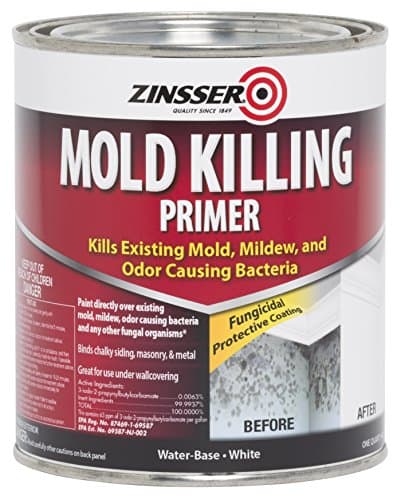
An EPA-registered fungicidal primer that kills existing mold, mildew, and odor-causing bacteria on contact. Creates a mold-resistant barrier on interior and exterior surfaces including drywall, wood, concrete, and masonry. Essential for mold remediation projects before applying topcoat paint.
Pros
- Kills existing mold on contact while priming
- EPA-registered fungicidal protective coating
- Bonds to all interior and exterior surfaces
Cons
- Strong odor during application, requires ventilation
- Water-based formula can raise grain on bare wood
- Must be topcoated with paint for lasting protection
Basement concrete
Vinegar penetrates unsealed concrete well. Spray generously, wait 60 minutes, scrub with a stiff deck brush, and mop up. The real challenge with basement mold isn't the cleaning — it's the humidity. If your basement stays above 60% relative humidity, the mold will return within weeks. A dehumidifier sized for the space is the actual fix.
Not Sure What's Growing?
Different mold species require different treatments — and some (like Stachybotrys) need more than vinegar. Identify yours first.
Identify Your Mold Type →Safety Warnings
Vinegar is far safer than bleach, but it's not risk-free:
- Never mix vinegar with bleach.This creates chlorine gas — the same poison used in WWI warfare. Even small amounts cause severe respiratory distress. If you've used bleach recently, rinse thoroughly and wait at least 24 hours before using vinegar in the same area.
- Never mix vinegar with hydrogen peroxide in a spray bottle. Combined, they form peracetic acid, which is corrosive at concentrated levels. Use them sequentially (vinegar first, rinse, then H₂O₂) — never at the same time.
- Wear an N95 mask while cleaning mold.Disturbing mold releases spores into the air regardless of what you're killing it with. The mask protects your lungs during cleanup.
- Ventilate the area. Open windows, run exhaust fans. The vinegar smell is harmless but unpleasant, and cross-ventilation helps disperse airborne spores faster.
- Don't use vinegar on natural stone. Marble, granite, travertine, and limestone are all damaged by acid. Acetic acid etches the surface permanently. Use hydrogen peroxide on stone surfaces instead.
After Cleaning: Prevent Mold from Coming Back
Killing mold without fixing the moisture source is a temporary fix at best. Mold spores are everywhere — in every cubic meter of air you breathe. They're not the problem. The problem is giving them the conditions to colonize: moisture above 50% relative humidity, an organic food source, and stagnant air.
After removing mold with vinegar:
- Find and fix the water source. Leak? Condensation? Poor ventilation? This is the root cause. The mold is a symptom.
- Get humidity below 50%.A $10–$15 hygrometer tells you exactly where you stand. Below 50% RH, most mold species can't establish colonies.
- Improve airflow. Stagnant air allows moisture to accumulate on surfaces. Exhaust fans in bathrooms should run 20+ minutes after showers. In basements, a circulation fan makes a measurable difference.
- Apply a preventive barrier. Concrobium left to dry on a surface creates a long-term antimicrobial coating. On walls, use mold-killing primer before repainting. On grout, a penetrating grout sealer ($12–$20 per bottle) keeps moisture out of the pores where mold thrives.
For the complete prevention protocol, see our mold removal guide.
Frequently Asked Questions
Does apple cider vinegar kill mold?
Yes, but it's less effective than white distilled vinegar. Apple cider vinegar typically has lower acetic acid concentration (around 5%) and contains sugars that can actually feed some mold species. Stick with white distilled vinegar — it's cheaper, more effective, and doesn't leave a residue.
How long do you leave vinegar on mold?
60 minutes minimum on porous surfaces (wood, grout, drywall). 30 minutes on non-porous surfaces (tile, glass). Don't rush it — the contact time is what allows the acetic acid to penetrate and kill the root structure. Spraying and immediately wiping does almost nothing.
Can I use vinegar in a spray bottle for mold prevention?
Yes. Weekly vinegar spraying in high-moisture areas (shower walls, under sinks, window sills) is an effective preventive routine. Spray, let it sit 15–30 minutes, wipe clean. This keeps mold from establishing colonies in the first place. It won't fix an existing humidity problem, though — you still need to address the moisture source.
Does cleaning vinegar work better than regular vinegar for mold?
Yes. Cleaning vinegar is typically 6% acetic acid versus regular white vinegar at 5%. That extra percentage point improves penetration and kill rate noticeably. If your grocery store carries it, spend the extra $1–$2. Don't use industrial vinegar (20%+ acidity) without proper PPE — it's corrosive at those concentrations.
Does vinegar kill mold on clothes?
For light mold on washable fabrics: add 1 cup of white vinegar to the wash cycle along with your detergent, wash on the hottest setting the fabric allows, and air dry in sunlight (UV helps kill remaining spores). For heavy mold on valuable clothing, professional cleaning is safer — see our mold on leather guide for professional cost estimates.
Is vinegar or hydrogen peroxide better for mold?
They're complementary, not competitors. Vinegar is better for routine cleaning on hard surfaces and grout. Hydrogen peroxide (3% concentration) is better for fabrics, carpet, and stain removal. H₂O₂ has a higher kill rate (~99% at 5%+ concentration) but degrades faster. For the best results on stubborn mold, use vinegar first (kills the colony), then hydrogen peroxide (removes the stain).
Still Dealing with Recurring Mold?
If mold keeps coming back after cleaning, hidden moisture or elevated spore levels may be the cause. A mold test identifies what you're dealing with.
Compare Testing Methods →Frequently Asked Questions
Does apple cider vinegar kill mold?
How long do you leave vinegar on mold?
Does cleaning vinegar work better than regular vinegar for mold?
Does vinegar kill mold on clothes?
Is vinegar or hydrogen peroxide better for mold?
Can I use vinegar in a spray bottle for mold prevention?
Related Articles
Does Bleach Kill Mold? The EPA Says No — Here's What Actually Works
Hydrogen Peroxide for Mold: Does It Actually Work?
Concrobium Mold Control Review: What It Does (and What It Won't)
Best Mold Removal Products: What Works for Every Surface & Situation
Mold on Walls: How to Remove It (and When to Replace the Wall)
Mold on Wood Floors: Remove It, Refinish, or Replace?
Need Professional Mold Removal?
Get free, no-obligation quotes from licensed mold remediation specialists in your area.
Get Free Quotes