Mold Testing Guide: Do You Need a Test & Which Type Is Best?
Out of the Mold Editorial Team
Our guides are research-backed and cite EPA, CDC, and peer-reviewed sources. Product reviews are based on hands-on testing, not manufacturer claims. Read our editorial standards.
Affiliate Disclosure: Out of the Mold is reader-supported. As an Amazon Associate, we may earn a commission when you buy through links on this page — at no extra cost to you. Our picks are based on independent standards, manufacturer specifications, and published research, not commissions.
Key Takeaways
- If you can see mold and the area is under 10 sq ft, skip testing and just remove it — the CDC and EPA agree.
- Five scenarios where testing IS worth it: insurance claims, real estate transactions, post-remediation clearance, unexplained health symptoms, and landlord-tenant disputes.
- Consumer Reports rates all DIY kits 'Not Recommended' — the issue is interpretation without context, not detection ability.
- ERMI DNA testing ($200–$250) is the most comprehensive consumer option — 36 species quantified from a single dust sample.
- The inspector and the remediator should be different companies. Avoid companies offering 'free inspections' if you hire them for remediation.
Most people don't need a mold test. If you can see mold, skip testing and remove it — the CDC agrees. Testing is worth the money in five specific situations: insurance claims, real estate transactions, post-remediation clearance, unexplained health symptoms, and landlord-tenant disputes. DIY test kits cost $10–$45. Professional inspections run $300–$900. ERMI DNA tests ($200–$250) are the most comprehensive consumer option. Consumer Reports rates all DIY kits "Not Recommended" — not because they don't detect mold, but because interpreting results without context leads to bad decisions.
Here's the uncomfortable truth about mold testing: the CDC and EPA both say it's usually unnecessary. The CDC's exact words: "Generally, it is not necessary to identify the species of mold growing in a residence." The EPA adds: "If you can see or smell mold, a health risk may be present. You do not need to know the type of mold growing in your home."
So why does a multi-billion dollar mold testing industry exist? Because there are situations where testing genuinely matters — and the trick is knowing which ones. I've seen homeowners waste $500+ on testing they didn't need, and I've seen others skip a $30 test that would have saved them $15,000 in remediation by catching a problem early. The decision framework below tells you which camp you're in.
Do You Actually Need a Mold Test?
Skip testing and just remove the mold if you can see it and it's under 10 square feet (the EPA's DIY threshold). You know it's mold, you know where it is, and you know how to clean it. A test telling you "yep, that's Aspergillus" doesn't change what you do next.
Testing IS worth the money in these five scenarios:
- Insurance claims — Adjusters want documented proof of mold type and concentration. A professional inspection report ($300–$600) often pays for itself by strengthening your claim. Most homeowner policies cap mold coverage at $1,000–$10,000 — you need evidence to hit that cap.
- Buying or selling a home— A pre-purchase mold test protects both parties. ERMI results provide a legally defensible baseline. I'd never buy a home in a high-humidity area (Florida, Gulf Coast, Pacific Northwest) without one.
- Post-remediation clearance— After professional remediation, a "clearance test" confirms spore levels have returned to normal. This is standard practice and protects you from incomplete work. Insist on it — reputable companies include it in the price.
- Health symptoms with no visible mold — You or your family have persistent coughing, wheezing, sinus congestion, or headaches that improve when you leave the house. If you smell musty odorsbut can't find the source, testing identifies whether elevated spore levels exist and where they're concentrated.
- Landlord-tenant disputes— Legal situations require documented evidence. A DIY test kit won't hold up in court, but a certified inspector's report will.
Types of Mold Tests Explained
Not all mold tests measure the same thing. Using the wrong test type for your situation wastes money and gives misleading results.
Air Sampling
Air samples capture spores floating in your indoor air using a calibrated pump. The key is comparison — you need both an indoor and outdoor sample taken at the same time. If indoor spore counts are significantly higher than outdoor counts, you have an active mold source inside.
Cost: $150–$400 professional; $30–$50 DIY with lab analysis.
Best for: Real-time snapshot of airborne mold, post-remediation clearance.
Limitation:A single sample captures only 5–15 minutes of data. Spore counts fluctuate hourly based on humidity, airflow, and activity (vacuuming and walking stir up settled spores). One clean air sample doesn't guarantee no mold.
Surface/Tape Lift Sampling
A piece of clear tape is pressed against a suspect surface, then sent to a lab for microscopic analysis. It identifies what species is growing at that specific spot.
Cost: $50–$150 per sample (professional); $15–$40 DIY with lab.
Best for: Confirming species on visible mold.
Limitation:Only tells you what's at that exact spot. Doesn't measure overall air quality or detect hidden mold.
ERMI (Environmental Relative Moldiness Index)
Developed by EPA researchers, ERMI uses DNA analysis (mold-specific quantitative PCR) to detect and quantify 36 mold species from a dust sample. It provides a score from -10 to 20+ that indicates overall moldiness relative to a national database.
Cost: $200–$250 DIY; $400–$800 professional with interpretation.
Best for: Comprehensive baseline assessment, home purchases, health investigations, legal documentation.
Limitation:Measures historical mold accumulation (weeks to months of spore deposits in dust), not current air quality. The EPA considers ERMI a research tool and doesn't officially recommend it for homeowner use — but it's the most comprehensive consumer-available test.
For our deep dive on ERMI testing — costs, how to interpret scores, and when it's worth it — see the ERMI mold test guide.
Culture Plates (Settle Plates)
These are the cheap DIY kits you see at hardware stores — open a petri dish, leave it exposed for a set time, seal it, and wait for colonies to grow. They're the main reason Consumer Reports rates DIY kits "Not Recommended."
The problem: every home has airborne mold spores. A settle plate will always grow something. Without a comparison sample (outdoor baseline), the results are meaningless. Growing Penicilliumon a plate doesn't tell you whether you have a mold problem or just normal background spore levels.
Cost: $10–$15 kit + $40 lab fee.
Best for: Satisfying curiosity. Not useful for decision-making.
Limitation: High false-positive rate, no quantitative data, no comparison baseline.
| Test Type | Cost | Accuracy | Best For | Limitations |
|---|---|---|---|---|
| Air Sampling | $30–$400 | Good (with indoor + outdoor comparison) | Post-remediation, real-time snapshot | 5–15 min sample; misses intermittent issues |
| Surface/Tape Lift | $15–$150 | Good (for that specific spot) | Species ID on visible mold | No overall air quality data |
| ERMI (DNA) | $200–$800 | Excellent (36 species quantified) | Home purchase, health investigation | Historical, not real-time; EPA calls it research-grade |
| Settle Plates | $10–$55 | Poor (no baseline comparison) | Screening / curiosity | High false positive rate; not actionable |
| Professional Inspection | $300–$900+ | Best (calibrated equipment + expert interpretation) | Insurance claims, legal, large problems | Most expensive; overkill for small visible mold |
Mold Armor FG500 Do It Yourself Mold Test Kit
Mold Armor
$9–15
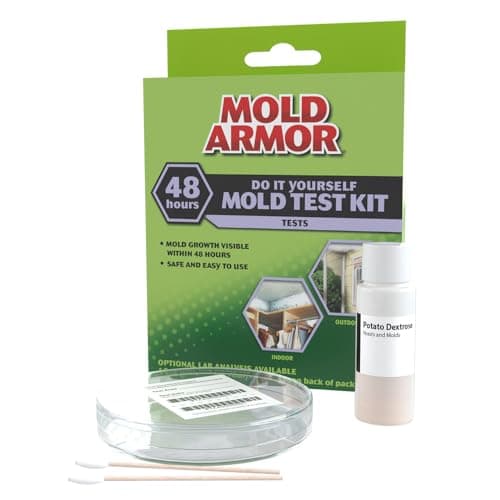
The most popular DIY mold test kit on Amazon. Includes a settling plate, swab, and pre-paid postage for AIHA-accredited lab analysis. The kit detects airborne mold spores and surface mold, identifying species like Aspergillus, Stachybotrys, and Penicillium.
Pros
- Very affordable entry-level test
- Includes petri dish, swab, and postage for lab analysis
- Results identify mold species
Cons
- Lab fee is separate (~$40)
- Takes 5-7 days for lab results
- Only tests one location per kit
DIY Mold Test Kits: What to Know Before You Buy
Consumer Reports rated every DIY mold test kit they tested "Not Recommended." That headline scared a lot of people off, but the nuance matters: the kits dodetect mold. The problem is what you do with the results. A positive settle plate test tells you mold spores exist in your home — which is true of every home on the planet. Without context, that result causes unnecessary panic or, worse, expensive remediation you didn't need.
The kits that actually provide useful data are air cassette kits with lab analysis. These work like a miniature version of what professionals use — they capture a measured volume of air, send it to an accredited lab, and return species identification plus spore counts. The critical requirement: you must take both an indoor and outdoor sample. Indoor counts higher than outdoor counts indicate an active mold source.
For a detailed comparison of the best and worst DIY kits, see our mold test kit buying guide.
Professional Mold Testing: When It's Worth the Cost
A professional mold inspection isn't just someone with a fancier test kit. It includes:
- Visual inspection — Checking common mold-prone areas (attics, crawl spaces, under sinks, behind appliances, HVAC systems) that homeowners often miss
- Moisture mapping — Using moisture meters and thermal imaging cameras to find wet spots behind walls and under floors. This is the single most valuable part of a professional inspection — mold always follows moisture, and finding the moisture source prevents recurrence.
- Air + surface sampling — Multiple samples collected with calibrated equipment for accurate comparison
- Lab analysis + interpretation — A certified inspector explains what the numbers mean for your specific home, climate, and health situation
- Remediation plan — Recommendations for what needs to be done, prioritized by severity
Cost breakdown: The inspection itself runs $300–$600. Each additional sample adds $50–$150. A comprehensive assessment with ERMI by a Certified Industrial Hygienist (CIH) runs $800–$1,200+. Most homeowners spend $400–$700 total, according to 2026 data from Angi and Fixr.
How to find a qualified inspector:Look for ACAC (American Council for Accredited Certification), IICRC, or AIHA credentials. Avoid companies that offer "free inspections" if you hire them for remediation — that's a conflict of interest. The inspector who finds the mold should not be the company that profits from removing it.
ImmunoLytics ERMI Mold Test Kit
ImmunoLytics
$190–220
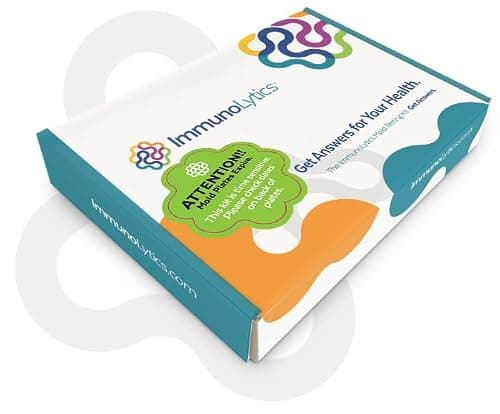
The most comprehensive home mold test available. Uses EPA-developed ERMI methodology with DNA-based MSQPCR analysis to quantify 36 mold species. Generates a standardized Relative Moldiness Index score that compares your home to a national database. Preferred by environmental consultants and real estate inspectors.
Pros
- ERMI (EPA Relative Moldiness Index) is the gold standard
- DNA-based analysis identifies 36 mold species
- Lab analysis included in price
Cons
- Most expensive home test kit
- Results take 7-10 business days
- Requires careful dust collection with included vacuum cassette
ERMI vs. Air Testing: Which Should You Choose?
This is the most common question I hear. The short answer: they measure different things.
| Factor | ERMI | Air Sampling |
|---|---|---|
| What it measures | Historical mold accumulation (weeks to months) | Current airborne spores (5–15 min snapshot) |
| Sample source | Carpet or floor dust | Air drawn through cassette |
| Species detected | 36 species (DNA-based) | Whatever is airborne at that moment |
| Best for | Baseline assessment, home purchases | Post-remediation clearance |
| Cost (DIY) | $200–$250 | $30–$50 |
My recommendation: ERMI for initial investigation (is there a problem?), air sampling for post-remediation (is the problem solved?). If budget allows only one, pick based on your scenario. Buying a home? ERMI. Verifying a cleanup? Air sampling. Health symptoms? Start with ERMI since it captures long-term exposure history, which correlates better with chronic health effects than a single air sample.
How to Interpret Mold Test Results
Getting results is easy. Understanding them is where most people get lost — or get exploited by remediation companies trying to upsell.
Air Sample Results
- Normal: Indoor spore counts similar to or lower than outdoor counts. The species mix should roughly mirror outdoor conditions. Some variation is expected.
- Elevated: Indoor counts significantly higher than outdoor, especially for specific species. If Aspergillus or Penicillium is 2–3x higher indoors, you have an active source. If Stachybotrysappears at any count, investigate — it's rarely airborne in normal conditions.
ERMI Scores
- Below 2: Low relative moldiness. Your home is better than the national average.
- 2 to 5: Moderate. Worth monitoring, especially if someone has respiratory issues.
- Above 5: High relative moldiness. Investigate moisture sources and consider professional inspection.
- Above 10: Very high. Active mold growth is likely. Professional remediation recommended.
Beware of remediation companies that show you a test result and immediately recommend $5,000+ in work. Get a second opinion from an independent inspector. The inspector and the remediator should be different companies.
What to Do After Getting Test Results
Your next steps depend entirely on what the results show:
- Normal levels, no symptoms— No action needed. Focus on prevention: keep humidity below 50%, fix leaks promptly, ventilate bathrooms. Retest annually if you're in a high-humidity area.
- Elevated levels, small area — DIY removal for areas under 10 sq ft. Clean with vinegar or hydrogen peroxide, fix the moisture source, apply Concrobium to prevent regrowth. See our mold removal products guide for product recommendations.
- Elevated levels, large area or behind walls — Professional remediation ($10–$25/sq ft, most projects $1,200–$3,750 in 2026). Get three quotes from IICRC-certified companies. Insist on clearance testing after remediation.
- Toxic species identified (Stachybotrys, high Aspergillus) — Professional remediation with containment. If anyone has health symptoms, consult your doctor and reference the CDC's mold health guidance.
Klein Tools ET140 Pinless Moisture Meter
Klein Tools
$45–60
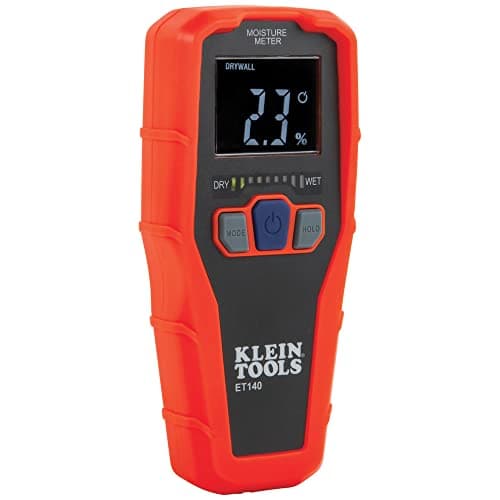
A professional-grade pinless moisture meter that detects hidden moisture in drywall, wood, and masonry without leaving holes. Uses electromagnetic sensor technology to measure moisture content up to 3/4 inch below the surface. Essential for identifying moisture problems before mold develops.
Pros
- Non-invasive pinless technology, no holes in walls
- Detects moisture up to 3/4 inch deep
- Visual and audible moisture alerts
Cons
- Less precise than pin-type meters on exact moisture percentage
- Battery not included
- Can give false readings on metallic or foil-backed surfaces
For help identifying what type of mold you're dealing with before testing, see our types of mold identification guide.
Dealing With Mold Right Now?
Our step-by-step mold removal guide walks you through testing your home, choosing the right products, and knowing when a job is too big for DIY.
Read the Removal GuideFrequently Asked Questions
How much does a mold test cost?
DIY settle plate kits: $10–$15 (+ $40 lab fee). DIY air cassette kits: $30–$50 (lab included). ERMI DNA tests: $200–$250 DIY, $400–$800 professional. Professional mold inspection: $300–$900+ depending on home size and number of samples. According to 2026 data from Angi, the average professional inspection costs $670.
Are home mold test kits accurate?
Consumer Reports rated all DIY kits "Not Recommended," but the issue is interpretation, not detection. Air cassette kits with indoor + outdoor comparison provide reasonably accurate data using the same methodology as professional inspectors. Settle plate kits (the cheapest option) lack the quantitative data needed for real decision-making.
What is the most accurate mold test?
ERMI DNA testing is the most comprehensive consumer option — 36 species quantified from a single dust sample. For real-time air quality, professional air sampling with calibrated pumps is most accurate. The "best" test depends on what question you're trying to answer. See the comparison table above.
How long does mold testing take?
DIY kits: 5–15 minutes to collect samples. Lab results take 5–10 business days. Professional inspections: 2–4 hours on-site for an average home. Lab results: 3–7 business days. Rush processing is available from most labs for an extra $50–$100.
Can I test for mold myself?
Yes, with limitations. DIY air cassette kits and ERMI kits are self-administered. The sample collection is straightforward — follow the kit instructions exactly. Where DIY falls short is interpretation. A professional doesn't just collect samples — they do a visual inspection, check moisture levels, and interpret results in context of your specific home.
Do I need a mold test before buying a house?
It's not required, but I'd strongly recommend it in humid climates (Florida, Gulf Coast, Pacific Northwest) or for homes with basements, crawl spaces, or known water damage history. An ERMI test ($200–$250) provides a comprehensive baseline that protects you from inheriting someone else's mold problem. It can also be a negotiation tool if results show elevated levels.
What mold level is dangerous?
There's no federally mandated "safe" mold level. The EPA and CDC don't set numerical thresholds because individual sensitivity varies widely. General guideline: indoor spore counts should be lower than outdoor counts for the same species. ERMI scores above 5 indicate higher-than-average moldiness. Any detection of Stachybotrys indoors warrants investigation.
Is mold testing covered by insurance?
Typically no — most homeowner policies don't cover mold testing as a standalone service. However, if testing is part of an insurance claim for a covered event (burst pipe, storm damage), the inspection cost may be reimbursable. Check your policy or call your agent before hiring an inspector.
How often should you test for mold?
For most homes: no routine testing is needed. Test when you have a reason to — water damage, persistent odor, health symptoms, or a real estate transaction. In flood-prone areas or homes with known moisture issues, an annual ERMI test provides a useful trend line. Post-remediation, test 30 days after completion to confirm levels normalized.
What's the difference between mold testing and mold inspection?
Testing collects samples for lab analysis. Inspection is a visual and instrument-based assessment of your home by a certified professional. A good inspection includes testing, but testing alone — without the visual inspection and moisture mapping — misses context. Mold always follows moisture, and finding the moisture source matters more than identifying the mold species.
Frequently Asked Questions
How much does a mold test cost?
Are home mold test kits accurate?
What is the most accurate mold test?
How long does mold testing take?
Can I test for mold myself?
Do I need a mold test before buying a house?
What mold level is dangerous?
Is mold testing covered by insurance?
How often should you test for mold?
What's the difference between mold testing and mold inspection?
Related Articles
ERMI Mold Test: Cost, Accuracy & When You Actually Need One
Best Mold Test Kits for Home Use: What Works & What's a Waste of Money (2026)
Which Mold Test Kit Is Most Accurate? DIY Methods Compared
Musty Smell in House? Here's How to Find & Fix the Source
What Does Mold Smell Like? How to Identify Mold by Smell
Best Mold Removal Products: What Works for Every Surface & Situation
Dealing With Mold Right Now?
Our step-by-step mold removal guide walks you through testing your home, choosing the right products, and knowing when a job is too big for DIY.
Read the Removal Guide