Can Black Mold Kill You? What the Science Actually Says
Out of the Mold Editorial Team
Our guides are research-backed and cite EPA, CDC, and peer-reviewed sources. Product reviews are based on hands-on testing, not manufacturer claims. Read our editorial standards.
Affiliate Disclosure: Out of the Mold is reader-supported. As an Amazon Associate, we may earn a commission when you buy through links on this page — at no extra cost to you. Our picks are based on independent standards, manufacturer specifications, and published research, not commissions.
Key Takeaways
- Household black mold does not kill healthy adults — fatalities are extremely rare. The serious risk is concentrated in immune-compromised, asthmatic, infant, and elderly people.
- The 'toxic black mold' scare traces to a 1993–96 Cleveland infant cluster the CDC's own 2000 review said 'did not prove an association' with mold.
- 'Black mold' isn't a single species, and color can't tell you if it's toxic — the CDC doesn't recommend testing to identify it because the cleanup is the same.
- Real documented effects are allergic/irritant: stuffy nose, sore throat, cough, wheeze, burning eyes, rash — worse with longer exposure.
- Act by patch size: under ~10 sq ft is careful DIY; larger, hidden, or HVAC growth (or anyone high-risk at home) means call a pro. Fix the moisture either way.
A healthy adult is not going to be killed by the black mold on a bathroom wall. Deaths from household mold exposure are extremely rare, and the dramatic "toxic black mold" stories trace back to a 1990s case cluster the CDC itself later said was never proven. What's real: black mold can trigger genuine respiratory and allergic problems, and it's a bigger danger to infants, the elderly, people with asthma, and anyone immune-compromised. What's overblown: the idea that any dark patch is a lethal poison. The honest answer is "serious enough to remove promptly, not the death sentence the internet sells." This is not medical advice — if you're having symptoms, see a healthcare provider.
Where the "black mold kills" story actually comes from
It's worth starting here, because almost every scary article skips it. Between 1993 and 1996, a cluster of infants in Cleveland, Ohio developed acute pulmonary hemorrhage — bleeding in the lungs — and their water-damaged homes tested high for Stachybotrys chartarum, the greenish-black mold people mean when they say "toxic black mold." Early CDC reports noted the association, the media ran with "killer mold," and the legend was born.
Then the CDC reviewed its own work. In a 2000 MMWR update, it reported that outside reviews "identified shortcomings in the conduct of the studies" and concluded the investigations "did not prove an association between [acute pulmonary hemorrhage] among infants and exposure to molds." The methods couldn't separate real exposure from background contamination. The single most cited proof that black mold kills is a case the agency behind it walked back. That doesn't mean mold is harmless — it means the fear got way out ahead of the evidence.
"Black mold" isn't one thing
There is no single species called "black mold." Plenty of molds look black or dark green — Cladosporium, Aspergillus niger, Alternaria, and yes, Stachybotrys. You cannot tell which one you have, or whether it's producing anything toxic, by its color. The CDC is direct about this: it does not recommend routine mold testing of homes and says the cleanup is the same regardless of species — because the responsedoesn't change. Any sustained indoor mold gets removed and the moisture fixed; the Latin name doesn't alter that plan.
Stachybotrysdoes produce mycotoxins under some conditions, and it favors chronically wet, high-cellulose materials — soaked drywall paper, ceiling tiles, cardboard. That makes it worth taking seriously when it shows up. But "can produce mycotoxins" is not the same claim as "will poison you across the room," and the research has never closed that gap for ordinary household exposure.
What exposure actually does to you
The EPA groups mold's effects into three buckets, and they're the fastest way to cut through the noise. Per the EPA, molds "produce allergens (substances that can cause allergic reactions), irritants, and in some cases, potentially toxic substances (mycotoxins)." The same guide adds a line the headlines ignore: "symptoms other than the allergic and irritant types are not commonly reported as a result of inhaling mold."
The CDC's symptom list is short and specific: "a stuffy nose, sore throat, coughing or wheezing, burning eyes, or skin rash." For most people, that's the ceiling of what black mold does — an allergy/irritant reaction, worse the longer you're exposed. The CDC also notes plainly that "exposure to damp and moldy environments may cause a variety of health effects, or none at all." Headaches, fatigue, and "brain fog" show up in countless personal accounts but aren't in the CDC's or EPA's established symptom descriptions — real experiences for some people, not proven mold effects, and worth a doctor's look rather than a self-diagnosis. For the full symptom breakdown, see our guide to mold allergy symptoms.
Who's actually in danger
This is where "rare" stops being reassuring, because the risk isn't evenly spread. The CDC singles out two groups for serious outcomes: "people with asthma or who are allergic to mold may have severe reactions," and "immune-compromised people and people with chronic lung disease may get infections in their lungs from mold." Add infants and the elderly, whose airways are more vulnerable.
- Asthma & mold allergy: attacks, wheezing, chest tightness — the best-documented harm, and it can be severe.
- Immune-compromised (chemo, transplant, HIV, long-term steroids): genuine risk of invasive lung infection — this is the population for whom mold can, in the worst case, become life-threatening.
- Chronic lung disease (COPD, cystic fibrosis): higher infection risk and harder recovery.
- Infants & the frail elderly: smaller or weaker airways, less margin.
If someone in one of these groups lives in the home, don't sit on it — remove the mold and the moisture now, and loop in their doctor about symptoms.
You found black mold. Now what?
Skip the panic; run the decision. The practical fork is size, which is where the EPA draws its DIY line:
- Measure the patch. Under about 10 square feet (a patch roughly 3 ft × 3 ft) is generally a careful DIY job. Our step-by-step black mold removal guide covers the gear and method.
- Over ~10 sq ft, or inside walls/HVAC, or anyone high-risk at home? Bring in a pro. See typical mold remediation costs so you know what a fair quote looks like, and black mold in your AC if the growth is in the system.
- Fix the water first. No moisture, no mold. Bleaching the stain without stopping the leak just resets the clock.
You don't need to identify the species to act — the plan is the same either way. But if you want to confirm what's growing (for a landlord dispute, a sale, or your own peace of mind), an inexpensive surface test kit sends a sample to a lab that names the genera:
Mold Armor FG500 Do It Yourself Mold Test Kit
Mold Armor
$9–15
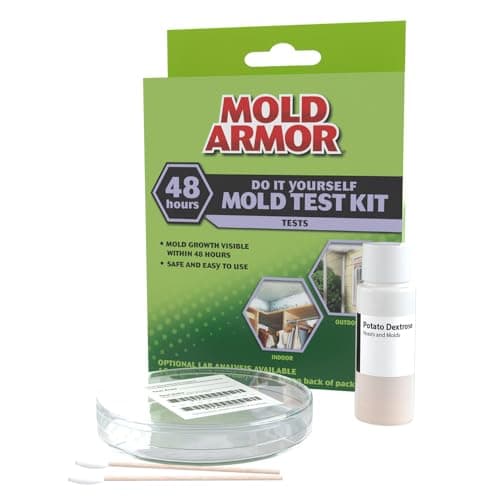
The most popular DIY mold test kit on Amazon. Includes a settling plate, swab, and pre-paid postage for AIHA-accredited lab analysis. The kit detects airborne mold spores and surface mold, identifying species like Aspergillus, Stachybotrys, and Penicillium.
Pros
- Very affordable entry-level test
- Includes petri dish, swab, and postage for lab analysis
- Results identify mold species
Cons
- Lab fee is separate (~$40)
- Takes 5-7 days for lab results
- Only tests one location per kit
For how the different methods compare — surface swabs, air cassettes, and ERMI dust tests — our guide to mold test kitslays out what each one can and can't tell you.
When to actually worry (the honest checklist)
Most black mold is a prompt-to-clean, not an emergency. Treat it as urgent — and get medical or professional help fast — when any of these is true:
- Someone in the home is immune-compromised, has moderate-to-severe asthma, or chronic lung disease, and is having breathing symptoms.
- An infant or elderly person is coughing, wheezing, or short of breath and there's visible mold or a persistent musty smell in the home.
- The mold covers more than about 10 square feet, keeps coming back, or you can smell it but can't find it (likely behind a wall or in the HVAC).
- Symptoms clearly ease when you leave the house and return when you come back — a pattern worth describing to your doctor.
Outside those cases, the realistic risk of the mold in your bathroom is a stuffy nose and an allergy flare, not your life. Clean it properly, keep the room dry, and the problem — and the fear — both go away.
Frequently Asked Questions
Can black mold actually kill you?
How much black mold exposure is dangerous?
Is all black-colored mold toxic?
When should I see a doctor about black mold?
Related Articles
Mold Allergy & Exposure Symptoms: What the Evidence Actually Shows
How to Get Rid of Black Mold: DIY Removal Guide
How to Test for Mold at Home: DIY Methods That Actually Work
Black Mold in Your AC: How to Identify, Remove & Prevent It
What Does Mold Smell Like? How to Identify Mold by Smell
Mold Removal Products: A Complete Guide to What Works and Why
Dealing With Mold Right Now?
Our step-by-step mold removal guide walks you through testing your home, choosing the right products, and knowing when a job is too big for DIY.
Read the Removal Guide