DampRid for Mold: What It Actually Does (and What It Can't)
Out of the Mold Editorial Team
Our guides are research-backed and cite EPA, CDC, and peer-reviewed sources. Product reviews are based on hands-on testing, not manufacturer claims. Read our editorial standards.
Affiliate Disclosure: Out of the Mold is reader-supported. As an Amazon Associate, we may earn a commission when you buy through links on this page — at no extra cost to you. Our picks are based on independent standards, manufacturer specifications, and published research, not commissions.
Key Takeaways
- DampRid is a calcium-chloride moisture absorber (desiccant), not a mold killer — it isn't EPA-registered as a biocide and makes no kill claim.
- It only works on small, enclosed air: closets, cabinets, safes, boat cabins, stored RVs. In an open room, humid air moves in faster than a passive absorber can grab it.
- It does nothing to mold that's already growing — that's a cleaning or removal job, not a job for a bag of crystals.
- For a damp room, basement, or whole floor you need a powered dehumidifier (pints/day), not DampRid (ounces/month); buying the wrong one is the most common DampRid mistake.
- Fragrance-free is the pick for enclosed storage; the collected brine is corrosive, so keep containers up off the floor and away from pets and kids.
DampRid is a moisture absorber, not a mold remover. It lowers humidity in small, closed spaces — a closet, a gun safe, a boat cabin, a stored RV — which helps prevent new mildew. It will not kill mold you already have, and it can't dry out a whole room. The active ingredient is calcium chloride, a desiccant that pulls water vapor out of trapped air; it makes no mold-killing claim and isn't EPA-registered as one. Use it in enclosed spaces. For a damp room or basement, you need a dehumidifier. For mold that's already growing, you need to clean it.
Search "damprid" and the whole first page is somebody trying to sell it to you — an Amazon listing, a "where to buy," a Target page — plus the one honest question that keeps surfacing in homeowner forums: does the stuff actually do anything? Nobody on that first page answers it plainly next to a buyer's guide. So here it is, mechanism first, because the whole reason people buy DampRid is to figure out whether it'll stop their mold problem — and the honest answer depends entirely on what that problem actually is.
What DampRid actually does (the calcium chloride part)
DampRid is calcium chloride, a hygroscopic salt — which is a fancy way of saying it's a crystal that is desperate to grab water out of the air. You've seen the same idea in the little "do not eat" silica packets in a shoebox, except calcium chloride is far thirstier. As the crystals pull humidity out of the air around them, they slowly dissolve into a salty brine that collects in the bottom of the bag or bucket. No power, no fan, no moving parts. That's the whole machine.
Here's the catch, and it's the catch that decides whether DampRid is right for you: a passive absorber can only work on the air it's touching. In a sealed closet or a shut-up boat cabin, the air is trapped, so the crystals steadily dry it out and the humidity drops and stays down. In an open room, new humid air pours in faster than a tub of crystals can ever grab it. The DampRid isn't broken — the job is just physically too big for a passive device. That one distinction explains almost every "DampRid didn't work" complaint on the internet.
Where DampRid genuinely earns its keep — and where it won't
The rule is simple: the smaller and more closed-off the space, the better DampRid works. Here's the honest breakdown of what to use it for and what to stop expecting from it.
| Situation | DampRid verdict |
|---|---|
| Closet, wardrobe, gun safe, cabinet, linen cupboard | Great fit.Small sealed air, exactly what it's for. |
| Boat cabin, stored RV, pop-up camper, storage unit | Great fit. Closed up for weeks — a hi-capacity tub shines here. |
| A closed, unused basement corner | Marginal. Helps a dead-air corner; won't dry a whole basement. |
| A damp, lived-in room or an open basement | Wrong tool. Air moves too freely → use a dehumidifier. |
| An active leak or standing water | No.Fix the water source first; an absorber can't keep up. |
| Mold that's already growing on a surface | No. It's not a biocide → see how to remove it. |
For a closet or a chest of drawers, the hanging bags are the easiest thing in the world — hook one over the rod and forget it for a month or two:
DampRid Hanging Moisture Absorber (3-Pack)
DampRid
$12–18
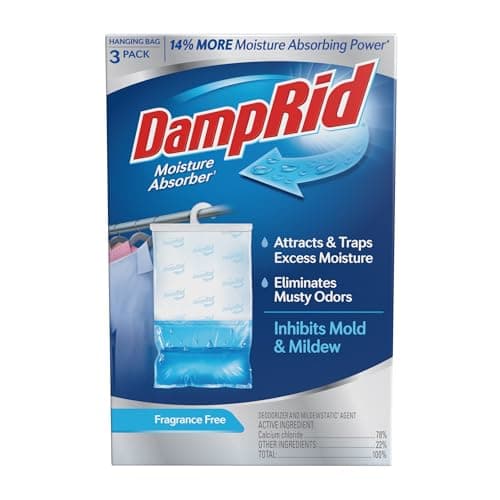
Passive calcium-chloride moisture absorbers that hang from a closet rod and pull humidity out of enclosed spaces without power. They won't fix a damp basement, but inside a closet, wardrobe, or stored vehicle they keep trapped air dry enough to stop mildew on clothes, leather, and linens. Each bag lasts roughly 45-60 days before the crystals fully dissolve.
Pros
- No electricity needed — works anywhere you can hang it
- Calcium chloride crystals absorb moisture for up to 60 days each
- Fragrance-free version won't add perfume to enclosed spaces
Cons
- Cannot meaningfully lower whole-room humidity
- Bags must be replaced once the crystals dissolve
- Collected brine must be handled carefully when disposing
For anything bigger and more closed-off — a stored boat, a basement corner that stays shut, a walk-in that never airs out — step up to the hi-capacity bucket. It holds far more crystal, so it lasts longer before you have to deal with it, and the detection strip tells you when the salt's spent:
DampRid Hi-Capacity Moisture Absorber Bucket (Fragrance Free)
DampRid
$25–35
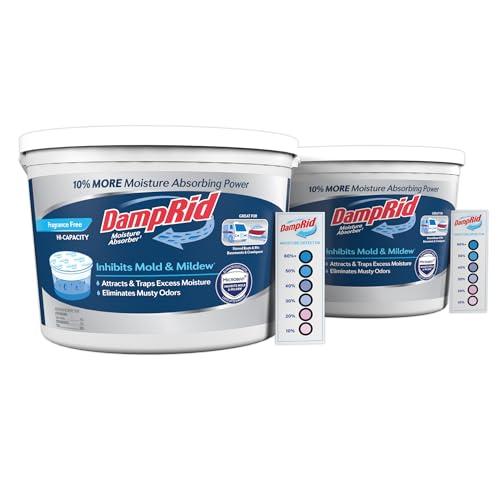
The heavy-duty tub version of DampRid for enclosed spaces too big for a hanging bag. Calcium-chloride crystals pull humidity into a sealed reservoir, and a detection strip tells you when they're used up. It will keep a stored boat cabin, a closed basement corner, or a damp walk-in closet dry enough to stop mildew — but like every passive absorber, it only conditions the trapped air around it and can't dry an open, lived-in room. For that you need a powered dehumidifier.
Pros
- Holds far more calcium chloride than a hanging bag — better for larger enclosed spaces
- No power, no noise — sits in a corner and works on its own
- Built-in detection strip shows when the crystals are spent and it's time to refill
Cons
- Still only dries the air in an enclosed space — useless in an open room
- The collected brine is corrosive and has to be emptied carefully
- Does nothing to mold that's already growing
The DampRid line, format by format
DampRid is the same chemistry in different packages — you're really just picking the delivery format for the space you're drying. Fragrance-free is the one to get for enclosed storage, where you don't want perfume soaking into clothes or linens.
| Format | Best for |
|---|---|
| Hanging bags (3-pack) | Closets, wardrobes, hanging in a stored RV |
| Disposable tubs / cups | Bathrooms, cabinets, a car left parked |
| Refillable bucket / Hi-Capacity tub | Bigger enclosed spaces, longer unattended spells |
| Refill bags / crystal refills | Topping up a refillable tub you already own |
One practical note the packaging buries: the brine that collects is a concentrated calcium-chloride solution, and it's corrosive and an irritant. Keep the containers up off the floor and out of reach of pets and kids, and don't let a tipped tub pour brine onto a hardwood floor or a metal surface. Empty a spent tub down the drain with running water, not into a flower bed.
DampRid vs a dehumidifier: which do you actually need?
This is the real decision, and the two aren't competitors so much as tools for completely different jobs. A $15 tub of DampRid absorbs a few ounces of water over a month. A powered dehumidifier pulls pints per dayand can actually hold a whole room at a target humidity. If your problem is a musty closet, DampRid is the right, cheap answer. If your problem is a damp room, a clammy basement, or anything you'd measure with a hygrometer reading above 60%, no amount of DampRid will fix it.
| DampRid | Dehumidifier | |
|---|---|---|
| How much water | Ounces over weeks | Pints per day |
| Power | None | Plugs in, runs a compressor |
| Works in | Small, sealed, closed air | Open rooms up to its rated size |
| Running cost | A few dollars a month in refills | A few dollars a month in electricity |
| Right for | Closets, storage, boats | Basements, damp rooms, whole-home humidity |
If you've read this far because you suspect your problem is bigger than a closet, it probably is. A 50-pint unit is the workhorse for a basement, a laundry room, or a humid ground floor, and it's the one tool that actually keeps a whole space below the 60% humidity where mold gets going:
hOmeLabs 50-Pint Energy Star Dehumidifier
hOmeLabs
$220–260
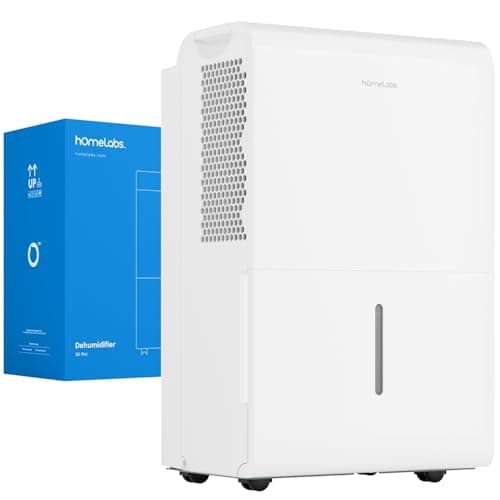
The best-selling 50-pint dehumidifier on Amazon and our top overall pick for mold prevention. Set your target humidity (aim for 45-50%) and the built-in humidistat cycles the compressor to hold it. A rear hose port allows continuous gravity draining into a floor drain, and turbo mode speeds up moisture removal after water events. Energy Star certified to keep 24/7 running costs reasonable.
Pros
- 50-pint capacity handles basements and large rooms up to 4,500 sq ft
- Built-in humidistat holds your target humidity automatically
- Continuous-drain hose port for set-and-forget operation
Cons
- No built-in pump — gravity drain or bucket emptying only
- 1.6-gallon bucket fills every 6-8 hours in very damp spaces
- Fan is audible on turbo mode
Our full dehumidifier for mold guide covers sizing, and the crawl-space dehumidifier writeup handles the sealed-vs-vented case under the house. DampRid is a fine sidekick to either — park a tub in the dead-air closet the dehumidifier can't reach — but it was never the main act.
Does DampRid stop mold and that musty smell?
Partly. By dropping the humidity in an enclosed space, DampRid removes the conditionmold needs, so it genuinely helps keep new mildew from starting in a closet and can take the edge off a mild damp smell. What it cannot do is cancel a smell that's coming from mold that already exists. If you open a closet and get hit with a strong, earthy, wet-sock must, that odor is being produced by a living colony somewhere — DampRid will dry the air but the smell stays until you find and remove the growth. Our guide to what a musty smell is telling you walks through hunting down the source.
Quick answers
Does DampRid kill mold?No. It's a desiccant that lowers humidity, not a biocide. It helps prevent new mold in a closed space by drying the air, but it does nothing to mold that's already growing — that needs cleaning or removal.
Is DampRid safe around pets and kids? The sealed product is low-risk, but the calcium-chloride brine it collects is corrosive and an irritant if spilled, licked, or swallowed. Keep tubs and buckets up high and out of reach, and clean up any spill with lots of water. For any question about health effects, talk to a doctor or poison control, not a cleaning blog.
DampRid or a dehumidifier — which do I need?If you're drying a closet, cabinet, safe, boat, or stored vehicle, DampRid. If you're drying a room, a basement, or a whole floor, a dehumidifier. They solve different-sized problems, and buying the wrong one is the single most common DampRid mistake.
Tried DampRid and the damp or the smell came back anyway? Tell us the space. Nine times out of ten it was too open for a passive absorber to keep up, or there's existing mold producing the odor — and both have a clear next step that isn't another bag of crystals.
Frequently Asked Questions
Does DampRid kill mold?
Does DampRid actually prevent mold?
DampRid or a dehumidifier — which do I need?
Is DampRid safe around pets and kids?
Related Articles
Best Dehumidifiers for Mold Prevention & Removal (2026)
Mold on Window Sill: Why It Grows and How to Stop It
Musty Smell in House? Here's How to Find & Fix the Source
Best Mold Removal Products: What Works for Every Surface & Situation
Best Crawl Space Dehumidifiers That Actually Work (2026)
Mold Armor: What It Is, What's In the Line, and Where It Works
Dealing With Mold Right Now?
Our step-by-step mold removal guide walks you through testing your home, choosing the right products, and knowing when a job is too big for DIY.
Read the Removal Guide