Best Crawl Space Dehumidifiers That Actually Work (2026)
Out of the Mold Editorial Team
Our guides are research-backed and cite EPA, CDC, and peer-reviewed sources. Product reviews are based on hands-on testing, not manufacturer claims. Read our editorial standards.
Affiliate Disclosure: Out of the Mold is reader-supported. As an Amazon Associate, we may earn a commission when you buy through links on this page — at no extra cost to you. Our picks are based on independent standards, manufacturer specifications, and published research, not commissions.
Key Takeaways
- A regular dehumidifier fails in a crawl space for three reasons: its coils freeze below ~60°F, it has no continuous drain so the bucket fills and it stops, and its bare coils corrode in the damp.
- The AlorAir Sentinel HD55S is the best overall pick — auto-defrost to 36°F, epoxy-coated coils, a low profile that fits the clearance, and a continuous gravity drain.
- Size for 40-100 pints/day by square footage and sealed-vs-vented status; a sealed space can drop a size or two because it isn't fed by outdoor air.
- Set the humidistat to 50% RH — mold germinates above ~60%, and 50% keeps you clear without running nonstop.
- Running a dehumidifier in an open vented crawl space dehumidifies the outdoors; lay a vapor barrier and seal the vents first so a smaller unit can win.
The best crawl space dehumidifier for most homes is the AlorAir Sentinel HD55S — a low-temperature, auto-defrost unit built to run continuously in a space that freezes, floods, and never gets a bucket emptied. A regular basement dehumidifier fails down there for three reasons: its coils ice over below about 60°F, it has no continuous drain so the bucket fills and it shuts off, and nobody is going to crawl in weekly to check on it. Size for 40–100 pints/day depending on square footage and whether the space is sealed, set it to 50% relative humidity, and plumb a continuous drain or pump. Expect to spend $150–$250 for a portable that might survive, or $450–$1,300 for a purpose-built crawl space unit that actually will.
A crawl space is the worst environment in your house to put an appliance, and most dehumidifier roundups pretend it's just a small basement. It isn't. You've got 18–24 inches of clearance, a dirt or thin-slab floor, temperatures that swing from freezing to muggy, and — critically — a space no human visits for months at a time. The unit you choose has to survive all of that unattended. Get it wrong and you'll find a dead, corroded box under the house next spring with the mold worse than when you started.
I've sorted the picks below by the constraints that actually matter down there, not by star ratings. But first, the two things people get wrong before they even shop: sizing and whether the crawl space is sealed.
Why a Regular Dehumidifier Dies in a Crawl Space
Take the $180 bucket unit that works great in your finished basement and put it under the house, and here's what happens over one season:
- The coils freeze. Standard compressor dehumidifiers are rated for 65–80°F. Below about 60°F, moisture freezes on the coils instead of dripping off, and the unit spends more time defrosting than drying — if it runs at all. Purpose-built crawl space units use hot-gas auto defrost; AlorAir's crawl space line keeps running down to 33.8°F.
- The bucket fills and it stops.There's no floor drain in a crawl space and no one emptying a reservoir. A unit without a continuous gravity drain or a built-in pump shuts off within a day or two and sits there full while the humidity climbs back up.
- The damp air corrodes it. Consumer units use bare aluminum coils. In a 90%-humidity crawl space they oxidize and fail fast. Crawl space units use epoxy-coated coils for exactly this reason.
- It can't fit or breathe.A tall portable won't stand up under 20 inches of clearance, and if the intake and exhaust are on top, it chokes itself against the joists.
This is why the honest budget answer isn't "a cheaper dehumidifier" — it's a real crawl space unit or a smaller problem. A $150 mini thermoelectric dehumidifier (the Pro Breeze class) pulls maybe 18 ounces a day and quits below 59°F. It has a place in a damp closet. It is useless under a house.
How to Size a Crawl Space Dehumidifier
Two variables set the size: square footage and whether the space is sealed. Most crawl spaces need a unit rated for 40 to 100 pints per day. A ventedcrawl space (open foundation vents, exposed dirt) needs far more capacity because you're fighting outdoor humidity that keeps pouring in — which is the whole argument for sealing it first (more on that below). A sealed and vapor-barriered space needs much less.
| Crawl space size | Sealed / encapsulated | Vented / exposed dirt |
|---|---|---|
| Up to 1,300 sq ft | 50–70 pint/day | 70–90 pint/day |
| 1,300–2,000 sq ft | 70 pint/day | 90–120 pint/day |
| 2,000–2,600 sq ft | 70–90 pint/day | 120+ pint/day |
Sizing follows AHAM/manufacturer crawl space guidance; a sealed space can drop a size or two because it isn't fed by outdoor air. Round up if the space floods or the region is humid.
The single most useful number to remember: set the target to 50% relative humidity — mold germinates above roughly 60%, and holding 50% keeps you clear without the unit running nonstop. Buy a unit with a built-in humidistat so it cycles on demand rather than running 24/7 at full tilt.
The Crawl Space Dehumidifiers Worth Buying
Best Overall: AlorAir Sentinel HD55S
This is the unit I'd put under my own house. It's built for the job the portables can't do: auto defrost down to 36°F, epoxy-coated coils that shrug off the damp, a low horizontal profile that fits the clearance, and — the part that matters most — a continuous gravity drain so it never fills a bucket. Its 120-pint saturation rating covers most residential crawl spaces with headroom. The catch: it's a gravity-drain model, so you need a low point or a slope to drain to. If you don't have one, jump to the pump pick.
AlorAir Sentinel HD55S Crawl Space Dehumidifier
AlorAir
$450–550
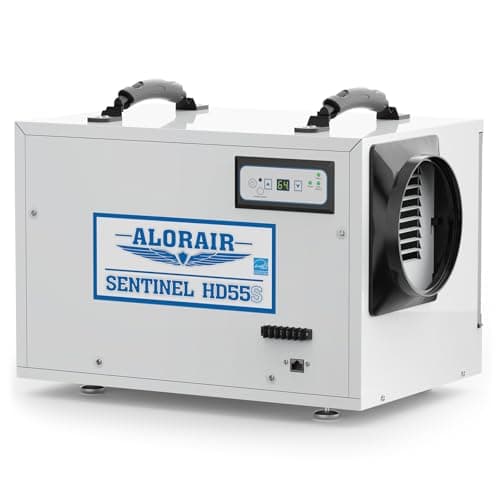
A commercial-grade crawl space dehumidifier engineered for the low temperatures and horizontal clearances portable units can't handle. Hot-gas auto defrost keeps it running down to 36°F, and its epoxy-coated coils resist the corrosion that kills consumer units in damp crawl spaces. The standard choice for crawl space moisture control after encapsulation.
Pros
- Purpose-built for crawl spaces — operates down to 36°F with auto defrost
- 120 pints per day saturation capacity, Energy Star certified
- 5-year warranty and ductable design for sealed installs
Cons
- Significant investment compared to portable units
- Gravity drain only on this model — pump version costs more
- Requires proper crawl space placement and clearance
Best With a Pump (No Floor Drain): Midea Cube 50-Pint
If your crawl space has no low point to drain to, you have two options: a dedicated crawl space unit plus a separate condensate pump ($60–$120), or a dehumidifier with the pump built in. For a smaller or sealed crawl space that stays above ~41°F, the Midea Cube with the internal pump is the value play — it lifts condensate up and out to a sink or exterior without extra plumbing, and its collapsible tank design fits low clearances better than a boxy portable. It is not a below-freezing crawl space unit, so match it to a sealed, milder space.
Midea Cube 50-Pint Smart Dehumidifier with Pump
Midea
$270–320
A 50-pint smart dehumidifier whose cube-in-cube design lifts open to more than double the water capacity of conventional buckets. The built-in pump can push condensate up to a sink or window — essential for below-grade basements with no drain. App control lets you watch humidity levels remotely, useful for vacation homes and rental properties where unnoticed humidity spikes turn into mold problems.
Pros
- Built-in pump pushes water up and out — no floor drain needed
- Unique nesting design extends bucket capacity to 4.2 gallons
- Wi-Fi app control with humidity alerts when you're away
Cons
- Costs more than pump-free 50-pint units
- Taller than a standard dehumidifier when extended
- Pump hose length limits where water can be sent
Budget Pick for a Sealed Space: hOmeLabs 50-Pint
Here's the honest budget path: a standard 50-pint unit only works in a crawl space that's already sealed and stays above about 50°F— a conditioned or semi-conditioned space, not an open vented one. If you've encapsulated and just need to hold humidity down in a mild climate, a $200–$250 unit with a continuous drain hose does the job for a fraction of the crawl space units' cost. Run a hose to a drain and set it to 50%. In an unsealed, freezing, or flooding space, this will die — buy the AlorAir instead. Don't split the difference.
hOmeLabs 50-Pint Energy Star Dehumidifier
hOmeLabs
$220–260
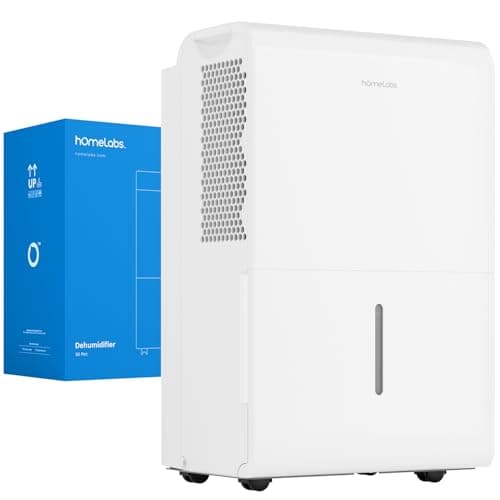
The best-selling 50-pint dehumidifier on Amazon and our top overall pick for mold prevention. Set your target humidity (aim for 45-50%) and the built-in humidistat cycles the compressor to hold it. A rear hose port allows continuous gravity draining into a floor drain, and turbo mode speeds up moisture removal after water events. Energy Star certified to keep 24/7 running costs reasonable.
Pros
- 50-pint capacity handles basements and large rooms up to 4,500 sq ft
- Built-in humidistat holds your target humidity automatically
- Continuous-drain hose port for set-and-forget operation
Cons
- No built-in pump — gravity drain or bucket emptying only
- 1.6-gallon bucket fills every 6-8 hours in very damp spaces
- Fan is audible on turbo mode
The $20 Tool That Saves the $500 One
You cannot manage what you can't see, and a crawl space is out of sight by definition. A cheap remote hygrometer (or a moisture meter for the framing) tells you whether the unit is actually holding 50% or quietly died three weeks ago. Check the framing moisture, not just the air — wood at 16% or higher is still feeding mold even if the air reads dry.
Klein Tools ET140 Pinless Moisture Meter
Klein Tools
$45–60
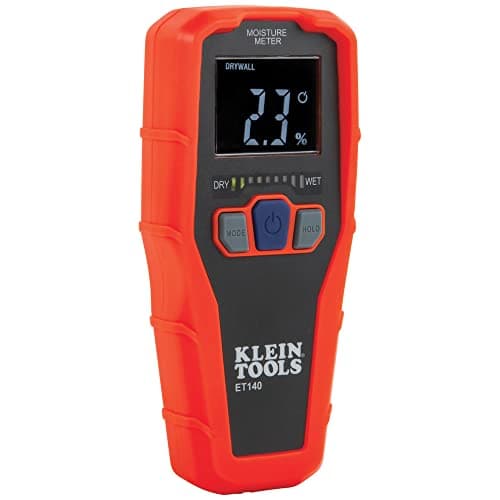
A professional-grade pinless moisture meter that detects hidden moisture in drywall, wood, and masonry without leaving holes. Uses electromagnetic sensor technology to measure moisture content up to 3/4 inch below the surface. Essential for identifying moisture problems before mold develops.
Pros
- Non-invasive pinless technology, no holes in walls
- Detects moisture up to 3/4 inch deep
- Visual and audible moisture alerts
Cons
- Less precise than pin-type meters on exact moisture percentage
- Battery not included
- Can give false readings on metallic or foil-backed surfaces
Installing It: Drainage, Placement, Monitoring
The install is where crawl space dehumidifiers succeed or fail:
- Drainage is non-negotiable.Gravity drain to a low point or sump if you have one; a condensate pump if you don't. A bucket you plan to empty is not a plan.
- Hang or elevate it.Set the unit on a pad or hang it from the joists so it's off the ground — out of any standing water and up in the air it's supposed to be drying.
- Give the coils clearance.Don't shove it against a wall or the subfloor; it needs to pull air through.
- Put a hygrometer across the spacefrom the unit so you're reading the far corner, not the air right at the outlet.
A Dehumidifier Alone vs. Sealing the Space First
This is the honesty a dehumidifier roundup owes you: running a dehumidifier in an open, vented crawl space is dehumidifying the outdoors. In summer, humid outside air pours through the foundation vents faster than the unit can dry it, and your electric bill climbs while the wood stays damp. The moisture also comes up from bare dirt. Before (or alongside) a dehumidifier, you want a crawl space vapor barrier over the ground and, ideally, sealed vents — that's what lets a smaller, cheaper unit actually win. Sealing the whole space is crawl space encapsulation— our guide covers the full-system cost and whether it's worth it for your space.
The right sequence: fix the water intrusion, treat any existing mold (a whole-space foggerreaches where you can't crawl), lay the vapor barrier over the dirt, seal the vents, thenadd the dehumidifier to hold the finish line. A dehumidifier is the last 10% of a moisture fix, not the whole thing. If you're still smelling that musty, earthy odorafter the unit's been running, the moisture source isn't actually handled yet.
What It Costs to Run
A crawl space dehumidifier pulls roughly 400–700 watts when the compressor is running. But with the humidistat set to 50%, it only runs when humidity rises — in a sealed space that might be a few hours a day, in a vented one it's most of the day (another reason to seal). Ball- park $15–$50 a month during humid season for a properly sized unit in a sealed space; more if it's fighting open vents. An Energy Star model and a sealed crawl space are the two levers that cut that bill.
Bottom line: for an exposed, cold, or flood-prone crawl space, buy a purpose-built low-temperature unit like the AlorAir and plumb a drain — the portable will cost you twice when it dies. For a sealed, mild space, a 50-pint unit on a continuous drain is genuinely enough. And whatever you install, put a $20 hygrometer next to it so you find out about a problem from your phone, not from your nose. Not sure a crawl space is even your moisture source? Start with our guide to the best dehumidifiers for mold by space and the basement mold playbook.
Out of the Mold is reader-supported. When you buy through links on this page we may earn an affiliate commission at no extra cost to you. Sizing follows AHAM and manufacturer crawl space guidance; humidity targets follow EPA indoor air quality recommendations.
Frequently Asked Questions
What size dehumidifier do I need for a crawl space?
Can I use a regular dehumidifier in a crawl space?
Do I need a dehumidifier with a pump for a crawl space?
Should I encapsulate the crawl space before adding a dehumidifier?
What humidity should a crawl space be kept at?
Related Articles
Mold in Your Crawl Space: DIY Removal vs Calling a Pro
Crawl Space Vapor Barrier: Mil Thickness & DIY Install (2026)
Best Dehumidifiers for Mold Prevention & Removal (2026)
How to Get Rid of Mold in Your Basement (2026 Guide)
Musty Smell in House? Here's How to Find & Fix the Source
Best Mold Fogger & Mold Bomb: Machines, Solutions & Safety Guide (2026)
Dealing With Mold Right Now?
Our step-by-step mold removal guide walks you through testing your home, choosing the right products, and knowing when a job is too big for DIY.
Read the Removal Guide