Mold in Your Humidifier: Why It Grows, How to Clean It Out, and How to Stop It
Out of the Mold Editorial Team
Our guides are research-backed and cite EPA, CDC, and peer-reviewed sources. Product reviews are based on hands-on testing, not manufacturer claims. Read our editorial standards.
Affiliate Disclosure: Out of the Mold is reader-supported. As an Amazon Associate, we may earn a commission when you buy through links on this page — at no extra cost to you. Our picks are based on independent standards, manufacturer specifications, and published research, not commissions.
Key Takeaways
- A humidifier is standing warm water plus a permanently damp wick — ideal mold habitat — so growth appears within days without daily emptying and drying.
- Pink slime isn't mold: it's Serratia marcescens bacteria. Named because scrubbing never 'kills' an airborne bacterium — you manage it by keeping surfaces dry.
- Clean in two steps: descale with vinegar or citric acid first, then disinfect with dilute bleach or 3% peroxide — and rinse hard (the EPA warns about aerosolizing chemicals).
- A moldy humidifier aerosolizes spores and bacteria into the air you breathe, so stop running it until it's clean; replace it if porous internals grow mold you can't reach.
- Prevention is a daily habit plus humidity control: empty daily, use distilled water, replace wicks, and keep the room at 30–50% RH (the EPA caps humidifier use at 50%).
A humidifier is a warm tank of standing water with a permanently damp wick — a near-perfect mold habitat — so growth and pink slime show up within days if it isn't emptied and dried between uses. Most units can be cleaned and saved: descale the tank with citric acid or white vinegar, disinfect, rinse hard, and replace the wick if it's crusted. The real fix is a two-minute daily habit — empty, wipe, dry — plus holding the room at a safe humidity so you're not breeding mold in the whole room on top of the machine.
It's heating season, the humidifier's been running every night to fight dry indoor air, and now there's a film in the tank or a smell coming off the mist. That timing isn't a coincidence. Humidifiers are a winter appliance, they sit full of standing water for days, and the stuff growing inside gets aerosolized straight into the air you're breathing while you sleep. The good news is that this is one of the most fixable mold problems in the house — if you understand why it happens.
Why humidifiers grow mold so fast
Mold needs three things, and a humidifier hands it all three at once: standing water that never fully dries, organic dust pulled in from the room as a food source, and room-temperature warmth. The EPA and CPSC don't mince words about it: "microorganisms often grow in humidifiers which are equipped with tanks containing standing water." The tank is the obvious spot, but growth also hides in the reservoir base, the wick or filter, and — on cool-mist and ultrasonic units — the gasket and the nebulizer disc.
One correction worth making up front, because half the people reading this are looking at pink, not black: the pink slime isn't mold. It's almost always Serratia marcescens, an airborne bacterium that colonizes the same damp surfaces and feeds on the same mineral residue — the exact stuff you see as pink mold in a bathroom. It gets managed the same way as mold here (clean, dry, repeat), but naming it matters, because no amount of scrubbing "kills" a bacterium that's floating in every room — you're controlling it, not eradicating it.
Is mold in a humidifier dangerous?
This is where a humidifier is genuinely different from a stain on a wall: the machine's entire job is to turn its contents into a breathable mist. So whatever is growing inside gets dispersed into the air of the room you spend the night in. The EPA/CPSC guidance notes that "breathing mist containing these pollutants has been implicated as causing a certain type of inflammation of the lungs." We don't give medical advice here — for health specifics, go to the CDC and EPA. What we can say plainly is that a visibly moldy humidifier is one you should stop running until it's clean, because it's a delivery system, not a passive stain.
When should you just throw it out instead of cleaning it? Replace the unit if the mold is in porous internals you physically can't reach and scrub, or if black growth keeps coming back within days no matter how you clean — at that point you're paying for descaler to disinfect a lost cause. A cheap cool-mist unit often isn't worth the fight; a $120 ultrasonic with reachable, rinseable parts usually is.
How to clean mold out of a humidifier
The routine the EPA/CPSC actually recommends is two layers: a daily reset and a deeper clean every few days. Their words: "empty the tank, wipe all surfaces dry, and refill the water in portable humidifiers daily," and "clean portable humidifiers every third day to reduce the buildup of scale and microorganisms." Here's how that plays out when mold has already taken hold:
- Empty and disassemble.Dump the water, pop off the tank, and separate the wick/filter and any gasket. Don't submerge the motor base or the ultrasonic nebulizer housing — those are the parts that mustnot go in water.
- Descale first. Fill the tank with white vinegar or a humidifier descaling solution and let it soak 20–30 minutes. Descaling matters because biofilm and slime cling to mineral scale — strip the scale and you strip their anchor.
- Then disinfect.After descaling, a dilute bleach solution (follow your humidifier maker's recommended dilution) or 3% hydrogen peroxide, swished and left a few minutes, handles the surviving growth. Our hydrogen peroxide for mold guide covers the peroxide route if you'd rather skip bleach.
- Rinse like you mean it.This step is non-negotiable on a humidifier. The EPA warns: "if you use a cleaning or disinfecting agent to clean your humidifier, rinse the tank thoroughly to avoid releasing chemicals into the air." Rinse until there's no smell, then air-dry fully before reassembling.
The wick is its own decision. On an evaporative humidifier the wick stays permanently wet and is the single part that grows mold fastest — once it's stiff, crusted, or smelly, replacing it is cheaper and more honest than trying to disinfect a saturated sponge.
IMPRESA Humidifier Cleaner & Descaler Powder
IMPRESA
$18–25
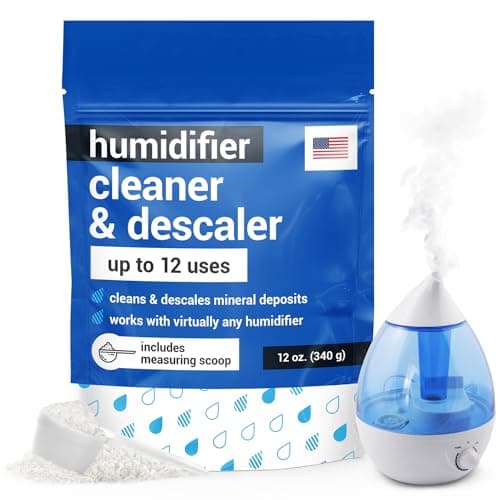
A citric-acid cleaning and descaling powder formulated for humidifier tanks and reservoirs. It dissolves the mineral scale that biofilm and pink Serratia slime cling to, so a weekly soak-and-rinse actually resets the tank instead of just wiping the surface. Because a humidifier sprays whatever is inside it into the air you breathe, the no-bleach, rinse-clean formula matters more here than on a surface you don't inhale off of.
Pros
- Citric-acid formula made for humidifier tanks — descales mineral scale and lifts biofilm in one soak
- 12 pre-measured uses; works on cool-mist, ultrasonic, and evaporative units
- No bleach fumes, and it rinses clean for a device that aerosolizes into air you breathe
Cons
- A soak-and-rinse cleaner, not a leave-in preventative — you still clean on a schedule
- Won't reach porous internals you can't physically scrub
- White vinegar does roughly the same descaling job cheaper (this is more convenient and consistent)
AIRCARE 1043 Replacement Evaporative Wick Filter
AIRCARE
$20–28
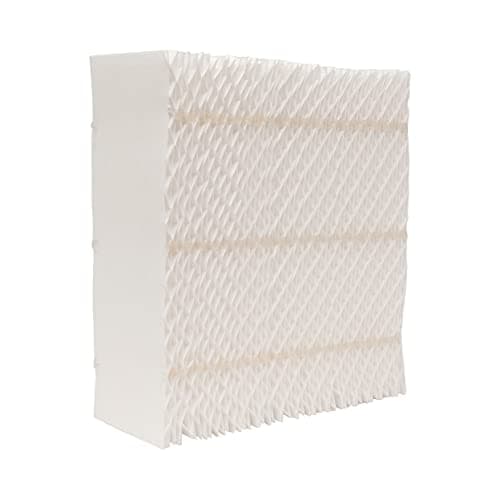
A genuine AIRCARE 1043 replacement wick for Space Saver and Essick Air evaporative humidifiers. On a wicking humidifier the wick stays permanently damp and is the single part that grows mold fastest, so once it is crusted, stiff, or smelly the honest move is to replace it rather than try to disinfect it. Wicks are model-specific — confirm your unit takes the 1043 size first.
Pros
- The wick is where evaporative humidifiers grow the most mold — replacing it is often cheaper than fighting it
- Genuine AIRCARE wick for the common Space Saver / Essick Air evaporative units
- Antimicrobial-treated paper wick that traps minerals so they don't go airborne
Cons
- Model-specific — confirm your humidifier takes the 1043 before buying (wicks are not universal)
- A wear part: replace every 1–2 months of heavy use, not once a season
- Only applies to evaporative (wicking) humidifiers, not ultrasonic or cool-mist tanks
Stop it coming back
Cleaning is damage control; prevention is the actual fix, and it's four habits:
- Empty and dry it every day. This one habit does more than any product. Standing water overnight is where the whole problem starts — dump it in the morning and wipe the tank dry.
- Use distilled water.The EPA recommends "water with low mineral content, such as distilled water." Less mineral scale means less for biofilm to grab onto — and less white dust on your furniture.
- Replace wicks on schedule (every 1–2 months of heavy use), and consider a bacteriostatic treatment in the tank to slow slime between cleans on a unit that runs daily.
- Watch the room's humidity, not just the tank. This is the mistake the stale guides miss entirely.
BestAir 3BT Humidifier Bacteriostatic Water Treatment
BestAir
$20–30
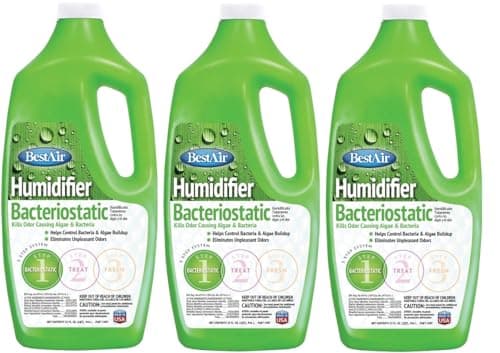
A bacteriostatic water treatment you add to the humidifier tank to slow the growth of the bacteria and microorganisms that form pink Serratia slime and biofilm between cleanings. It does not replace the EPA's empty-and-dry-daily routine, but on a unit running all day through heating season it buys time between deep cleans. Check your humidifier maker's guidance before using it in an ultrasonic unit.
Pros
- Added to the tank water, it slows the bacterial and microbial growth that causes pink slime between cleanings
- Compatible with most evaporative and cool-mist humidifiers
- Extends how long the tank stays clean — useful during peak heating-season daily use
Cons
- A supplement to cleaning, not a substitute — you still empty and scrub
- Not for ultrasonic units unless the maker approves it
- Ongoing consumable cost through the season
That last point is the one that quietly matters most. Cranking the humidifier to beat dry winter air is easy to overshoot — and if you push the whole room past 60% relative humidity, you're no longer just risking mold in the machine, you're growing it on windowsills, in closets, and behind furniture. The EPA's line for humidifiers is firm: "do not humidify to indoor relative humidity levels exceeding 50 percent," and its general mold guidance is to keep a home below 60% (ideally 30–50%). A cheap hygrometer in the room turns that from a guess into a number you can see:
Govee H5075 Bluetooth Hygrometer Thermometer
Govee
$10–15

An inexpensive Bluetooth hygrometer that continuously tracks a room's relative humidity and temperature and graphs the history in an app. Mold needs sustained humidity above roughly 60%, so a logging hygrometer in the bathroom, basement, or a closet is the cheapest way to see a moisture problem building before mold appears. It monitors conditions — it does not detect or identify mold itself.
Pros
- Logs humidity history so you can spot rooms that creep past 60% RH
- Bluetooth app graphs the trend and alerts you when a room gets damp
- Cheap enough to put one in every mold-prone room
Cons
- Measures humidity, not mold — it flags the conditions, never confirms spores
- App/Bluetooth only; no Wi-Fi remote access without the hub
- Consumer-grade accuracy — fine for mold risk, not lab precision
If what tipped you off was the smell rather than the slime, our what mold smells like guide helps you place it — and the opposite appliance has the opposite problem: a dehumidifier that smells musty or grows black mold is the same standing-water story running in reverse, in a machine that pulls moisture out instead of pushing it in.
Frequently Asked Questions
Is the pink stuff in my humidifier mold?
Can I clean humidifier mold with vinegar?
Should I throw out a moldy humidifier?
How do I stop mold coming back in my humidifier?
Related Articles
Dehumidifier Smells Musty? Here's Which Part Is Actually the Problem
Black Mold in Your Dehumidifier? First Decide: Clean It or Replace It
Pink Mold: What It Really Is, How to Remove It, and How to Prevent It
What Does Mold Smell Like? How to Identify Mold by Smell
Mold in Your Home: A Room-by-Room Guide to Finding and Fixing It
Musty Smell in House? Here's How to Find & Fix the Source
Dealing With Mold Right Now?
Our step-by-step mold removal guide walks you through testing your home, choosing the right products, and knowing when a job is too big for DIY.
Read the Removal Guide