How to Remove Mold from Clothes, Fabric & Leather (Without Ruining Them)
Out of the Mold Editorial Team
Our guides are research-backed and cite EPA, CDC, and peer-reviewed sources. Product reviews are based on hands-on testing, not manufacturer claims. Read our editorial standards.
Affiliate Disclosure: Out of the Mold is reader-supported. As an Amazon Associate, we may earn a commission when you buy through links on this page — at no extra cost to you. Our picks are based on real testing and independent standards, not commissions.
Key Takeaways
- Pre-soak first (oxygen bleach, vinegar, or borax), then wash on the hottest setting the fabric allows and dry in the sun.
- Oxygen bleach and vinegar are color-safe; chlorine bleach is whites-only because it destroys dyes.
- Delicates (silk, wool, dry-clean-only) need gentle spot-treatment or a dry cleaner — not an oxygen-bleach soak.
- A garment is unsalvageable if the fibers are rotted or the musty smell survives two full treatments.
- Prevent it by storing only fully-dry clothes and keeping closet humidity below 50% with a desiccant or dehumidifier.
To remove mold from washable clothes: brush off loose spores outside, pre-soak the garment for several hours in warm water with oxygen bleach or a cup of white vinegar, then wash on the hottest setting the fabric allows and dry it in direct sun. Oxygen bleach is the safest choice for colors; chlorine bleach is whites-only. Delicates like silk and wool need gentle spot-treatment or a dry cleaner. The honest catch: if mold has rotted the fibers or the musty smell survives two full treatments, the garment is done.
Finding mold on your clothes is one of those small domestic gut-punches — a favorite jacket pulled from storage with a dusting of white fuzz, or a load left in the washer overnight that comes out smelling like a cellar. The good news is that most fabric mold comes off, and you probably have what you need in the kitchen already. The realistic news is that some of it won't, and knowing which is which saves you from wasting a Saturday on a shirt that's already lost.
Why mold grows on clothes
Fabric is basically a buffet for mold: cotton, linen, and wool are organic fibers, and they hold onto exactly the moisture spores need. It shows up in four predictable situations:
- Damp clothes left sitting. A wet load forgotten in the washer, or a gym bag zipped shut. Mold can take hold in 24–48 hours.
- Seasonal storage without full drying.Packing away summer or winter clothes with any residual moisture, in a bin or bag that can't breathe.
- Humid, unventilated closets. Especially closets on an exterior wall or in a basement, where trapped humid air settles into stored fabric.
- A moldy washing machine.If the machine itself is the source, cleaning the clothes is only half the job — here's how to fix mold in a washing machine.
How to remove mold from washable clothes
Work through these in order. Do the brushing step outdoors — you don't want to shake live spores loose inside your home.
- Brush off the surface mold outside. Take the garment outdoors and brush or shake off loose mold before it goes anywhere near your washer.
- Pre-soak. This is the step that does the heavy lifting. Soak the garment for several hours — overnight for anything established — in warm water with either oxygen bleach or about a cup of white vinegar per gallon.
- Wash hot.Run the hottest wash cycle the care label allows, adding oxygen bleach or a borax booster. Cold water doesn't kill mold; heat matters.
- Dry in the sun. Line-dry in direct sunlight if you can. UV is a genuine mold killer and helps lift the last of the musty smell.
- Check before you trust it. Once fully dry, smell and inspect. If any staining or mustiness remains, repeat once. If it survives a second full treatment, move on — see the salvage test below.
Oxygen bleach vs. vinegar vs. borax — which to reach for
These three are the workhorses, and they're not interchangeable:
- White vinegar kills roughly 82% of mold speciesand strips the musty odor, and it's safe on colors. It's the cheapest first move but a weaker preventer than borax.
- Oxygen bleach(sodium percarbonate — the OxiClean-type powders) is color-safe and the most effective on set-in staining. It releases hydrogen peroxide in warm water, so give it heat and time. It's the best choice for anything colored that isn't delicate.
- Borax shines as a soak for established mold and as a long-term preventer — an overnight borax soak gives the best results on stubborn cases.
- Chlorine bleach works but is whites-only; it destroys dyes and weakens fibers, so keep it away from anything colored.
OxiClean Versatile Stain Remover (Oxygen Bleach Powder)
OxiClean
$10–20
A sodium-percarbonate (oxygen) bleach that releases hydrogen peroxide in warm water to break down mold and the odor it leaves behind, without stripping color the way chlorine bleach does. Used as an overnight pre-soak or a hot-wash booster, it's the safest color-fabric option for salvaging moldy clothes.
Pros
- Color-safe oxygen bleach — lifts mold and musty odor without the dye damage chlorine bleach causes
- Works as a pre-soak or an in-wash booster on washable fabrics
- One tub handles laundry, grout, and hard-surface mildew
Cons
- Needs warm water and time — a long soak beats a quick wash
- Not for silk, wool, or other delicate protein fibers
- Won't restore fabric where mold has already rotted the fibers
How to handle delicate fabrics
Silk, wool, cashmere, and anything marked dry-clean-only are protein or delicate fibers that harsh chemicals and hot water will wreck. Don't soak them in oxygen bleach. Instead, spot-treat gently with diluted white vinegar and cold water, blot rather than rub, and air-dry. For anything valuable, take it to a dry cleaner and tell them it's mold — the solvents they use handle it, and you avoid gambling a $200 garment on a home remedy.
How to remove mold from leather
Leather is its own problem — it mistakes mold for a snack and the fuzz comes back fast if you don't follow up with conditioner. The short version: wipe it down outdoors with a cloth dampened in a rubbing-alcohol-and-water solution, let it dry, then re-condition so the leather doesn't crack. We cover the full method, including when leather is beyond saving, in our mold on leather guide.
Can moldy clothes be saved? The honest test
Most articles dodge this. Here's the real answer: a garment is past saving once one of two things is true.
- The fibers are compromised.If mold has eaten into the fabric — leaving holes, thin patches, or a rotted, weakened feel — the material is structurally gone. Cleaning it won't bring the fibers back.
- The smell survives two full treatments. If the musty odor is still there after two complete cycles of soak, hot wash, and full dry, the mold is embedded deeper than surface cleaning can reach. Let it go.
Everything short of that is usually recoverable. And be honest with yourself about health, too: heavily mold-infested clothing that won't come clean isn't worth keeping — the EPA and CDC both note that mold exposure can aggravate allergies and asthma, so a rotted, un-cleanable garment belongs in the trash, not back in the drawer.
How to prevent mold on clothes
Fabric mold is almost always a moisture-and-storage problem, so prevention is about keeping stored clothes dry:
- Never store anything even slightly damp. Fully dry every item before it goes into a drawer, bin, or garment bag. This causes more storage mold than anything else.
- Put a moisture absorber in the closet.A hanging desiccant pulls humidity out of enclosed spaces that powered units can't reach — ideal for a wardrobe or a bin of off-season clothes.
- Drop closet humidity below 50%. In a chronically damp closet or basement storage area, a dehumidifieris the actual fix — mold can't grow below about 50% relative humidity.
- Let closets breathe.Don't cram clothes wall to wall; air needs to move. Louvered doors or an occasional open door help.
- Wash a musty smell at the source. If clean laundry keeps coming out musty, the washer — not the closet — is the problem.
DampRid Hanging Moisture Absorber (3-Pack)
DampRid
$12–18
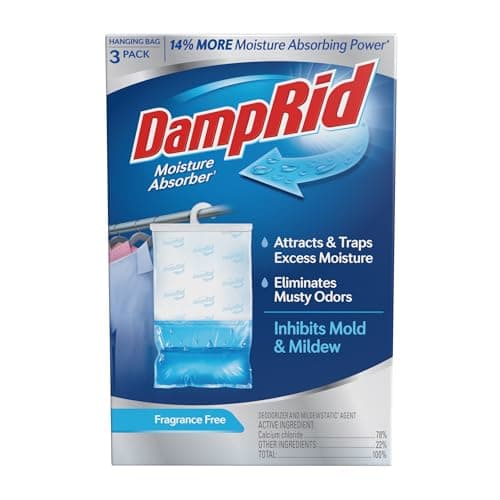
Passive calcium-chloride moisture absorbers that hang from a closet rod and pull humidity out of enclosed spaces without power. They won't fix a damp basement, but inside a closet, wardrobe, or stored vehicle they keep trapped air dry enough to stop mildew on clothes, leather, and linens. Each bag lasts roughly 45-60 days before the crystals fully dissolve.
Pros
- No electricity needed — works anywhere you can hang it
- Calcium chloride crystals absorb moisture for up to 60 days each
- Fragrance-free version won't add perfume to enclosed spaces
Cons
- Cannot meaningfully lower whole-room humidity
- Bags must be replaced once the crystals dissolve
- Collected brine must be handled carefully when disposing
If the musty smell has spread beyond the clothes themselves, it's worth figuring out where it's coming from — our guide to the musty smell in a house walks through tracking it down, and the best mold removal products roundup covers what to use on the walls, shelves, and hard surfaces around your stored clothes.
Frequently Asked Questions
Can moldy clothes be saved?
Is mold on clothes dangerous?
Will washing clothes in hot water kill mold?
What's the best way to remove mold from colored clothes?
Should I throw away clothes with mold?
Related Articles
Mold in Washing Machine: How to Remove It & Keep It Gone
How to Remove Mold from Leather (Without Ruining It)
Does Vinegar Kill Mold? The Science, the Limits, and How to Use It Right
Musty Smell in House? Here's How to Find & Fix the Source
Best Dehumidifiers for Mold Prevention & Removal (2026)
Mold Removal Products: A Complete Guide to What Works and Why
Need Professional Mold Removal?
Get free, no-obligation quotes from licensed mold remediation specialists in your area.
Get Free Quotes