Professional Mold Testing: What It Costs, How It Works, and When You Actually Need It
Out of the Mold Editorial Team
Our guides are research-backed and cite EPA, CDC, and peer-reviewed sources. Product reviews are based on hands-on testing, not manufacturer claims. Read our editorial standards.
Affiliate Disclosure: Out of the Mold is reader-supported. As an Amazon Associate, we may earn a commission when you buy through links on this page — at no extra cost to you. Our picks are based on independent standards, manufacturer specifications, and published research, not commissions.
Key Takeaways
- Most visible mold doesn't need testing — the EPA says if mold is visible, sampling is generally unnecessary; you just clean it.
- Professional testing is worth it mainly for home sales, insurance/landlord disputes, unexplained symptoms, or post-remediation clearance.
- Expect roughly $300–$600 for an inspection with air sampling; detailed ranges live on our mold inspection cost page.
- Air sampling reads the air right now; surface tests ID a visible spot; ERMI scores the home's dust history — pros often combine them.
- Never let the company that would remediate also do your 'free' test — independent testing and remediation should be separate.
Professional mold testing usually runs about $250–$500 for an inspection with air sampling, and more for whole-home or ERMI lab work. But here's the part the companies selling it won't lead with: most visible mold doesn't need testing at all. The EPA's own position is that if you can see the mold, sampling is generally unnecessary — you just clean it. So the real question isn't "who tests mold near me," it's whether your situation is one of the few where lab data actually changes what you'd do.
Search "professional mold testing" and the entire first page is local directories trying to book you an inspection. None of them answer the question you're actually asking: do I need this, what should it cost, and how do I avoid getting upsold? So let's do that — starting with whether to hire anyone at all.
DIY kit, pro inspector, or neither — decide this first
Before you spend a dollar, sort your situation into one of three buckets:
- Visible mold, obvious source → neither.You can see mold on the bathroom ceiling and you know the room stays wet. Testing tells you nothing you can act on — it's mold, clean it and fix the moisture. The EPA is blunt here: "In most cases, if visible mold growth is present, sampling is unnecessary." (EPA.)
- You want it confirmed, no high stakes → DIY kit. Curiosity, a mild musty smell, a small spot you want identified. A $30 home test kit sends a sample to a lab and names what's growing. See how the DIY test methods compareand what each can and can't tell you.
- Real stakes → professional testing earns its cost. Buying or selling a home, an insurance or landlord dispute, unexplained symptoms with no visible source, or clearance after a remediation — these are the situations where independent lab data actually matters.
If you landed in the middle bucket, a surface test kit is the honest, cheap first step before you pay for an inspection:
Mold Armor FG500 Do It Yourself Mold Test Kit
Mold Armor
$9–15
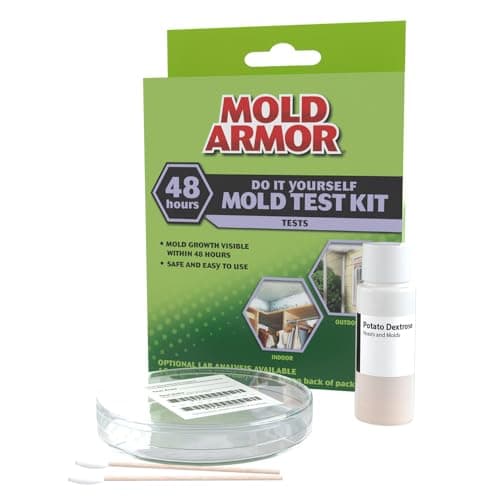
The most popular DIY mold test kit on Amazon. Includes a settling plate, swab, and pre-paid postage for AIHA-accredited lab analysis. The kit detects airborne mold spores and surface mold, identifying species like Aspergillus, Stachybotrys, and Penicillium.
Pros
- Very affordable entry-level test
- Includes petri dish, swab, and postage for lab analysis
- Results identify mold species
Cons
- Lab fee is separate (~$40)
- Takes 5-7 days for lab results
- Only tests one location per kit
What a professional mold test actually includes
"Testing" is really an inspection with sampling bolted on, and knowing the parts keeps you from paying for ones you don't need. A legitimate visit covers:
- A visual and moisture inspection.The inspector walks the home looking for growth, water staining and damp materials, usually with a moisture meter and sometimes an infrared camera. This is the core of the job — the part that finds the problem.
- Air sampling. Spore-trap cassettes pull a measured air volume indoors and outdoors; the lab compares the two. Indoor spore counts well above the outdoor baseline suggest a hidden indoor source.
- Surface or tape-lift sampling.A swab or clear tape lifted off a suspect spot, read under a microscope to confirm it's mold and roughly what type.
- A written lab report.Turnaround is typically a few business days. You should get spore types, counts, and a plain-language interpretation — not just a sheet of numbers.
One thing worth repeating from the EPA: sampling "should be conducted by professionals who have specific experience in designing mold sampling protocols, sampling methods, and interpreting results." A result is only as good as the person who collected and read it.
Air sampling vs. surface vs. ERMI — which does what
The three common methods measure genuinely different things, which is why a pro often uses more than one. Here's the honest comparison:
| Method | What it tells you | Rough cost | Best for |
|---|---|---|---|
| Air sampling (spore trap) | Airborne spore types & counts, indoor vs. outdoor | $50–$150 per sample, on top of the inspection | Suspected hidden mold; is the air affected right now |
| Surface / tape lift | Confirms a visible spot is mold and its type | $15–$40 DIY; $50–$150 via a pro | Identifying a specific patch you can see |
| ERMI (DNA dust test) | A lab score of 36 mold species from settled dust | $200–$250 as a DIY lab kit | Whole-home history; sensitized or symptomatic occupants |
Air sampling is a snapshot of right now; ERMI reflects accumulated dust over time, so it reads the home's history rather than the moment. If you're weighing the two, we compare them head-to-head in ERMI vs. air test, and the ERMI test guidecovers when that DNA method is worth it. This also folds in "air quality mold test" — that's the air-sampling row above, not a separate kind of test.
What it costs, by scenario
Prices vary by home size, sample count and region, but the national shape in 2026 is consistent: a visual-only inspection is the floor, air sampling adds per-sample fees, and ERMI or whole-home lab work sits at the top. Rather than reprint the full breakdown, we keep the detailed cost math on one page — see mold inspection cost for the visual-only, with-air-testing, and comprehensive-with-lab ranges and what drives a quote up or down. Use that to judge whether a bid is fair before you sign anything.
The thing that moves the number most isn't the lab fee — it's how many samples get taken. A single air comparison on a focused problem is cheap; a sampler who wants six cassettes in a three-bedroom house with no visible issue is padding the invoice.
When professional testing is a waste of money
This is the part the directories can't tell you, because they make money when you book. Skip or push back on testing when:
- The mold is visible and the source is obvious.Clean it, fix the water. A lab naming the species doesn't change the cleanup — the response is the same regardless of type.
- You haven't fixed the moisture yet.Testing a still-wet problem just documents a number that'll be wrong after you dry it out. Fix the leak, dry the space, then test only if you still need to.
- The "test" is free — from a remediation company. A firm that both tests and remediates has a built-in conflict of interest: the test conveniently finds a job worth doing. Independent testing and independent remediation should be two different companies. If you only remember one rule from this page, make it that one.
- No moisture, no symptoms, no transaction."Peace of mind" testing of a dry, odor-free home usually buys you a report that says what you already assumed.
The flip side: when there arereal stakes — a sale, a dispute, symptoms with no visible cause, or post-remediation clearance — good independent testing is cheap insurance, and clearance testing from a third party (not the remediator grading their own work) is how you confirm a job was actually done. That's the handful of cases the $250–$500 is genuinely worth it. Everything else, the mop and a dehumidifier beat the lab.
Frequently Asked Questions
Is professional mold testing worth it?
How much does a mold inspection cost?
Can I just use a DIY kit instead?
Related Articles
How Much Does a Mold Inspection Cost? (2026 Price Guide)
How to Test for Mold at Home: DIY Methods That Actually Work
Best Mold Test Kits for Home Use: What Works & What's a Waste of Money (2026)
ERMI Mold Test: Cost, Accuracy & When You Actually Need One
ERMI vs Air Test vs HERTSMI-2: Which Mold Test Do You Need?
Mold Testing Guide: Do You Need a Test & Which Type Is Best?
Dealing With Mold Right Now?
Our step-by-step mold removal guide walks you through testing your home, choosing the right products, and knowing when a job is too big for DIY.
Read the Removal Guide