Do Air Purifiers Help With Black Mold? What They Can and Can't Do
Out of the Mold Editorial Team
Our guides are research-backed and cite EPA, CDC, and peer-reviewed sources. Product reviews are based on hands-on testing, not manufacturer claims. Read our editorial standards.
Affiliate Disclosure: Out of the Mold is reader-supported. As an Amazon Associate, we may earn a commission when you buy through links on this page — at no extra cost to you. Our picks are based on independent standards, manufacturer specifications, and published research, not commissions.
Key Takeaways
- A purifier captures airborne black-mold spores and cuts the smell, but can't remove mold on surfaces — the EPA says air cleaners don't address the cause.
- Buy for three specs: true HEPA (not 'HEPA-type'), smoke CADR ≥ 2/3 of room square footage, and an activated-carbon stage for the musty gas.
- Black mold in the AC coil or ducts reseeds the air every cycle — a portable purifier can't fix a contaminated HVAC system.
- Order of operations: dry the source, remove the mold, then filter and verify. The purifier is the third move, not the first.
- In a damp room a neglected HEPA filter can grow mold itself — pair the purifier with a dehumidifier and change filters on schedule.
An air purifier can capture airborne black-mold spores and cut the musty smell — it cannot kill or remove black mold growing on a wall, ceiling, or HVAC coil. Buying one without fixing the moisture and removing the growth is treating the symptom while the source keeps pumping out fresh spores. Used correctly — during and after remediation, or alongside a dehumidifier when you can't fully fix the source — a true-HEPA unit with activated carbon genuinely lowers what you're breathing. Used as a substitute for cleanup, it's a $200 fan fighting a colony that never sleeps.
"Black mold" carries a specific dread, so the marketing around purifiers that "remove mold" sells hard to exactly the people searching this. The honest version is a clean split: there's what a purifier does to the spores in your air, and what it does to the mold on your surfaces — and those are two very different answers.
What it can and can't do about black mold
Hold the two columns in your head at once, because every good decision here depends on keeping them straight.
What it can do. Black mold (Stachybotrys and the far more common Aspergillus/Penicilliumthat people call "black mold") reproduces by releasing spores into the air — that's how a leak in one room becomes a whole-house problem and what you actually inhale. Mold spores run roughly 1–30 microns; true HEPA is certified to trap 99.97% of particles at 0.3 microns, the hardest size to catch, so spores — being far larger — are well within what it reliably removes. Add an activated-carbon stage and it also pulls down the musty microbial-VOC smell. So in the room it's running in, it genuinely lowers the airborne spore load and the odor.
What it can't do. It has zero effect on mold colonizing drywall, grout, subfloor, or an AC coil. The EPA is explicit in its Guide to Air Cleaners in the Home: portable air cleaners "do not address the cause of mold and musty odors," and while they "may remove some of the particles generated by mold…they will not resolve a mold and moisture problem." Run one next to active black mold without fixing the source and the colony simply refills the air faster than the filter clears it. You'll run the machine forever and never get ahead.
If you're buying one anyway — size it right
A purifier earns its place during cleanup, after cleanup, for an allergy/asthma sufferer in an otherwise-clean home, or as damage control when a damp source can't be fully fixed. In any of those, three specs decide whether it actually works for mold:
- True HEPA, not "HEPA-type.""Type," "like," or "99% at 2 microns" means it's not held to the 99.97%-at-0.3-micron standard and can recirculate finer spore fragments. Insist on true HEPA / H13.
- CADR matched to the room.Clean Air Delivery Rate is how fast it processes air; the working rule is to pick a unit whose smoke CADR is at least two-thirds of the room's square footage, for four-plus air changes an hour. An undersized unit in a big basement barely moves the spore count. (Our air purifier for mold roundup sizes specific picks by room so you're not guessing.)
- An activated-carbon stagefor the smell. The musty odor is a gas; a particle filter does nothing to it. The EPA notes particle-removal cleaners are "incapable of controlling gases and some odors," which is exactly why HEPA-only units leave a room still smelling off. Carbon is what clears it.
The spec that matters less than the marketing implies: UV-C and ionizers. Air moves past a purifier's UV bulb far too fast for a meaningful kill dose, and some ionizers emit ozone, a lung irritant. The filtration does the real work. For a mold-prone bedroom or living room, a proven true-HEPA unit with carbon is the pick:
Coway Airmega AP-1512HH True HEPA Air Purifier
Coway
$200–260
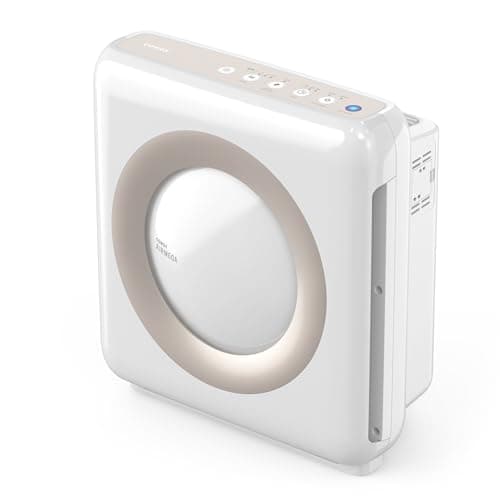
The long-standing benchmark for HEPA air purifiers. A four-stage system — pre-filter, deodorizing activated-carbon filter, True HEPA, and an optional ionizer — pulls mold spores, pollen, and musty odor out of rooms up to 1,748 sq ft. The pollution sensor ramps the fan when spore counts spike (say, right after you disturb growth during cleanup), then idles down in Eco mode. Independent testing sites have ranked it a top performer for years.
Pros
- True HEPA captures 99.97% of particles down to 0.3 microns — well below mold spore size
- Dedicated activated-carbon layer handles the musty VOCs HEPA can't
- Covers up to 1,748 sq ft; air-quality sensor auto-adjusts fan speed
Cons
- Ionizer mode is on by default — turn it off (produces trace ozone, no mold benefit)
- Replacement filter sets run ~$40–60 a year
- No app control on the base model
If the black mold has anyone in the home reacting — the case where lowering spore load actually matters most — a medical-grade H13 unit with a deeper carbon bed is the one to size up to, especially for a larger room or open floor:
Medify MA-40 Medical-Grade H13 HEPA Air Purifier
Medify
$200–260
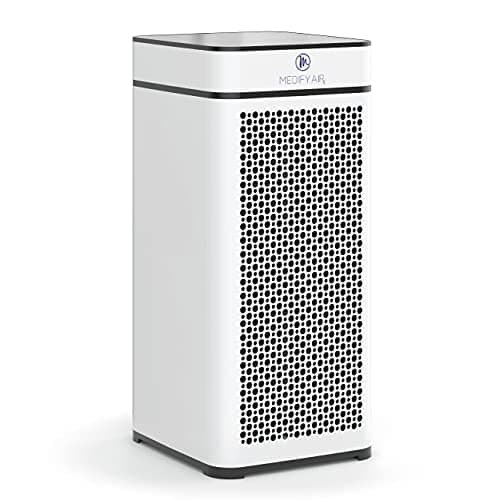
The MA-40 leans on a medical-grade H13 filter and a genuinely sealed housing — the detail that separates a purifier that filters air from one that leaks dusty air around a loose filter. It moves enough air to turn over a large room hourly, which is what you want during and just after remediation when spore counts are elevated. Skip the pricier UV-C version: for mold, a properly sealed HEPA does the work.
Pros
- H13 medical-grade HEPA (a tighter grade than standard True HEPA)
- High turnover — rated to clean 1,793 sq ft in about an hour
- Simple sealed design with a real gasket, so unfiltered air doesn't leak around the filter
Cons
- No air-quality sensor on the base model — you set the speed manually
- Filters are proprietary and mid-priced
- UV-equipped versions cost much more for little proven mold benefit
The black-mold-in-the-ductwork trap
A lot of "black mold air purifier" searches come from someone who found black growth on an AC vent or air filter and hopes a purifier fixes it. It doesn't — and this is the most important edge case to get right. If black mold is on your AC coil or in the ductwork, the HVAC system is actively distributing spores every time it runs, from a cold, wet surface a room purifier can't touch. A portable unit will clear some of what's already airborne, but the coil keeps reseeding the air. The fix is at the source: clean or service the coil, address the condensation, and only then does running a purifier downstream make sense. Treating a contaminated HVAC system with a plug-in purifier is the clearest example of mistaking the symptom for the disease.
Where the purifier fits in a black-mold plan
Put it in order and the purifier stops being a false hope and becomes a real tool — the third move, not the first:
- Dry the source. Black mold is always a moisture story. A dehumidifier holding the room under 60% relative humidity attacks the cause; this comes first, every time.
- Remove the growth.Clean hard surfaces and cut out soaked porous material — the EPA's ~10-square-foot rule marks the DIY line (how to get rid of black mold). Running the purifier during this step is where it shines, knocking down the spore cloud that cleanup stirs up.
- Then filter and verify. With the source dry and the mold gone, the purifier clears the lingering airborne spores and shortens how long the room reads high on a follow-up test.
One gotcha worth repeating: in a damp room, a neglected HEPA filter can itself hold moisture and grow mold, then blow it back at you. Keep the space under 60% RH and change filters on schedule — the purifier and the dehumidifier are a team, not alternatives. For the broader buying decision across room sizes, the best air purifier for mold roundup ranks the leading units against these exact criteria, and does a mold air purifier work covers the general case beyond black mold specifically.
Frequently Asked Questions
Will an air purifier get rid of black mold?
Is a HEPA filter enough for black mold spores?
Air purifier or dehumidifier for black mold — which first?
Can an air purifier remove black mold from my AC or vents?
Related Articles
Best Air Purifiers for Mold Spores & Musty Odors (2026)
Mold Air Purifier: Does It Work, and When Is It Worth It?
Best Dehumidifiers for Mold Prevention & Removal (2026)
How to Get Rid of Black Mold: DIY Removal Guide
Black Mold in Your AC: How to Identify, Remove & Prevent It
What Does Mold Smell Like? How to Identify Mold by Smell
Dealing With Mold Right Now?
Our step-by-step mold removal guide walks you through testing your home, choosing the right products, and knowing when a job is too big for DIY.
Read the Removal Guide