Mold Air Purifier: Does It Work, and When Is It Worth It?
Out of the Mold Editorial Team
Our guides are research-backed and cite EPA, CDC, and peer-reviewed sources. Product reviews are based on hands-on testing, not manufacturer claims. Read our editorial standards.
Affiliate Disclosure: Out of the Mold is reader-supported. As an Amazon Associate, we may earn a commission when you buy through links on this page — at no extra cost to you. Our picks are based on independent standards, manufacturer specifications, and published research, not commissions.
Key Takeaways
- A purifier removes airborne spores, not mold on surfaces or the moisture feeding it — the EPA says air cleaners don't address the cause.
- It earns its place during remediation, after remediation, when the source can't be fixed, and for allergy/asthma sufferers.
- Buy for three specs: true HEPA (not 'HEPA-type'), CADR ≥ 2/3 of room square footage, and an activated-carbon stage for the musty smell.
- Neglected in a damp room, the filter itself can grow mold — pair it with a dehumidifier and replace filters on time.
- If you can buy only one, buy the dehumidifier; the purifier is the second move, not the first.
A mold air purifier captures airborne mold spores — it does not remove mold growing on your walls, floors, or in your HVAC, and it won't touch the moisture that's feeding it. The EPA is blunt about this: portable air cleaners "do not address the cause of mold and musty odors". So a HEPA purifier is a genuinely useful supplement— during cleanup, after remediation, or when you can't fully fix the source — but it's never the cure. Fix the water, remove the mold, then run a true-HEPA unit with activated carbon to clear the spores and the smell.
"Will an air purifier get rid of my mold?" is the question behind this search, and the honest answer is: not the way you're hoping. An air purifier pulls room air through a filter and traps particles — including spores floating in that air. What it physically cannot do is reach into a patch of mold on the drywall and kill it, or dry out the damp that let the mold grow. If you buy one expecting it to make a visible mold problem disappear, you'll be disappointed and still sick. If you buy one understanding what it's actually for, it's one of the better tools in the box.
What a purifier actually does about mold
Mold reproduces by releasing spores into the air — that's how a leak in one room becomes a musty smell throughout the house, and it's what you inhale. A true-HEPA air purifier is built to capture exactly this kind of particle. Mold spores run roughly 1 to 20 microns across (the common indoor offenders, Aspergillus and Penicillium, sit around 2–5 microns). True HEPA is certified to trap 99.97% of particles at 0.3 microns — the hardest-to-catch size — which means spores, being far larger, are well within what it reliably removes. So the purifier genuinely lowers the airbornespore count in the room it's running in.
But airborne is the key word. The EPA's guidance spells out the limit precisely: portable air cleaners "may remove some of the particles generated by mold…but they will not resolve a mold and moisture problem." The agency's actual fix is the same one we repeat on every page here: get rid of the moisture source and clean up the mold. The purifier handles what's in the air; it does nothing about what's on the surface or in the wall.
When a purifier is worth it — and when it isn't
This is where most "best air purifier for mold" articles go soft. A purifier earns its spot in four specific situations:
- During remediation.Scrubbing, sanding, and tearing out moldy material throws enormous spore counts into the air. Running a HEPA unit in the work area (this is a scaled-down version of the "air scrubber" pros use) keeps those spores from settling all over the rest of the house.
- After remediation. Once the source is fixed and the mold is gone, a purifier mops up the spores that got stirred up and shortens the time the room smells and reads high on a follow-up air test.
- When the source genuinely can't be eliminated— a chronically damp climate, a basement you can't fully dry, a rental where the landlord won't fix things. Here a purifier plus a dehumidifier is damage control, and it's legitimate damage control.
- For someone with mold allergies or asthmain a home that's otherwise been cleaned. Lowering the ambient spore load measurably reduces symptoms, which is the whole point for sensitized people.
When is it notworth it? When you have visible mold and you're buying a purifier instead of cleaning it. That's spending $150–$300 to filter a few spores out of the air while the colony keeps pumping out new ones around the clock. Clean first; filter second.
The three specs that matter (and one that doesn't)
You don't need to memorize a spec sheet. For mold specifically, three things decide whether a unit does the job:
- True HEPA, not "HEPA-type."The word "type" (or "HEPA-like," "99% at 2 microns") means it's not certified to the 99.97%-at-0.3-micron standard and may let finer spore fragments recirculate. Insist on true HEPA / H13.
- CADR matched to your room.Clean Air Delivery Rate tells you how fast it processes air. The rule of thumb: pick a unit whose smoke CADR is at least two-thirds of your room's square footage so you get four-plus air changes an hour. An undersized purifier in a big basement is theater.
- An activated-carbon stage for the musty smell. Mold odor is a gas (microbial VOCs), and a HEPA filter — which only catches particles — does nothing to it. Carbon is what actually removes the musty smell, which is why cheap HEPA-only units leave a room still smelling off. (More on the smell itself in what does mold smell like.)
The spec that doesn't matter as much as marketing implies: UV-C lightsand "ionizers." UV-C can kill microbes in theory, but in a purifier the air moves past the bulb far too fast for a meaningful dose, and some ionizers generate ozone, a lung irritant. The filtration does the real work; treat UV-C as a minor bonus, not a reason to buy.
Coway Airmega AP-1512HH True HEPA Air Purifier
Coway
$200–260
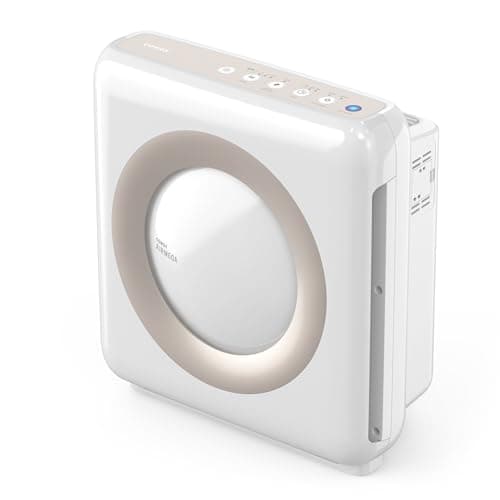
The long-standing benchmark for HEPA air purifiers. A four-stage system — pre-filter, deodorizing activated-carbon filter, True HEPA, and an optional ionizer — pulls mold spores, pollen, and musty odor out of rooms up to 1,748 sq ft. The pollution sensor ramps the fan when spore counts spike (say, right after you disturb growth during cleanup), then idles down in Eco mode. Independent testing sites have ranked it a top performer for years.
Pros
- True HEPA captures 99.97% of particles down to 0.3 microns — well below mold spore size
- Dedicated activated-carbon layer handles the musty VOCs HEPA can't
- Covers up to 1,748 sq ft; air-quality sensor auto-adjusts fan speed
Cons
- Ionizer mode is on by default — turn it off (produces trace ozone, no mold benefit)
- Replacement filter sets run ~$40–60 a year
- No app control on the base model
We rank the leading units against exactly these criteria — true HEPA, CADR by room size, and carbon for odor — in our best air purifier for mold roundup, with a specific pick for bedrooms, basements, and post-remediation cleanup. For a large basement or an open floor the bigger-CADR Levoit Core 400S is the one to size up to:
LEVOIT Core 400S Smart True HEPA Air Purifier
Levoit
$190–240
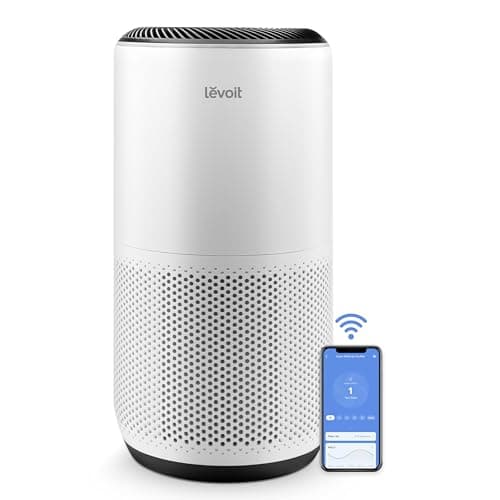
Levoit's large-room workhorse. The 360-degree intake and H13 HEPA move a lot of air — enough to cycle a 1,733 sq ft basement several times an hour on high — and the VeSync app surfaces a real PM2.5 number so you can watch spore-laden dust drop after you clean. Pair it with a dehumidifier and it's the closest thing to a permanent air-quality fix for a chronically damp lower level.
Pros
- Rated for large open spaces up to 1,733 sq ft — good for basements and finished lower levels
- H13 True HEPA plus a high-capacity activated-carbon layer for musty basements
- App shows a live PM2.5 reading and lets you schedule/auto-run 24/7
Cons
- Filter is a single combined unit — the whole thing gets replaced (~$50 every 6–8 months in a damp space)
- Physically large; not a discreet bedroom unit
- Wi-Fi setup can be finicky on 5 GHz-only networks
The gotcha nobody warns you about: your purifier can become the mold source
Here's the expert detail that almost no buying guide mentions. A HEPA filter is a mat of fibers that collects organic dust and — in a humid room — holds moisture. That is a growth surface. Run a purifier in a damp basement and neglect the filter, and spores it captured can colonize the filter itself, at which point your "mold air purifier" is quietly blowing mold-laden air around the room. Three rules keep that from happening:
- Keep the room under 60% relative humidity. A purifier and a dehumidifier are a team, not alternatives — the dehumidifier protects the filter as much as it protects the room.
- Replace HEPA filters on schedule(typically every 6–12 months, sooner in a mold-heavy space), and don't try to wash a true-HEPA filter — wetting it wrecks the fiber structure.
- Don't run it in a closed, unremediated damp room for weeks on end as a substitute for fixing the leak. You're just force-feeding the filter.
Purifier or dehumidifier — which first?
If you can only buy one thing right now and the mold keeps coming back, buy the dehumidifier. Mold needs moisture to grow; drying the air below 60% RH attacks the cause, while the purifier only manages a symptom (airborne spores). The purifier is what you add once the humidity's under control and you want to clear the air you breathe — especially if anyone in the home reacts to mold. The two together, in a room you've actually cleaned, is the setup that holds. One without moisture control is a filter fighting a losing battle.
Frequently Asked Questions
Does an air purifier get rid of mold?
Do air purifiers help with the musty mold smell?
What size air purifier do I need for mold?
Can a mold air purifier make mold worse?
Air purifier or dehumidifier for mold — which first?
Related Articles
Best Air Purifiers for Mold Spores & Musty Odors (2026)
Best Dehumidifiers for Mold Prevention & Removal (2026)
What Does Mold Smell Like? How to Identify Mold by Smell
Musty Smell in House? Here's How to Find & Fix the Source
How to Get Rid of Mold in Your Basement (2026 Guide)
How to Test for Mold at Home: DIY Methods That Actually Work
Dealing With Mold Right Now?
Our step-by-step mold removal guide walks you through testing your home, choosing the right products, and knowing when a job is too big for DIY.
Read the Removal Guide