Best Air Purifier for Mold and Dust: One Machine for Both (HEPA Picks by Room Size)
Out of the Mold Editorial Team
Our guides are research-backed and cite EPA, CDC, and peer-reviewed sources. Product reviews are based on hands-on testing, not manufacturer claims. Read our editorial standards.
Affiliate Disclosure: Out of the Mold is reader-supported. As an Amazon Associate, we may earn a commission when you buy through links on this page — at no extra cost to you. Our picks are based on independent standards, manufacturer specifications, and published research, not commissions.
Key Takeaways
- One True HEPA purifier covers both mold spores and dust — they're the same filtration job, no special 'mold and dust' machine needed.
- The pre-filter is what changes for a dusty home: a washable one (like the Coway's) carries the dust load and protects the HEPA, cutting your ongoing filter cost.
- Insist on True HEPA / H13, a real activated-carbon layer for the musty smell, and a smoke CADR of at least two-thirds the room's square footage.
- A purifier clears airborne spores and dust but can't kill mold on surfaces or fix moisture — the EPA says air cleaners 'do not address the cause of mold.' Dry the room to 30–50% RH and remove the growth first.
- For a whole floor, two right-sized units beat one giant one; a persistent whole-home musty smell is a moisture-and-remediation problem, not a purifier problem.
Yes — one True HEPA air purifier handles both mold spores and household dust. You don't need a special "mold and dust" machine. Both are particles a HEPA filter is built to trap, so the two problems are really one filtration job. What actually decides the result is the thing most buying guides skip: the pre-filter, which carries the dust load and protects the expensive HEPA, and matching the unit's CADR to your room. Get those two right and you're done.
A True HEPA filter removes at least 99.97% of airborne particles at 0.3 microns — the single hardest size to catch — per the EPA's definition of a HEPA filter. Mold spores and fine household dust are both bigger than that, so a single HEPA unit covers both without any mold-specific gimmick. The catch isn't the HEPA — it's how fast a dusty home chews through filters, which is the part no "best air purifier" list prices out. That's where this guide spends its time.
The pre-filter is the part that changes for a dusty home
Every multi-stage purifier pulls air through a mesh or fabric pre-filter before it hits the HEPA. In a home with pet dander, a renovation underway, or an allergy sufferer kicking up dust, that pre-filter is doing most of the visible work — it catches the lint, hair, and coarse dust that would otherwise blind the HEPA in weeks. The HEPA behind it then handles the fine stuff: the mold spores and the sub-micron dust that makes you sneeze, all of it larger and finer around the 0.3-micron size the filter is tested against.
So the dust-home decision isn't a different filter— it's a different habit. Pick a unit with a washable or vacuum-able pre-filter and clean it every few weeks, and the HEPA lasts its full rated life. Ignore the pre-filter and a dusty room will have you replacing the HEPA two or three times as often, which is the real cost of a mold-and-dust home. Keep that in mind before you fall for a sealed, no-pre-filter "mold" unit — those exist, and they're a maintenance trap in exactly the homes buying this.
One more thing the pre-filter won't fix: the musty smell. That odor is a gas, and the EPA notes most filters "are designed to filter either particles or gases," so a HEPA-only stack does nothing to it. If a damp, musty smell rides along with your dust problem, buy a unit with a real activated-carbon layer — the picks below all have one. (More on why mold smells the way it does in what mold actually smells like.)
The picks, by room size
These are the same True-HEPA-plus-carbon units we rank in the main air purifier for mold roundup, chosen here for the combined mold-and-dust job: strong pre-filters, real carbon for odor, and CADR you can size to a room. Prices are editorial ranges — check the listing for today's price.
| Product | Rating | Price | Best For | Link |
|---|---|---|---|---|
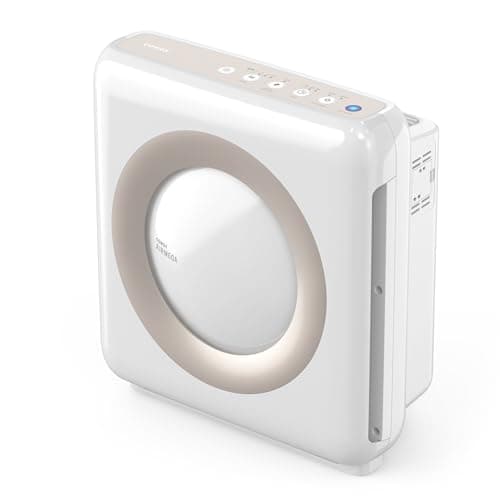 Coway Airmega AP-1512HH True HEPA Air Purifier Coway Best all-round for a mold-and-dust room | $200–260 | Most homes — the all-around best HEPA + carbon purifier for mold spores and odor | View | |
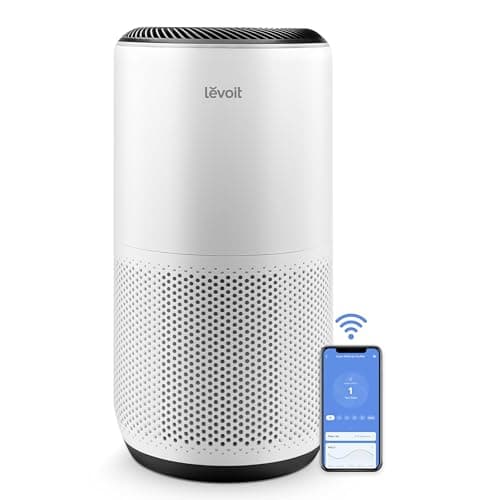 LEVOIT Core 400S Smart True HEPA Air Purifier Levoit Best for basements & large/dusty rooms | $190–240 | Basements and large rooms where you want a live spore/PM2.5 reading and set-and-forget scheduling | View | |
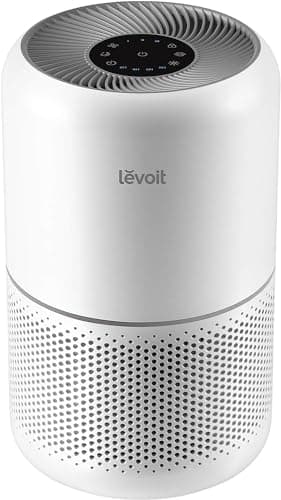 LEVOIT Core 300 True HEPA Air Purifier Levoit Budget bedroom pick | $80–100 | Bedrooms, nurseries, and small offices — the budget pick for one room | View | |
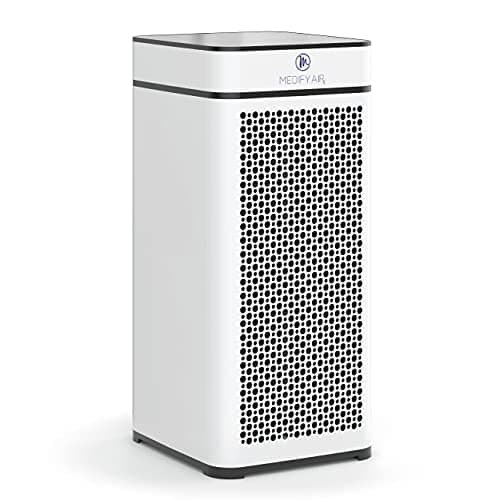 Medify MA-40 Medical-Grade H13 HEPA Air Purifier Medify Max spore capture, sensitive households | $200–260 | Running alongside or right after active mold remediation, when you want maximum spore capture | View |
For most people — a living room or main bedroom with some dust and a mold worry — the Coway is the one to buy. It has a genuine pre-filter, a dedicated carbon layer, and a particle sensor that ramps the fan when dust or spores spike (useful the moment you start cleaning):
Coway Airmega AP-1512HH True HEPA Air Purifier
Coway
$200–260
The long-standing benchmark for HEPA air purifiers. A four-stage system — pre-filter, deodorizing activated-carbon filter, True HEPA, and an optional ionizer — pulls mold spores, pollen, and musty odor out of rooms up to 1,748 sq ft. The pollution sensor ramps the fan when spore counts spike (say, right after you disturb growth during cleanup), then idles down in Eco mode. Independent testing sites have ranked it a top performer for years.
Pros
- True HEPA captures 99.97% of particles down to 0.3 microns — well below mold spore size
- Dedicated activated-carbon layer handles the musty VOCs HEPA can't
- Covers up to 1,748 sq ft; air-quality sensor auto-adjusts fan speed
Cons
- Ionizer mode is on by default — turn it off (produces trace ozone, no mold benefit)
- Replacement filter sets run ~$40–60 a year
- No app control on the base model
If the problem is a big, dusty, finished basement or an open main floor, size up to the Levoit 400S. It's rated for large spaces and shows a live PM2.5 number in the app, so you can actually watch the dust and spore load fall after you run it — the closest thing to proof the machine is earning its keep:
LEVOIT Core 400S Smart True HEPA Air Purifier
Levoit
$190–240
Levoit's large-room workhorse. The 360-degree intake and H13 HEPA move a lot of air — enough to cycle a 1,733 sq ft basement several times an hour on high — and the VeSync app surfaces a real PM2.5 number so you can watch spore-laden dust drop after you clean. Pair it with a dehumidifier and it's the closest thing to a permanent air-quality fix for a chronically damp lower level.
Pros
- Rated for large open spaces up to 1,733 sq ft — good for basements and finished lower levels
- H13 True HEPA plus a high-capacity activated-carbon layer for musty basements
- App shows a live PM2.5 reading and lets you schedule/auto-run 24/7
Cons
- Filter is a single combined unit — the whole thing gets replaced (~$50 every 6–8 months in a damp space)
- Physically large; not a discreet bedroom unit
- Wi-Fi setup can be finicky on 5 GHz-only networks
For a single bedroom or a nursery where you just want clean air to sleep in, the Levoit Core 300 is the budget pick — quiet enough to sit next to and cheap to re-filter, which matters more than it sounds for a dust-heavy room (see the next section). And if someone in the house reacts hard to dust and mold, the Medify MA-40's medical-grade H13 filter and sealed housing push for maximum capture:
LEVOIT Core 300 True HEPA Air Purifier
Levoit
$80–100
The default single-room budget purifier. For a bedroom where mold spores or a faint musty smell are the concern, the Core 300's H13 HEPA and carbon pre-filter clean the air about five times an hour and it's quiet enough to sleep next to. Don't ask it to cover more than one closed room — size up to the Core 400S or Coway for anything larger.
Pros
- H13 True HEPA in an affordable, compact body
- Whisper-quiet on low (24 dB) — genuinely bedroom-friendly
- Cheap, widely stocked replacement filters
Cons
- Small coverage — roughly 219 sq ft at proper turnover
- No sensor or app on the standard Core 300
- Not enough for a basement or open floor plan
Medify MA-40 Medical-Grade H13 HEPA Air Purifier
Medify
$200–260
The MA-40 leans on a medical-grade H13 filter and a genuinely sealed housing — the detail that separates a purifier that filters air from one that leaks dusty air around a loose filter. It moves enough air to turn over a large room hourly, which is what you want during and just after remediation when spore counts are elevated. Skip the pricier UV-C version: for mold, a properly sealed HEPA does the work.
Pros
- H13 medical-grade HEPA (a tighter grade than standard True HEPA)
- High turnover — rated to clean 1,793 sq ft in about an hour
- Simple sealed design with a real gasket, so unfiltered air doesn't leak around the filter
Cons
- No air-quality sensor on the base model — you set the speed manually
- Filters are proprietary and mid-priced
- UV-equipped versions cost much more for little proven mold benefit
Size it with the working rule the roundup uses: pick a unit whose smoke CADR is at least two-thirds of the room's square footage, then size up for a dusty or moldy space because the particle source is continuous. An underpowered unit in a big room runs all day and never catches up.
Why one HEPA covers two problems — and what it can't
It helps to see the machine doing two jobs at once. Household dust is a mix of skin cells, fabric fibers, pet dander, and outdoor soil — most of it coarse enough that the pre-filter grabs it, with a fine fraction the HEPA finishes. Mold spores are a narrower target — comfortably larger than the 0.3-micron particle HEPA is certified against — so they land squarely in its range. Same filter, same airflow, both captured. That's the whole reason you don't need two appliances.
What a purifier can't do is the part the marketing blurs. The EPA is blunt about it: portable air cleaners "do not address the cause of mold and musty odors." A purifier pulls spores and dust out of the air; it does nothing to mold growing on drywall, grout, or an AC coil, and nothing to the moisture feeding it. Run one next to active mold and the colony refills the air faster than the filter clears it. So the order is: fix the leak, dry the room below 50% relative humidity (the EPA says "keep indoor humidity below 60 percent, ideally between 30 and 50 percent"), remove the growth, thenlet the purifier mop up what's airborne. A dehumidifierdoes the moisture half of that job; the purifier can't. If you're still deciding whether a purifier even belongs in your plan, start with does a mold air purifier actually work, and for the black-mold-specific case see do air purifiers help with black mold.
Skip the ozone side of the aisle entirely. The EPA says ozone generators sold as air cleaners "intentionally produce the gas ozone" and "no federal government agency has approved these devices for use in occupied spaces" — ozone is a lung irritant, the last thing an allergy household needs. Leave any ionizer mode off, too; on the Coway it's on by default.
The ongoing cost a dusty home actually pays
This is the number the roundups leave out, and in a dust-and-mold home it's the one that bites. The HEPA's rated life assumes an average room. A home with pets, carpet, or a damp basement loads the filters faster, so you replace them sooner — and the sticker price tells you nothing about that. Here's how the four picks compare on the part that recurs:
| Unit | Pre-filter buffer | Maker-rated filter life | In a pet / dusty home |
|---|---|---|---|
| Coway AP-1512HH | Separate pre-filter — clean every 2–4 weeks | HEPA ~12 mo, carbon ~6 mo | Coway says ~8–10 months for the HEPA with pets or heavy dust |
| Levoit Core 300 | Built into the combined filter | ~6–8 months | Levoit says ~4–6 months in a pet household; cheapest to re-filter |
| Levoit Core 400S | Combined unit (vacuum it) — no cheap buffer | ~6–12 months | No separate pre-filter to sacrifice, so budget for sooner swaps |
| Medify MA-40 | Sealed H13 filter, no washable stage | Replace on Medify's schedule | Sealed design captures more but has no pre-filter to extend HEPA life |
Filter-life figures are the manufacturers' own ratings (Coway and Levoit, checked October 2026) for roughly 8–12 hours of daily use; your own run time and air quality shift them. Confirm the current filter price on each listing before you buy.
The takeaway is a habit, not a product: in a dusty home, a purifier with a separatepre-filter (the Coway here) tends to cost the least to run, because you clean a mesh screen every couple of weeks instead of buying HEPA early. If you're chasing dust from pets or a renovation, that maintenance detail matters more than a $30 gap in the sticker price.
When one machine isn't enough
A single purifier covers a single room well. Dust and mold don't respect doorways, though, so if your problem spans a whole floor you have a choice: one oversized unit in the main living space, or a cheap bedroom unit (the Core 300) per room plus one larger unit for the shared area. Two right-sized units usually beat one giant one — they put clean air where people actually breathe, and a closed bedroom door turns a small purifier into a very effective sealed box.
The exception is a persistent whole-home musty smell, which points at a source — a damp basement, an HVAC problem — that no number of purifiers fixes. That's a moisture-and-remediation job first. If a musty smell keeps coming back after you clean, track it down with why your house smells musty before you buy another machine. And if the dust is settling on surfaces as much as it's floating, a purifier won't touch that — a HEPA vacuumis the tool for dust you can see, the purifier for the dust you can't.
If you run a unit with a live reading, watch the PM2.5 number the first week: it should drop within an hour of switching on and stay low with the doors shut. If it doesn't, the room's too big for the unit, a filter's overdue, or there's an active source still feeding the air — and that's worth chasing down before you blame the machine. Reacting to dust and mold even with the purifier running usually means a mold allergywith a source still in the house, not a purifier that's failing.
Frequently Asked Questions
Can one air purifier handle both mold and dust?
Do I need a special 'mold and dust' air purifier?
True HEPA vs 'HEPA-type' — does it matter for dust and spores?
What size air purifier do I need for a dusty, moldy room?
Related Articles
Best Air Purifiers for Mold Spores & Musty Odors (2026)
Mold Air Purifier: Does It Work, and When Is It Worth It?
Do Air Purifiers Help With Black Mold? What They Can and Can't Do
Mold Allergy & Exposure Symptoms: What the Evidence Actually Shows
Best Dehumidifiers for Mold Prevention & Removal (2026)
HEPA Vacuum for Mold: Why a Regular Vacuum Makes It Worse
Dealing With Mold Right Now?
Our step-by-step mold removal guide walks you through testing your home, choosing the right products, and knowing when a job is too big for DIY.
Read the Removal Guide