Mold in Your Apartment? Your Rights, Removal & What Your Landlord Owes You
Out of the Mold Editorial Team
Our guides are research-backed and cite EPA, CDC, and peer-reviewed sources. Product reviews are based on hands-on testing, not manufacturer claims. Read our editorial standards.
Affiliate Disclosure: Out of the Mold is reader-supported. As an Amazon Associate, we may earn a commission when you buy through links on this page — at no extra cost to you. Our picks are based on independent standards, manufacturer specifications, and published research, not commissions.
Key Takeaways
- Mold in a rental is usually the landlord's responsibility because it traces to a moisture defect they control under the implied warranty of habitability (which varies by state).
- Document and report in writing before you clean — a dated paper trail protects you if it escalates.
- Clean only small (<10 sq ft) areas on non-porous surfaces; never paint over mold or cut into drywall in a unit you don't own.
- The CDC does not recommend routine mold testing; if you can see it, focus on removal and the moisture source.
- Renters control humidity: a portable dehumidifier, moisture absorbers, and running the bath fan do more than repeated cleaning.
In most cases mold in a rental is the landlord's problem to fix, because it almost always traces back to a moisture issue — a leak, bad ventilation, a failing seal — that the landlord controls under the implied warranty of habitability recognized in most states. Your job as a renter is narrower: document it, report it in writing, clean only the small areas you safely can without damaging a unit you don't own, and control the moisture you do control. What you should not do is quietly scrub it, paint over it, or cut into the wall — that can cost you your deposit and let a landlord argue you caused it.
Is Your Landlord Responsible for the Mold?
This is the question renters actually search, so start here. The general principle — not legal advice, and it varies by state — is that most states recognize an implied warranty of habitability: a landlord has to keep the unit fit to live in, which includes repairing the leaks, roof failures, and ventilation problems that let mold grow. When mold comes from a building defect the landlord is responsible for, fixing both the mold and its moisture source is usually their duty, not yours.
The line moves when the moisture is something the tenant caused:
- Usually the landlord's duty: a plumbing or roof leak, a window or foundation that lets water in, a bathroom with no working exhaust fan, mold that was there when you moved in.
- Can shift to the tenant: mold from a leak you noticed and never reported, never using the bath fan, drying laundry indoors with no ventilation, or blocking vents.
The practical takeaway: the faster you report moisture in writing, the harder it is for anyone to argue you caused the mold by neglect. For the official, non-legal baseline on mold and your home, the EPA's mold guide and your local health department are the right references — and for a question about yourstate's tenant law, a local tenant union or legal-aid office, not a mold website.
Document It Before You Touch It
The single most useful thing you can do the day you spot mold is build a record, because if this escalates, the paper trail is what protects you.
- Photograph and date everything — the mold, the water stain, the location, and anything damaged (clothes, furniture).
- Report it in writing.Email or a dated letter, not a text or a hallway conversation. State where it is, that you're requesting repair, and ask for a written response.
- Keep a timeline.When you first noticed it, when you reported it, and every reply (or non-reply). Dates matter more than you'd think.
What a Renter Can Safely Clean — and What to Leave Alone
If it's a small patch, you can clean it yourself while you wait on the landlord — but stay inside the lines so you don't damage the unit or make the problem worse. The EPA's rule of thumb: if the moldy area is less than about 10 square feet (roughly a 3-by-3-foot patch), in most cases you can handle it yourself. Bigger than that, or into the wall cavity, is the landlord's (and a professional's) job.
What a renter can do safely:
- Wipe mold off non-porous surfaces — tile, glass, sealed countertops, the bathroom ceiling — with a detergent or an EPA-registered cleaner.
- Follow the surface-specific methods in our guides to removing shower mold, bathroom ceiling mold, and what vinegar can and can't do.
What NOT to do in a unit you don't own:
- Don't paint over it. It comes back through the paint and signals a cover-up — bad for you if the landlord later claims you hid damage.
- Don't cut into drywallor pull up flooring. That crosses from cleaning into alteration, and it's the landlord's repair to make.
- Don't reach for bleach on porous walls.The EPA doesn't recommend routine biocide use, and bleach doesn't fix drywall. See why bleach is usually the wrong call.
Concrobium Mold Control
Concrobium
$10–15
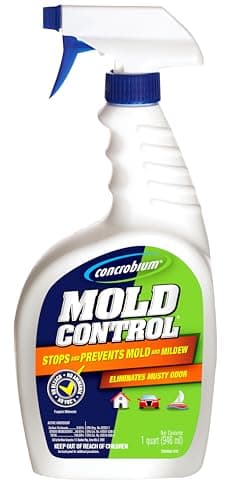
A patented, EPA-registered mold control solution that kills mold without bleach, ammonia, or VOCs. The tri-salt polymer formula crushes mold spores as it dries and leaves an invisible antimicrobial barrier to prevent regrowth. Safe for indoor use on virtually any surface.
Pros
- Non-toxic, no bleach or ammonia
- Kills mold and prevents regrowth
- Safe for use around children and pets
Cons
- Does not remove existing mold stains
- Takes longer to work than bleach-based products
- May require multiple applications for severe infestations
If the Landlord Won't Fix It
When written requests go nowhere, renters generally have an escalation ladder — but what's actually available to you depends heavily on your state and city, so treat this as "things that exist, go confirm locally," not as advice:
- A formal written demand with a deadline and your documentation attached.
- A complaint to your local health department or housing/code enforcement office, which can inspect and cite the unit.
- State-specific remedies that may or may not apply where you live — rent escrow, repair-and-deduct, or breaking a lease for uninhabitability. A local tenant union or legal-aid clinic can tell you which exist in your jurisdiction.
Where Apartment Mold Hides
Apartments concentrate moisture in predictable spots. If you find it in one, check the rest — and each of these has a dedicated walkthrough:
- Bathroom — the shower and grout, the ceiling, and under the sink.
- Kitchen — under the sink and behind the fridge where condensation collects.
- Windows and sills where condensation pools, and closets on exterior walls with no air movement.
- HVAC vents and the wall behind furniture pushed tight to a cold outside wall.
Preventing Mold in a Rental (What You Control)
You can't re-plumb the building, but a renter controls the humidity side completely — and that's usually where the fight is won. The EPA's target is keeping indoor humidity below 60%, ideally 30–50%. Gear that works in a rental is portable, needs no installation, and leaves with you:
DampRid Hanging Moisture Absorber (3-Pack)
DampRid
$12–18
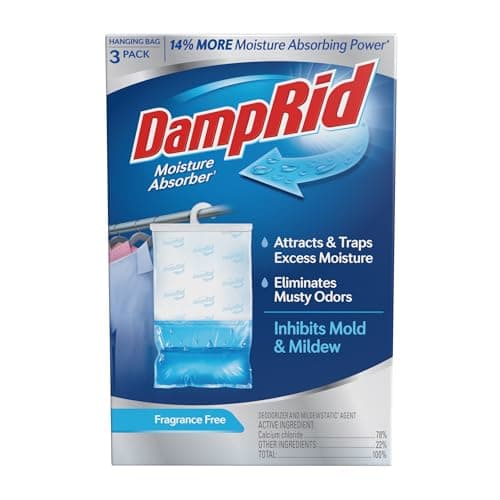
Passive calcium-chloride moisture absorbers that hang from a closet rod and pull humidity out of enclosed spaces without power. They won't fix a damp basement, but inside a closet, wardrobe, or stored vehicle they keep trapped air dry enough to stop mildew on clothes, leather, and linens. Each bag lasts roughly 45-60 days before the crystals fully dissolve.
Pros
- No electricity needed — works anywhere you can hang it
- Calcium chloride crystals absorb moisture for up to 60 days each
- Fragrance-free version won't add perfume to enclosed spaces
Cons
- Cannot meaningfully lower whole-room humidity
- Bags must be replaced once the crystals dissolve
- Collected brine must be handled carefully when disposing
Pro Breeze Electric Mini Dehumidifier
Pro Breeze
$35–50
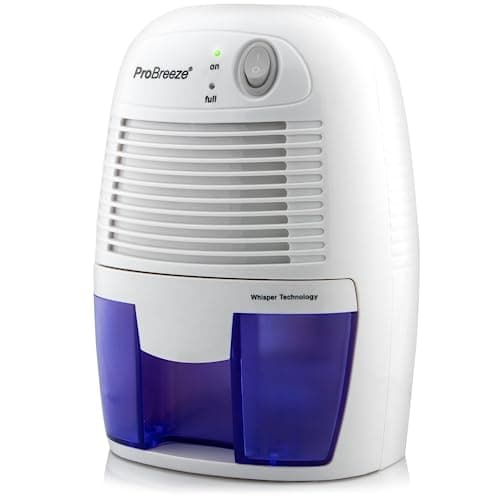
A compact thermoelectric (Peltier) dehumidifier for small enclosed spaces prone to condensation and musty smells. It won't dry out a basement, but for a windowless bathroom, closet, or boat cabin it quietly pulls enough moisture to keep surfaces below the humidity mold needs. No compressor means near-silent operation and low power draw.
Pros
- Whisper-quiet thermoelectric design with no compressor
- Small footprint fits bathrooms, closets, and RVs
- Auto shut-off with indicator when the tank is full
Cons
- Only effective in small spaces up to ~215 sq ft
- Thermoelectric units lose effectiveness below about 59°F
- 17-ounce tank needs frequent emptying in damp rooms
- Run the bathroom fanduring and 30 minutes after every shower. If there isn't one, that's a repair worth putting in writing.
- A small portable dehumidifier in the dampest room, or a larger oneif a whole unit runs humid. Moisture absorbers like DampRid handle closets and cabinets where a plug isn't practical.
- A HEPA air purifier for the airborne-spore and musty- air side — renter-friendly because it just plugs in.
- Report leaks the day you see them, and do a photo walkthrough at move-in so pre-existing damage is on record.
LEVOIT Core 300 True HEPA Air Purifier
Levoit
$80–100
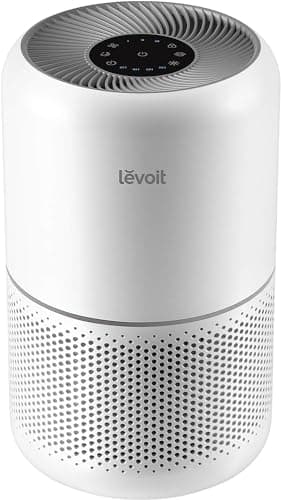
The default single-room budget purifier. For a bedroom where mold spores or a faint musty smell are the concern, the Core 300's H13 HEPA and carbon pre-filter clean the air about five times an hour and it's quiet enough to sleep next to. Don't ask it to cover more than one closed room — size up to the Core 400S or Coway for anything larger.
Pros
- H13 True HEPA in an affordable, compact body
- Whisper-quiet on low (24 dB) — genuinely bedroom-friendly
- Cheap, widely stocked replacement filters
Cons
- Small coverage — roughly 219 sq ft at proper turnover
- No sensor or app on the standard Core 300
- Not enough for a basement or open floor plan
For the full prevention picture — why humidity control beats repeated cleaning — see our best air purifiers for mold roundup and the musty smell in the house walkthrough, which is where a lot of renters start before they ever find visible mold.
Frequently Asked Questions
Can I break my lease because of mold?
Who pays for mold testing — me or my landlord?
Is apartment mold an emergency?
Can renters use a dehumidifier to stop mold?
Related Articles
Best Dehumidifiers for Mold Prevention & Removal (2026)
Best Air Purifiers for Mold Spores & Musty Odors (2026)
How to Remove Mold from Your Shower (Step-by-Step)
How to Remove Mold from Your Bathroom Ceiling (And Keep It Gone)
Mold in Your Closet: Causes, Removal & Prevention
Mold Under Sink: How to Remove It and Stop Leaks for Good
Dealing With Mold Right Now?
Our step-by-step mold removal guide walks you through testing your home, choosing the right products, and knowing when a job is too big for DIY.
Read the Removal Guide