Mold on Subfloor: Treat, Encapsulate, or Replace?
Out of the Mold Editorial Team
Our guides are research-backed and cite EPA, CDC, and peer-reviewed sources. Product reviews are based on hands-on testing, not manufacturer claims. Read our editorial standards.
Affiliate Disclosure: Out of the Mold is reader-supported. As an Amazon Associate, we may earn a commission when you buy through links on this page — at no extra cost to you. Our picks are based on independent standards, manufacturer specifications, and published research, not commissions.
Key Takeaways
- It's a three-way call: treat surface stains on sound wood, encapsulate deep stains on firm wood, replace soft/rotted/widespread mold.
- Probe with a screwdriver and read a moisture meter before deciding — you can't treat or seal wet or structurally failed wood.
- Treating is a ~$100–$300 DIY job; replacement runs $428–$2,978 (Bob Vila 2026), mostly the flooring on top, not the wood itself.
- If the subfloor is moldy, check the joists underneath — a soft or sagging joist is structural and not a DIY fix.
- Every option fails unless the water source is fixed first and the space is held under 60% RH.
Mold on a subfloor comes down to one call: treat it, encapsulate it, or rip it out. Treat in place if the staining is on the surface only and the plywood is still hard and sound. Encapsulate if the stain has soaked deep but the wood is structurally fine. Replace it if the wood is soft, crumbling, or delaminating, if mold covers more than about a quarter of the area, or if it keeps coming back after you've treated it. The decision isn't cosmetic — a treat job is a weekend and a couple hundred dollars in materials, while a full replacement runs into the thousands. And none of it holds unless you fix the water first.
Most people meet their subfloor the hard way — pulling up carpet that always smelled musty, or lifting a warped board — and find dark staining on the plywood or OSB underneath. Subfloor mold is more serious than mold on a wall for one reason: the subfloor is structure. It carries the floor you walk on, so "is the wood still strong?" is a real question, not a cosmetic one, and the answer decides whether you're spending $200 or $2,000. Here's how to make that call before you spend either.
Is it mold, and how deep does it go?
First, confirm you're looking at mold and gauge how far it's gotten. The signs that bring people here:
- A musty, earthy smell the moment the floor covering comes up
- Dark gray, green, or black staining on the plywood or OSB
- Soft, spongy, or springy spots when you press or walk on it
- Flooring above that cupped, warped, or buckled
- Wood that flakes apart in layers (plywood delaminating)
The difference between a treat job and a replace job is depth and strength, and there are two cheap tests for it. First, press and probe: push a screwdriver into the stained wood. If it's firm and the tip barely dents it, the wood is structurally sound. If it sinks in, or the wood is soft and mealy, the mold (or rot behind it) has eaten the structure and no amount of primer brings that back — that's a replace. Second, a pinless moisture meter tells you whether it's still wet, which matters because you cannot treat or seal wet wood— it just re-grows. Compare a reading on the stained area to a reading on dry subfloor of the same material; you want them to match before you do anything. The EPA's baseline rule is that "if wet or damp materials or areas are dried 24-48 hours after a leak or spill happens, in most cases mold will not grow" — the corollary is that wood left wet for weeks under carpet is exactly why you're here.
Klein Tools ET140 Pinless Moisture Meter
Klein Tools
$45–60
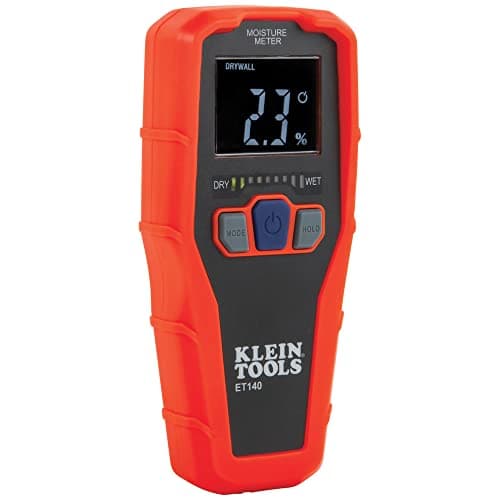
A professional-grade pinless moisture meter that detects hidden moisture in drywall, wood, and masonry without leaving holes. Uses electromagnetic sensor technology to measure moisture content up to 3/4 inch below the surface. Essential for identifying moisture problems before mold develops.
Pros
- Non-invasive pinless technology, no holes in walls
- Detects moisture up to 3/4 inch deep
- Visual and audible moisture alerts
Cons
- Less precise than pin-type meters on exact moisture percentage
- Battery not included
- Can give false readings on metallic or foil-backed surfaces
So the three-way split, concretely:
| What you find | The call |
|---|---|
| Surface stain only, wood hard, under ~25% of the area | Treat in place |
| Stain soaked through to both sides, but wood still firm | Encapsulate |
| Soft/crumbling wood, delaminating, over ~25% of area, or recurring | Replace |
Gear up before you disturb any of it — grinding into moldy plywood throws spores, and a subfloor job is a confined, dusty space.
3M 8511 N95 Particulate Respirator
3M
$20–30
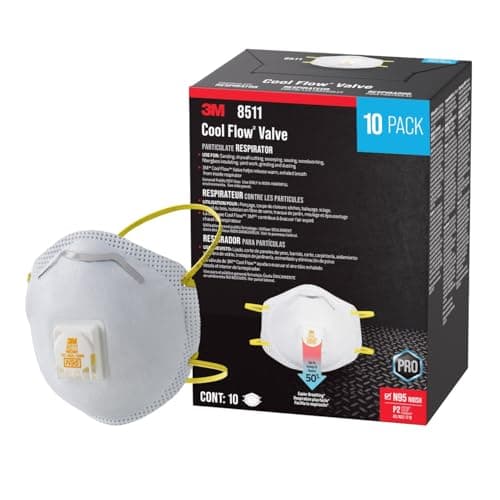
A NIOSH-approved N95 particulate respirator with Cool Flow exhalation valve for comfortable breathing during mold remediation. Filters at least 95% of airborne particles including mold spores. The adjustable M-noseclip and dual-strap design provide a secure seal. OSHA-recommended for mold work.
Pros
- NIOSH-approved N95 filtration
- Cool Flow valve reduces heat buildup
- Adjustable nose clip for secure fit
Cons
- Disposable, not reusable long-term
- Does not protect against chemical fumes or VOCs
- May not fit all face shapes comfortably
Treat it in place
For surface staining on sound wood, this is the cheapest fix and it preserves the floor structure. The sequence:
- Dry it completely first. Fix the water source, then run a dehumidifier and fans until the meter reads the same as dry wood. Skip this and everything below fails.
- Sand or wire-brush the surface growth (N95 on, vacuum as you go with a HEPA vac) to knock the colony off the top layer.
- Prime with a mold-killing primer. A product like Zinsser Mold Killing Primer kills residual spores and lays down a mold-resistant, paintable coat. Skip straight bleach here — on porous wood it mostly drives water in and leaves the surface no more sealed than before (the full argument is in our does bleach kill mold breakdown).
Materials are modest — a can or two of primer (around $18–$25 each), a sanding disc or brush, an N95, and a moisture meter you keep — plus your own labor. This is firmly in DIY territory: it's well under the EPA's ~10-square-foot threshold for what a homeowner can handle. For the full technique on bare wood, our guide to removing mold from wood goes deeper on finished vs. unfinished surfaces.
Zinsser Mold Killing Primer (Quart, 3-Pack)
Zinsser
$55–65 (3 quarts)
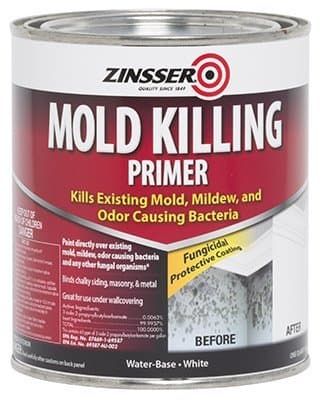
An EPA-registered fungicidal primer that kills existing mold, mildew, and odor-causing bacteria on contact. Creates a mold-resistant barrier on interior and exterior surfaces including drywall, wood, concrete, and masonry. Essential for mold remediation projects before applying topcoat paint.
Pros
- Kills existing mold on contact while priming
- EPA-registered fungicidal protective coating
- Bonds to all interior and exterior surfaces
Cons
- Strong odor during application, requires ventilation
- Water-based formula can raise grain on bare wood
- Must be topcoated with paint for lasting protection
Encapsulate it
The middle option, for when the stain has soaked deep but the wood is still structurally firm — common when a leak sat long enough to discolor the full thickness but not long enough to rot it. You clean and dry as above, then coat the wood in an antimicrobial encapsulant that dries to a sealed film, locking any residual growth in and giving spores nothing to feed on. Products like Concrobium or a dedicated mold sealant are built for this.
Two honest cautions. Encapsulation seals mold in; it doesn't remove it, so it only works if the wood is genuinely sound and bone-dry first. And it fails completely if the moisture source isn't fixed — a sealed film over wood that keeps getting wet just traps water against the structure. Done right, it's a durable fix at a fraction of replacement cost.
Concrobium Mold Control (32 oz Spray, 2-Pack)
Concrobium
$34–40 (2 bottles)
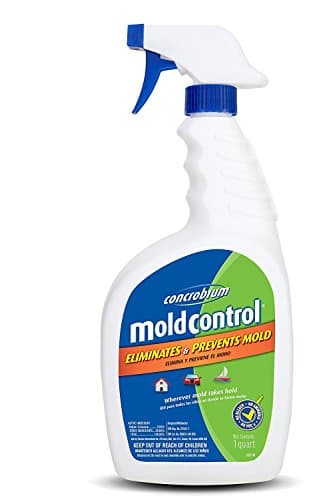
A patented, EPA-registered mold control solution that kills mold without bleach, ammonia, or VOCs. The tri-salt polymer formula crushes mold spores as it dries and leaves an invisible antimicrobial barrier to prevent regrowth. Safe for indoor use on virtually any surface.
Pros
- Non-toxic, no bleach or ammonia
- Kills mold and prevents regrowth
- Safe for use around children and pets
Cons
- Does not remove existing mold stains
- Takes longer to work than bleach-based products
- May require multiple applications for severe infestations
Replace it
When the wood is soft, crumbling, delaminating, or the mold covers a large area — or it keeps returning after treatment — the honest answer is to cut out the affected subfloor and lay in new. You remove the flooring, cut back to solid framing, treat the exposed joists, screw down new plywood or OSB, and reinstall the floor on top.
The good news is that subfloor material itself is cheap. According to Bob Vila's 2026 cost data (retrieved November 2026), replacing a subfloor runs $428 to $2,978, national average around $572, with material costs of $1.30 to $12 per square foot depending on type — plywood lands around $1.50/sq ft and OSB around $1.40/sq ft. Labor adds roughly $25–$30 per hour; a small section is about a half-day, a whole room can run several days. The expensive part is almost never the wood — it's the flooring you have to tear up and relay on top, and any structural work underneath.
That cost math is exactly what our mold removal cost calculator is built to price — it uses sourced Bob Vila and Fixr benchmarks so you walk into a contractor conversation knowing whether you're looking at a few hundred dollars or a few thousand. When a subfloor replacement is part of a bigger wet-basement problem, the whole-room scope is in our basement mold removal guide.
Check the joists before you close it up
This is the step most guides skip, and it's the one that comes back to bite people: if moisture reached the subfloor, it very likely reached the floor joistsunderneath. Pull up enough subfloor to look. Surface mold on a firm joist treats the same way as the subfloor — brush it, prime it, seal it. But a joist that's soft, rotted, or sagging is structural, and that is not a DIY job; a failing joist gets sistered or replaced by someone who knows how to support the load first. Bob Vila puts joist repair at roughly $100 to $2,000 per joist. Don't lay new subfloor over compromised framing — you'll just be doing the whole job again.
Stop it coming back
Every option above is wasted effort if the water that caused it is still there. Before you treat, encapsulate, or screw down a single new sheet:
- Fix the moisture source. A plumbing leak, a failed vapor barrier, groundwater, poor drainage, or carpet laid over concrete with no barrier — find it and fix it first.
- Put a vapor barrier between the ground and the subfloor in a crawl space (see crawl-space vapor barrier and encapsulation).
- Use pressure-treated plywood for any replacement in a moisture-prone spot.
- Hold the space under 60% relative humiditywith a dehumidifier — the EPA's line again. A below-grade room that stays dry doesn't grow mold on its subfloor, full stop.
hOmeLabs 50-Pint Energy Star Dehumidifier
hOmeLabs
$220–260
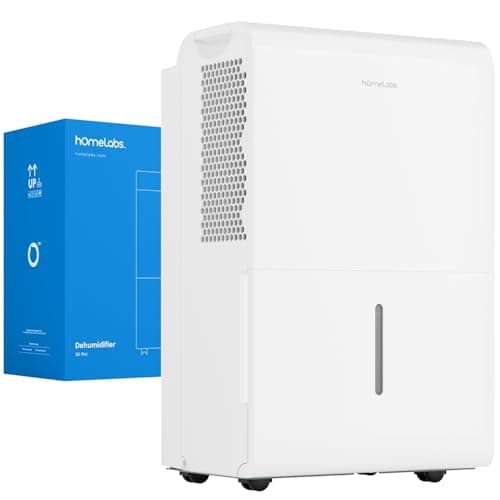
The best-selling 50-pint dehumidifier on Amazon and our top overall pick for mold prevention. Set your target humidity (aim for 45-50%) and the built-in humidistat cycles the compressor to hold it. A rear hose port allows continuous gravity draining into a floor drain, and turbo mode speeds up moisture removal after water events. Energy Star certified to keep 24/7 running costs reasonable.
Pros
- 50-pint capacity handles basements and large rooms up to 4,500 sq ft
- Built-in humidistat holds your target humidity automatically
- Continuous-drain hose port for set-and-forget operation
Cons
- No built-in pump — gravity drain or bucket emptying only
- 1.6-gallon bucket fills every 6-8 hours in very damp spaces
- Fan is audible on turbo mode
Common questions
Can I just paint over mold on a subfloor? Not with ordinary paint — that traps living mold under a film and it keeps growing and spreading underneath. A mold-killing primer is different: it kills the growth as it seals. But both still require the wood to be dry and sound first.
Does subfloor mold always mean replacement? No — replacement is only for soft, rotted, delaminated, or widespread mold. Surface staining on firm, dried wood treats or encapsulates for a fraction of the cost. The screwdriver-probe and moisture-meter tests tell you which.
Does homeowners insurance cover it?It depends entirely on the cause. Sudden, accidental water damage (a burst pipe) is often covered; mold from long-term leaks, humidity, or deferred maintenance usually isn't, and many policies cap mold remediation specifically. Read your policy's mold sub-limit before you assume, and document the source.
Should I use bleach on it? No. On porous wood, bleach leaves the surface wetter and no more sealed; a mold-killing primer or encapsulant is the right chemistry. Our bleach breakdown explains why.
If you discovered this pulling up carpet, check the carpet and pad too — they're usually the thing that held the water against the wood in the first place. That's covered in our mold in carpet guide.
Frequently Asked Questions
Can I just paint over mold on a subfloor?
Does subfloor mold always need to be replaced?
How much does subfloor mold remediation cost?
Does homeowners insurance cover subfloor mold?
Should I use bleach on subfloor mold?
Related Articles
Mold on Wood Floors: Remove It, Refinish, or Replace?
How to Remove Mold from Wood (Without Ruining It)
Mold in Carpet: How to Tell If You Should Save It or Replace It
How to Get Rid of Mold in Your Basement (2026 Guide)
Crawl Space Encapsulation: The Complete Cost & DIY Guide (2026)
How to Test for Mold at Home: DIY Methods That Actually Work
Dealing With Mold Right Now?
Our step-by-step mold removal guide walks you through testing your home, choosing the right products, and knowing when a job is too big for DIY.
Read the Removal Guide