Mold Test for Home: DIY Kits vs. Pro, and When Each Is Worth It
Out of the Mold Editorial Team
Our guides are research-backed and cite EPA, CDC, and peer-reviewed sources. Product reviews are based on hands-on testing, not manufacturer claims. Read our editorial standards.
Affiliate Disclosure: Out of the Mold is reader-supported. As an Amazon Associate, we may earn a commission when you buy through links on this page — at no extra cost to you. Our picks are based on independent standards, manufacturer specifications, and published research, not commissions.
Key Takeaways
- A DIY kit answers 'is there elevated mold here?' for ~$10–$40; a professional test answers 'what species, how much, and where?' for ~$300–$1,000 (Bob Vila: inspection $299–$1,014, average $656).
- Spores are everywhere, so a DIY plate almost always grows something — a positive is a reason to investigate, not a diagnosis. Accurate kits compare indoor vs. outdoor.
- Pick the test by the question you're asking: surface swab for a specific spot, air-pump kit for 'is my air bad?', professional ERMI/air test for species and amount.
- Skip testing entirely if you can see the mold — the EPA says sampling is then unnecessary; just fix the moisture and remove it.
- Go straight to a pro for home purchases, insurance/landlord disputes, health situations, or post-flood growth you can't see.
A DIY kit — from about $15 for a surface test to ~$200 for a whole-house ERMI — answers one question: "is there elevated mold here?" A professional inspection ($300–$1,000) answers the expensive ones: "what species, how much, and where?" Start with a DIY surface or air kit. Pay for a pro only when the result comes back positive and the stakes are high: a home purchase, a health situation, an insurance claim, or a flood. And if you can already see the mold, skip testing entirely — the EPA says so, and the fix is the same either way.
The tell is on the search results page. Under all the kits for sale sits a Reddit thread titled, roughly, "how do I test for mold without paying hundreds?" — and nobody answers it straight, because the honest answer has two halves that have to be said together. Yes, a cheap kit can tell you something real. No, it can't tell you the thing a lab visit tells you. Which half matters depends entirely on whyyou're testing, and that's the question every kit-seller skips so they can sell you the kit.
The accuracy truth no one selling a kit will tell you
Here's the part that reframes everything: a DIY settle plate left open in your house will almost always grow mold. That's not a positive result — it's physics. As the EPA puts it, "molds reproduce by means of tiny spores; the spores are invisible to the naked eye and float through outdoor and indoor air." Spores are everywhere, all the time. So a plate that grows something after 48 hours has told you almost nothing — unless you also ran a control and compared counts, which most people don't.
That's why the single most useful sentence about home mold testing is this: a positive DIY test is a reason to investigate, not a diagnosis.It flags "look harder here," not "you have a mold problem." The kits that are genuinely informative are the ones that compare an indoor sample against an outdoor baseline — because elevated relative to outside is the signal that means something. A plate with no baseline is a mood ring.
The flip side matters just as much. The EPA is blunt that "in most cases, if visible mold growth is present, sampling is unnecessary". If there's a black patch on your bathroom ceiling, you don't need a $250 test to confirm it's mold — you need to fix the moisture and remove it. Save your testing money for the situations where you genuinely can't see what you're dealing with.
The three ways to test, ranked by what you're trying to learn
Don't pick a test by price — pick it by the question you're actually asking. There are three, and they escalate:
| The question you're asking | The test that answers it | Rough cost |
|---|---|---|
| "Is this spot I can see/smell actually active mold?" | DIY surface swab or settle-plate kit | ~$10–$15 + lab fee |
| "Is my air bad — spore counts indoors vs. outdoors?" | DIY air-pump / spore-trap kit (the "air quality mold test") | ~$30–$80 |
| "What species, how much, whole-house, or hidden?" | DIY ERMI dust kit, or a professional inspection + lab | ~$200 DIY · $300–$1,000 pro |
Level one — the surface kit. The cheapest way in. You swab a spot or set a plate, and a lab tells you what grew. Best for confirming whether a specific stain is active mold, not for judging your whole home.
Mold Armor FG500 Do It Yourself Mold Test Kit
Mold Armor
$9–15
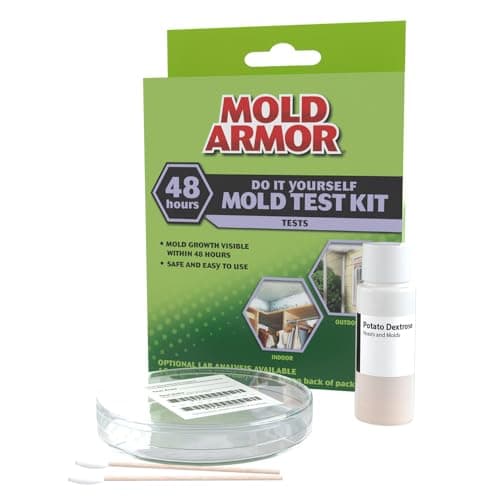
The most popular DIY mold test kit on Amazon. Includes a settling plate, swab, and pre-paid postage for AIHA-accredited lab analysis. The kit detects airborne mold spores and surface mold, identifying species like Aspergillus, Stachybotrys, and Penicillium.
Pros
- Very affordable entry-level test
- Includes petri dish, swab, and postage for lab analysis
- Results identify mold species
Cons
- Lab fee is separate (~$40)
- Takes 5-7 days for lab results
- Only tests one location per kit
Level two — the air kit.This is what people mean by an "air quality mold test." A pump pulls a measured volume of air through a cassette so the lab can count spores, and — done right — you run one indoors and one outdoors so the comparison means something. It's the same methodology a professional uses; the difference is the calibration and the interpretation.
My Mold Detective 2-Room Mold Test Kit
My Mold Detective
$70–80 + $39/sample lab
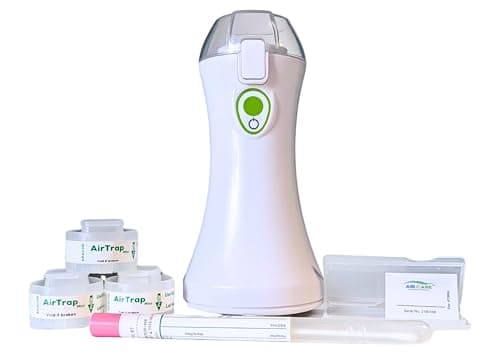
An air sampling kit: the included pump draws a measured volume of air through cassette collectors, and an accredited lab reports which mold genera are present and at what spore concentration — the same method inspectors use. The kit covers two rooms; lab analysis is billed separately at $39 per sample, and samples ship to the lab on a $10 FedEx 2-Day label.
Pros
- Air pump and sampling cassettes included — measures spore counts, not just presence
- Accredited lab identifies 20–30 mold genera, including Stachybotrys (black mold)
- Digital lab report within 3 business days of the lab receiving samples
Cons
- Lab analysis is extra: $39 per sample submitted
- More setup than a settle-plate kit
- Covers two rooms — larger homes need the 4- or 6-room version
Level three — the whole-house DNA test.ERMI analyzes settled dust for the DNA of 36 mold species and scores your whole home against a national reference. It's the most comprehensive consumer option and the most defensible in a dispute — which is why it's the one worth paying for before a purchase or an insurance claim. Our full ERMI breakdown covers what the score actually means, and ERMI vs. an air test walks through which to choose.
ImmunoLytics ERMI Mold Test Kit
ImmunoLytics
$190–220
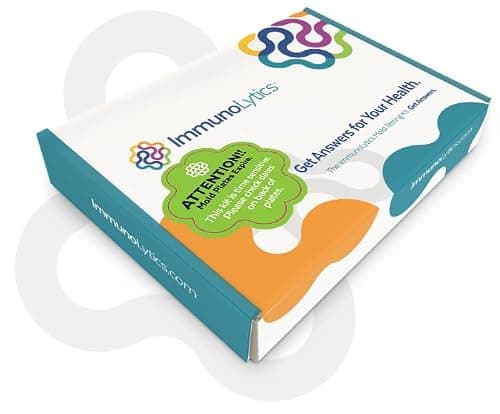
The most comprehensive home mold test available. Uses EPA-developed ERMI methodology with DNA-based MSQPCR analysis to quantify 36 mold species. Generates a standardized Relative Moldiness Index score that compares your home to a national database. Preferred by environmental consultants and real estate inspectors.
Pros
- ERMI (EPA Relative Moldiness Index) is the gold standard
- DNA-based analysis identifies 36 mold species
- Lab analysis included in price
Cons
- Most expensive home test kit
- Results take 7-10 business days
- Requires careful dust collection with included vacuum cassette
If you want the side-by-side of every kit by accuracy and price, that lives on our most-accurate mold test kit guide, and the mold test kit pillarbreaks down each type. This page is the step before that: deciding whether you even need a kit, and which question you're paying to answer.
How to run a DIY test so the result actually means something
Most "my kit was useless" complaints are really "I ran it wrong." Three things separate a result you can act on from a coin flip:
- Always take a control. For an air kit, run one sample outdoors the same day. Indoor spore counts only mean something relativeto what's floating outside — that's the whole method. An indoor-only number is uninterpretable.
- Test where water actually goes, not where it's convenient. The rooms people skip are the ones that matter: behind and under sinks, below windows where condensation runs, the basement, the closet on an exterior wall. If a musty smell sent you here, test the room the smell is strongest in.
- Give it the full window and don't over-read it. Settle plates need 48–72 hours to develop. And remember the baseline problem: a plate growing a few colonies is normal. You're looking for "a lot more than the control," not "anything at all."
One honest limit worth knowing before you spend: no DIY kit finds mold that's sealed inside a wall cavity. For that you're looking for the moisture first — the precondition mold needs — which is why a moisture meter and the behind-the-walls detection ladder often beat a test kit for hidden growth.
What a professional test costs — and when to skip DIY entirely
A professional inspection isn't cheap, and it isn't always worth it. Bob Vila's 2026 cost data puts a professional mold inspection at $299 to $1,014, national average $656, with lab analysis of samples adding roughly $400 to $500 when samples go out for testing. Our mold inspection cost breakdown has the full picture of what that money buys.
So when do you skip the DIY kit and go straight to a pro? Four situations make the math obvious:
- A real-estate transaction. You want a neutral, lab-backed, defensible report — not a petri dish you ran yourself.
- Health is on the line in the household(we don't give medical advice here — see the CDC and EPA — but if symptoms track the house, a professional with calibrated equipment removes the guesswork).
- An insurance claim or a landlord dispute, where you need documentation someone else will accept.
- After a flood or major water event, when growth may be widespread and behind surfaces you can't open.
One thing the pros will tell you that the kits won't: the EPA says "sampling for mold should be conducted by professionals who have specific experience in designing mold sampling protocols, sampling methods, and interpreting results." That isn't a reason to never DIY — it's a reason to treat a DIY positive as a prompt to look closer, and to bring in a pro when the stakes justify the calibration. Whichever route you take, the EPA's one unchanging rule holds: "the key to mold control is moisture control." A test tells you where to look. Finding and fixing the water is still the job.
Frequently Asked Questions
Are home mold test kits accurate?
Should I do a DIY mold test or hire a professional?
What is the best air quality mold test for home use?
Do I need to test if I can already see the mold?
Related Articles
Best Mold Test Kits for Home Use: What Works & What's a Waste of Money (2026)
Which Mold Test Kit Is Most Accurate? DIY Methods Compared
ERMI Mold Test: Cost, Accuracy & When You Actually Need One
ERMI vs Air Test vs HERTSMI-2: Which Mold Test Do You Need?
How Much Does a Mold Inspection Cost? (2026 Price Guide)
Musty Smell in House? Here's How to Find & Fix the Source
Dealing With Mold Right Now?
Our step-by-step mold removal guide walks you through testing your home, choosing the right products, and knowing when a job is too big for DIY.
Read the Removal Guide