Moisture Meter for Mold: Finding Hidden Mold Before You See It
Out of the Mold Editorial Team
Our guides are research-backed and cite EPA, CDC, and peer-reviewed sources. Product reviews are based on hands-on testing, not manufacturer claims. Read our editorial standards.
Affiliate Disclosure: Out of the Mold is reader-supported. As an Amazon Associate, we may earn a commission when you buy through links on this page — at no extra cost to you. Our picks are based on independent standards, manufacturer specifications, and published research, not commissions.
Key Takeaways
- A moisture meter measures moisture, not mold — but moisture is the precondition for mold, so it's the right first tool.
- Mold-risk thresholds (wood-industry convention): ~16% MC on engineered wood, ~19% on solid lumber, sustained; ~28% is saturation.
- Drywall and concrete read on a relative scale — compare a suspect spot to a known-dry area, never trust one absolute number.
- For mold hunting, pinless scanning beats pins: map walls fast with no holes, then confirm a spot. Dual-mode meters do both.
- The meter diagnoses; it doesn't cure. Fix the water source and hold the room under 60% RH with a dehumidifier.
A moisture meter finds moisture, not mold — but since mold can't grow without sustained moisture, an elevated reading is the single best early warning for hidden mold. It won't confirm spores or name a species; what it does is tell you where to look and where to stop guessing. A dry reading on a suspect wall largely clears that spot; a wet one flags where mold is likely starting behind the surface. That's exactly how a pro works a water-damage call — meter first, then open the wall only where the numbers say to.
The top result when people search this is a Reddit thread asking "is a moisture meter enough to determine if mold is present?" — and it goes unanswered honestly, because the honest answer is "no, but it's the right first tool anyway." Those two halves need to be said together. A meter can't see mold. It also can't be fooled by the thing that grows mold: water. Mold needs a sustained damp surface and a food source; take away the moisture and it can't establish. So the meter isn't a mold detector — it's a moisture detector, and moisture is the precondition you can actually measure before anything is visible.
What a reading actually tells you
Think of it as ruling spots in or out rather than diagnosing. A low, known-dry reading on a wall with no leak history is strong evidence that's notwhere your problem is — useful, because it stops you tearing into the wrong wall. A reading that's clearly elevated compared to a dry reference area means water is or was present, which is the condition mold needs. It doesn't prove mold is there yet; it proves the risk is there, and that this is the spot worth a borescope, an air test, or an inspection hole.
The reason pros reach for the meter before anything invasive: moisture is invisible and mold is often behind the surface. The EPA's core mold guidance is that controlling moisture is the whole game — "the key to mold control is moisture control." A meter is how you find the moisture you can't see.
What counts as "too wet" — by material
This is the part the manufacturer manuals bury and the generic roundups skip. A single number means nothing without knowing the material. These thresholds come from wood-science and building-research convention (Home Innovation Research Labs and the restoration industry's wood-moisture scales), not from our own testing — use them as reference ranges, and always compare a suspect spot to a known-dry area of the same material:
| Material | Normal / dry | Investigate | Mold / rot risk |
|---|---|---|---|
| Framing lumber (solid wood) | ~6–12% MC | 13–18% MC | ≥19% MC sustained (saturation ~28%) |
| Plywood / OSB (engineered wood) | <12% MC | 12–15% MC | ≥16% MC sustained |
| Drywall / gypsum | Reads low & even | Elevated vs. a dry reference | Wet to the touch / reads high & climbing |
| Concrete / masonry | Low relative reading | High relative reading | Visibly damp / efflorescence present |
Two caveats that save you from false alarms. First, drywall and concrete don't have a meaningful absolute "moisture percentage" — meters read them on a relative (wood-equivalent) scale, so the reading is only useful in comparison to a dry patch, not as a standalone figure. Second, the wood numbers are about sustainedmoisture: a board that briefly hits 17% after a spill and dries out in a day isn't a mold problem; one that sits at 19%+ for weeks is. For the wall version of this hunt, our detect-mold-behind-walls ladder walks the whole escalation.
Pin vs. pinless — which to buy for mold
Two technologies, and for mold hunting the choice is clearer than most guides admit:
- Pinlessmeters scan a wall with a sensor pad and leave no holes. That's ideal for mold work: you can sweep whole walls, ceilings, and floors fast, mapping where it's damp without putting a single pinhole in finished surfaces. The trade-off is they read a relative value near the surface (typically to ~¾ inch deep) rather than an exact percentage.
- Pin meters push two probes into the material and read actual moisture content at that depth — more precise, but they leave tiny holes and only read where you stick them.
For most homeowners the honest "best for mold" answer is pinless for the hunt— scan fast, no damage, find the wet zone — and a pin reading only to confirm a specific spot. That's why a good value pick is a quality pinless meter, and the upgrade pick is a dual-mode meter that does both. Here's the pinless workhorse first:
Klein Tools ET140 Pinless Moisture Meter
Klein Tools
$45–60
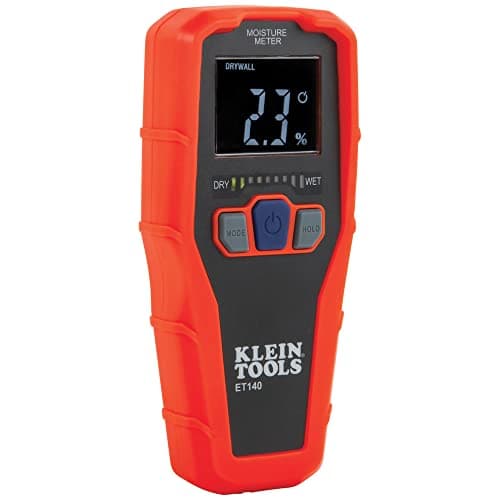
A professional-grade pinless moisture meter that detects hidden moisture in drywall, wood, and masonry without leaving holes. Uses electromagnetic sensor technology to measure moisture content up to 3/4 inch below the surface. Essential for identifying moisture problems before mold develops.
Pros
- Non-invasive pinless technology, no holes in walls
- Detects moisture up to 3/4 inch deep
- Visual and audible moisture alerts
Cons
- Less precise than pin-type meters on exact moisture percentage
- Battery not included
- Can give false readings on metallic or foil-backed surfaces
If you'd rather carry one tool that scans andtakes pin readings — plus reads the room's temperature and humidity, which is the other half of the mold equation — a combination meter is worth the step up:
General Tools MMH800 4-in-1 Pin/Pinless Moisture Meter
General Tools
$95–115
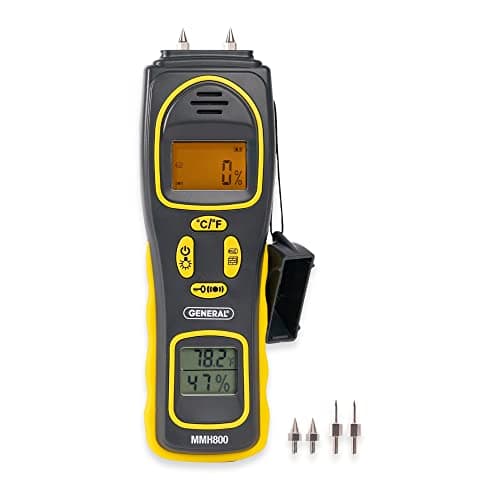
A combination pin and pinless moisture meter that also logs ambient temperature and relative humidity. The pinless pad scans walls without holes to find a damp zone fast; the pins then confirm exact moisture content at depth once you've narrowed it down. The RH reading matters because mold tracks sustained humidity, not just surface moisture — this is the do-everything meter when you'd rather carry one tool than two.
Pros
- Does both: pinless scanning AND pin-depth readings in one tool
- Also reads ambient temperature and relative humidity — the conditions mold needs
- A single device for scanning a wall, then confirming the wet spot
Cons
- Pricier than a single-mode meter — overkill if you only need to scan
- Pin pads/caps are a wear item you'll eventually replace
- More buttons/modes than a beginner needs for one job
How to hunt hidden mold with it
A meter is only as good as where you point it. Work the places water collects, and always establish a baseline on a wall you know is dry so you have something to compare against:
- Under and behind sinks, dishwashers, and the washer. Slow supply-line and drain leaks are the classic source — see mold under the sink.
- Around windows and below sills where condensation runs down, and along baseboards under them.
- Exterior-facing walls and below any past leak — roof, plumbing, or a finished basement wall.
- Behind and beside the toilet and tub surround, the wet-room spots where a meter beats your eyes.
When a spot reads high, don't grab a saw — climb the ladder. An elevated meter reading earns a look with a borescope fed through an outlet box, then an air or ERMI test to confirm spores, and you open the wall last, only where everything points. The payoff is a hand-sized inspection hole instead of exploratory demolition.
Found the moisture — now kill the cause
A meter diagnoses; it doesn't cure. Once you've located the damp zone, the fix is the same one the EPA keeps repeating: eliminate the water source and dry the material below the mold threshold and keep it there. In a chronically damp room — a basement, a laundry, a bath that never fully dries — the standing tool for that is a dehumidifier holding the space under 60% relative humidity, which is also what keeps your meter readings from creeping back up. If the thing that sent you here was a smell rather than a stain, our what mold smells like and musty-smell-in-the-houseguides pair with the meter to pin down a source you can't see.
Frequently Asked Questions
Can a moisture meter detect mold?
What moisture level means mold on wood?
Pin or pinless moisture meter for mold?
What's a normal moisture meter reading on drywall?
Related Articles
How to Detect Mold Behind Walls (Without Tearing Them Down)
Is There a Mold Detector? What Actually Detects Mold in Your Home
Best Dehumidifiers for Mold Prevention & Removal (2026)
Musty Smell in House? Here's How to Find & Fix the Source
What Does Mold Smell Like? How to Identify Mold by Smell
ERMI vs Air Test vs HERTSMI-2: Which Mold Test Do You Need?
Dealing With Mold Right Now?
Our step-by-step mold removal guide walks you through testing your home, choosing the right products, and knowing when a job is too big for DIY.
Read the Removal Guide