Is There a Mold Detector? What Actually Detects Mold in Your Home
Out of the Mold Editorial Team
Our guides are research-backed and cite EPA, CDC, and peer-reviewed sources. Product reviews are based on hands-on testing, not manufacturer claims. Read our editorial standards.
Affiliate Disclosure: Out of the Mold is reader-supported. As an Amazon Associate, we may earn a commission when you buy through links on this page — at no extra cost to you. Our picks are based on independent standards, manufacturer specifications, and published research, not commissions.
Key Takeaways
- There's no consumer 'mold detector' that finds mold like a smoke detector finds smoke — the device you're picturing doesn't exist.
- An 'electronic mold detector' is almost always a moisture meter or air-quality monitor; it reads conditions, not mold.
- The only product that actually detects mold is a test kit — it captures spores for lab ID and costs less than most gadgets.
- For prevention, monitor humidity: mold needs sustained RH above ~60%, and a $12 logging hygrometer flags it early.
- A moisture meter finds the wet spot a leak is feeding; your nose finds the smell — both beat a $30 gadget.
There is no consumer “mold detector” that finds mold the way a smoke detector finds smoke. What's sold as an “electronic mold detector” for $15–$40 is almost always a moisture meter, a hygrometer, or an air-quality monitor — useful for the damp conditions mold needs, but none of them confirm mold or tell you the species. To actually detect mold you use a test kit (captures spores for lab ID) or your nose (that musty smell) plus a moisture reading to find the leak feeding it.
People search for a “mold detector” expecting a gadget they plug into the wall that beeps when mold is present. It's a reasonable thing to assume — we have detectors for smoke, carbon monoxide, and radon, so why not mold? The honest answer, the one none of the product listings will tell you because it costs them a sale, is that the device you're picturing doesn't exist. Mold isn't a single gas with a known signature; it's hundreds of species that release spores intermittently, and no cheap sensor can watch the air and say “that's Aspergillus.” What you can buy falls into four buckets, and it's worth knowing which one you're actually looking at before you spend anything.
The four things people mean by “mold detector”
Search “home mold detector” and you'll get a jumble of products that do genuinely different jobs at genuinely different prices. Here's what each one actually measures and whether it detects mold at all:
| What it's sold as | What it really measures | Detects mold? | Honest use |
|---|---|---|---|
| Electronic “mold detector” ($15–$40) | Usually a rebadged moisture or VOC meter | No | Treat it as a moisture meter, or skip it |
| Moisture meter ($20–$60) | % moisture in a surface | No — finds the wet spots mold needs | Finding the leak; prevention |
| Hygrometer / humidity monitor ($10–$25) | Room relative humidity | No — flags the >60% RH that grows mold | Early warning, prevention |
| Air-quality monitor ($80–$330) | VOCs, humidity, sometimes particulates | Indirectly — a VOC/humidity spike can hint | Continuous trending, not confirmation |
| Mold test kit ($15–$60) | Captures spores for lab identification | Yes — this is the real detector | Confirming mold and identifying species |
The trap is the top row. A $30 “electronic mold detector” on Amazon is, nine times out of ten, a generic moisture or air-quality meter with “mold” printed on the box because that's what people type into search. It will happily show you a number. That number is not mold. If you want to know whether you have mold, keep reading — the answer is cheaper and more accurate than the gadget.
To confirm mold, use a test kit — not a gadget
The only consumer product that actually answers “do I have mold?” is a test kit, because it captures physical spores that a lab (or a stain reaction) identifies. There are three flavors, and they map cleanly onto how sure you need to be:
- Air / settle-plate kitscatch airborne spores. Pair an indoor sample with an outdoor one and you can tell whether your indoor count is abnormally high — the same logic a professional uses. Cheapest real test, roughly $15–$50.
- Surface swabs confirm whether a specific stain is mold and, with lab analysis, what species. Best when you can see something suspect and want it identified.
- ERMI (DNA) testinganalyzes settled dust for 36 species and gives a standardized score. It's the $200–$250 option you reach for when you're buying a house, pursuing a claim, or chasing chronic symptoms — not for a spot on the bathroom wall. Our ERMI test guide and the four DIY methods compared walk through which fits your situation.
Here's the one-line comparison the gadget listings bury: a $30 electronic “detector” can't tell you what a $20 lab-analyzed swab can. One reads humidity; the other tells you there's Stachybotrys behind your shower tile. If your goal is confirmation, the test kit wins on both accuracy and price.
Mold Armor FG500 Do It Yourself Mold Test Kit
Mold Armor
$9–15
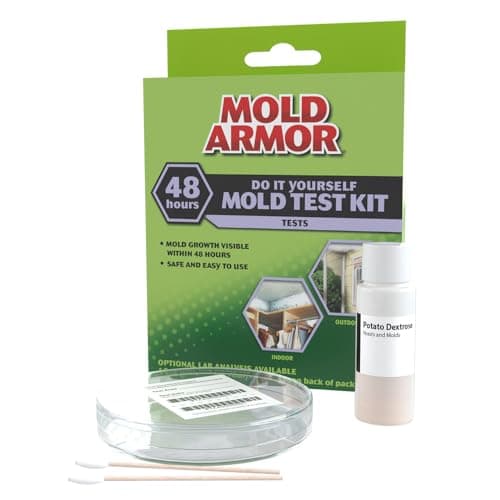
The most popular DIY mold test kit on Amazon. Includes a settling plate, swab, and pre-paid postage for AIHA-accredited lab analysis. The kit detects airborne mold spores and surface mold, identifying species like Aspergillus, Stachybotrys, and Penicillium.
Pros
- Very affordable entry-level test
- Includes petri dish, swab, and postage for lab analysis
- Results identify mold species
Cons
- Lab fee is separate (~$40)
- Takes 5-7 days for lab results
- Only tests one location per kit
For early warning, monitor moisture — not “mold”
A test kit tells you whether mold is here now. If what you actually want is a heads-up beforemold starts — the smoke-detector instinct — then you're monitoring the right thing but calling it the wrong name. Mold needs sustained humidity above roughly 60%. So the useful “detector” for prevention is a cheap hygrometer that logs humidity and shows you when a room creeps into the danger zone. Put one in the bathroom, the basement, a chronically musty closet, and behind any big piece of furniture on an exterior wall.
A logging model matters more than the price. A $5 dial hygrometer shows you the current number and nothing else; a $12 Bluetooth one graphs the trend, so you catch the room that sits at 65% every night after a shower — which is exactly the pattern that grows mold while a one-time reading looks fine. Feed that humidity number into our mold risk calculatorto see your risk tier and, if it's high, the dehumidifier size that would pull you back under 60%.
Govee H5075 Bluetooth Hygrometer Thermometer
Govee
$10–15
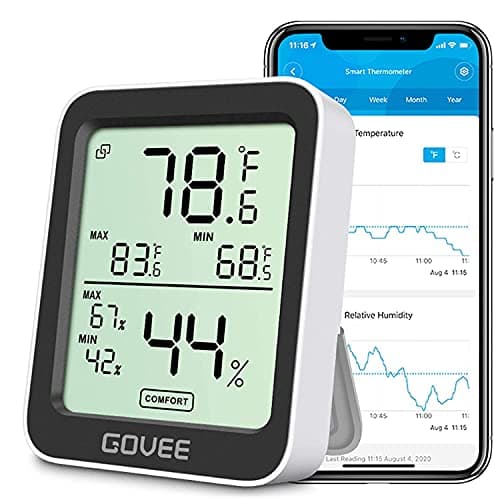
An inexpensive Bluetooth hygrometer that continuously tracks a room's relative humidity and temperature and graphs the history in an app. Mold needs sustained humidity above roughly 60%, so a logging hygrometer in the bathroom, basement, or a closet is the cheapest way to see a moisture problem building before mold appears. It monitors conditions — it does not detect or identify mold itself.
Pros
- Logs humidity history so you can spot rooms that creep past 60% RH
- Bluetooth app graphs the trend and alerts you when a room gets damp
- Cheap enough to put one in every mold-prone room
Cons
- Measures humidity, not mold — it flags the conditions, never confirms spores
- App/Bluetooth only; no Wi-Fi remote access without the hub
- Consumer-grade accuracy — fine for mold risk, not lab precision
A moisture meter is the other half of prevention. Humidity is the air; a moisture meter reads the surface— drywall, wood, the base of a cabinet — so you can find the wet zone a leak is feeding before it turns black. A pinless meter reads through a wall without drilling, which makes it the tool for checking behind a suspicious stain or under a sink you think is sweating. If you smell mold but can't see it, this is how you hunt the source; our mold behind walls guide covers the meter-and-borescope routine.
Klein Tools ET140 Pinless Moisture Meter
Klein Tools
$45–60
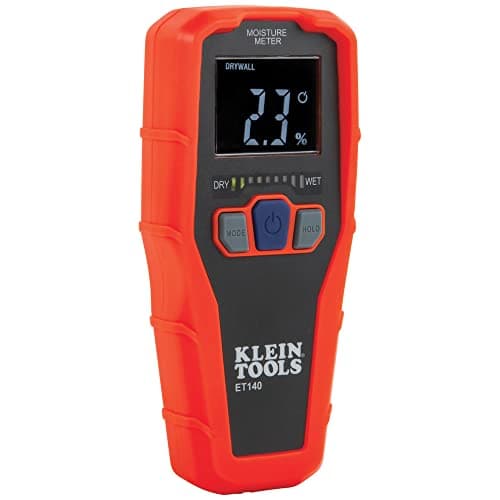
A professional-grade pinless moisture meter that detects hidden moisture in drywall, wood, and masonry without leaving holes. Uses electromagnetic sensor technology to measure moisture content up to 3/4 inch below the surface. Essential for identifying moisture problems before mold develops.
Pros
- Non-invasive pinless technology, no holes in walls
- Detects moisture up to 3/4 inch deep
- Visual and audible moisture alerts
Cons
- Less precise than pin-type meters on exact moisture percentage
- Battery not included
- Can give false readings on metallic or foil-backed surfaces
Air-quality monitors: a legit product doing the wrong job
Airthings-class air-quality monitors are real, well-made devices — and they're the closest thing to the “plug-in mold detector” people imagine, which is exactly why they get marketed that way. They trend humidity, VOCs, CO2, and sometimes particulates over weeks. A sustained climb in VOCs alongside high humidity canhint at hidden microbial growth. But “can hint” is the whole caveat: it will never confirm mold or name a species, and at $130–$330 it costs more than a test that would. Buy one if you want ongoing whole-home air data. Don't buy one expecting it to answer “is this stain mold?” — that's a $20 swab's job.
Airthings 322 Wave Enhance Indoor Air Quality Monitor
Airthings
$130–160
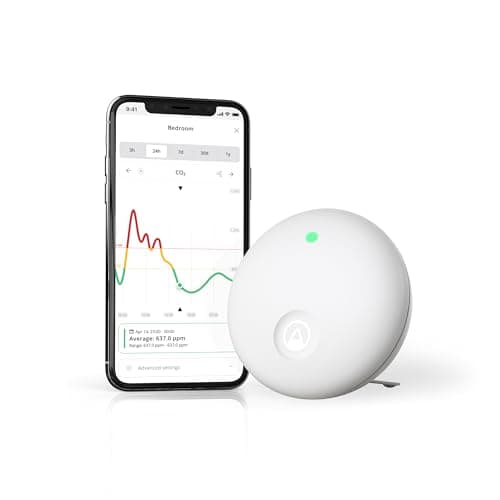
A well-regarded indoor air-quality monitor that continuously measures humidity, VOCs, CO2, temperature, and barometric pressure and charts them in an app. It is the honest version of an 'electronic mold detector': it can surface the damp, high-VOC conditions mold likes, but it cannot confirm that mold is present or tell you the species. Use it for ongoing monitoring, then a test kit when you actually need to know.
Pros
- Tracks humidity, VOCs, CO2, temperature and pressure over time
- A sustained VOC + humidity climb can hint at hidden microbial growth
- App history is genuinely useful for trending a whole home
Cons
- Does NOT test for mold or identify species — it is not a mold detector
- Overkill if you only need a humidity reading (a $12 hygrometer does that)
- Higher price than a test kit that would actually confirm mold
“My meter read high” — what to actually do next
Say you bought one of these and it's telling you something. Here's how to turn a reading into a decision instead of a panic:
- High moisture reading, no visible mold:you've found a wet spot, not mold. Trace it to the leak or condensation source and dry it. Mold follows water — kill the water and you usually kill the problem before it starts.
- High humidity that won't drop below 60%:that's a ventilation/dehumidification job, not a remediation one. A dehumidifier sized to the space is the fix.
- Musty smell but nothing visible:your nose is a better mold detector than most gadgets. Now confirm it — a test kit or, if you're chasing symptoms, an ERMI. Start with what mold actually smells like and why your house smells musty.
- You can already see mold under about 10 sq ft:don't test at all. The EPA says a small patch you can identify is a cleanup job, not a testing job — just remove it. See how to get rid of black mold.
The through-line: a device tells you about conditions. A test kit or your own eyes and nose tell you about mold. Spend on the one that answers your actual question — and if you're not sure which that is, it's almost always “confirm it,” which means a kit.
What it costs to actually detect mold
DIY, detection is cheap. A humidity monitor runs $10–$25, a moisture meter $20–$60, and a real test kit $15–$60 (an ERMI DNA test is the outlier at $200–$250). Compare that to a professional inspection, which runs $450–$800for the visit alone before any remediation. For most homeowners the honest kit is: a logging hygrometer to watch the conditions, a moisture meter to find the source, and a test kit for when you need a yes-or-no on the mold itself — under $100 for all three, and not one of them is the $30 gadget with “detector” on the label.
Frequently Asked Questions
Is there a device that detects mold in the air?
Do electronic mold detectors work?
What's the best way to detect mold behind walls?
How much does it cost to detect mold?
Related Articles
Best Mold Test Kits for Home Use: What Works & What's a Waste of Money (2026)
How to Test for Mold at Home: DIY Methods That Actually Work
ERMI Mold Test: Cost, Accuracy & When You Actually Need One
What Does Mold Smell Like? How to Identify Mold by Smell
Mold Testing Guide: Do You Need a Test & Which Type Is Best?
How Much Does a Mold Inspection Cost? (2026 Price Guide)
Dealing With Mold Right Now?
Our step-by-step mold removal guide walks you through testing your home, choosing the right products, and knowing when a job is too big for DIY.
Read the Removal Guide