Dehumidifier for Mold Prevention: What Humidity to Hold and How to Set It Up
Out of the Mold Editorial Team
Our guides are research-backed and cite EPA, CDC, and peer-reviewed sources. Product reviews are based on hands-on testing, not manufacturer claims. Read our editorial standards.
Affiliate Disclosure: Out of the Mold is reader-supported. As an Amazon Associate, we may earn a commission when you buy through links on this page — at no extra cost to you. Our picks are based on independent standards, manufacturer specifications, and published research, not commissions.
Key Takeaways
- The EPA target is one number: below 60% relative humidity, ideally 30–50%. Below it, mold can't establish.
- RH is relative to temperature — cold walls and slabs hit their dew point first, which is why mold shows up on exterior-facing surfaces.
- Buy a $12 hygrometer before the dehumidifier and leave it in the worst corner; you can't manage a number you can't see.
- For prevention you can size toward the lower end of the ENERGY STAR chart — you're holding a reasonable space, not drying a flood.
- A dehumidifier dries air, not leaks. If the moisture is a liquid-water source, it buys time but never wins — fix the water first.
Hold the air in the room below 60% relative humidity — ideally 30 to 50% — and mold physically can't establish, because it needs sustained surface moisture to germinate. That one number is the whole job. A dehumidifier is how you hold it in a basement, a crawl space, or a house closed up for winter. Buy a $12 hygrometer first so you're setting a target instead of guessing, size the unit to the space and how damp it runs, and set the humidistat to 50%. The catch: a dehumidifier manages air. If the moisture is coming from a leak, a flood, or bad grading, it buys you time but it will never win.
Prevention is a different problem from removal, and most dehumidifier advice blurs the two. If you already have mold, you clean it — that's the job our main dehumidifier-for-mold guide covers, and it's the right page if you're staring at black spots right now. This page is for the reader on the other side of that: you've cleared a mold problem, or you've got a basement that smells like it's thinking about one, and you want to keep it from ever happening. The target is the same either way, but the moves are different — you're managing a number over a whole season, not scrubbing a wall.
Why 60% is a ceiling, not a goal
The EPA's guidance is one sentence worth memorizing: "If possible, keep indoor humidity below 60 percent (ideally between 30 and 50 percent) relative humidity." (EPA, A Brief Guide to Mold, Moisture and Your Home, retrieved November 2026.) Read it carefully: 60% is the line you must stay under, not where you aim. Aim for 45 to 50% and you've got a buffer for the hours the number drifts up — after a shower, overnight, during a humid spell.
Relative humidity is relative to temperature, and that's the part that trips people up. The same amount of water in the air reads as a comfortable 45% in a warm room and a dangerous 70% against a cold basement wall, because cold air holds less moisture before it saturates. That's why mold shows up on the outside-facing wall of a closet, behind furniture pushed against an exterior wall, or on the cold sill under a window — the room average looks fine, but the air touching that cold surface has hit its dew point and gone effectively to 100%. A dehumidifier fixes this by pulling the whole room's moisture down so even the cold spots stay below the line. If your mold keeps coming back on one specific cold surface, read our guide to spotting hidden mold by smell — the nose finds these before the eyes do.
Which is the real reason to own a hygrometer before you own a dehumidifier. You cannot manage a number you can't see, and the "it feels damp" test is useless below 60%. A $12 sensor you leave in the worst corner of the room — not out in the open where it'll read best-case — turns the whole thing from a vibe into a dial you adjust.
Govee H5075 Bluetooth Hygrometer Thermometer
Govee
$10–15
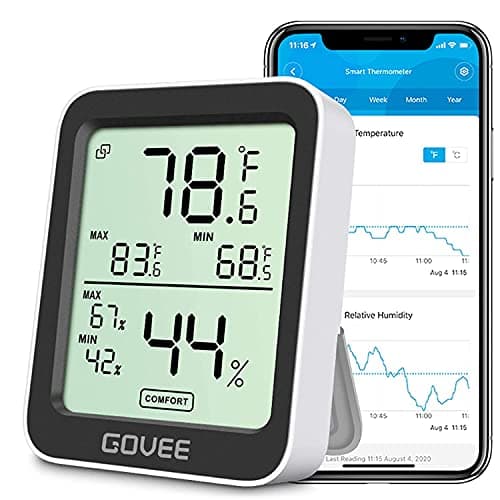
An inexpensive Bluetooth hygrometer that continuously tracks a room's relative humidity and temperature and graphs the history in an app. Mold needs sustained humidity above roughly 60%, so a logging hygrometer in the bathroom, basement, or a closet is the cheapest way to see a moisture problem building before mold appears. It monitors conditions — it does not detect or identify mold itself.
Pros
- Logs humidity history so you can spot rooms that creep past 60% RH
- Bluetooth app graphs the trend and alerts you when a room gets damp
- Cheap enough to put one in every mold-prone room
Cons
- Measures humidity, not mold — it flags the conditions, never confirms spores
- App/Bluetooth only; no Wi-Fi remote access without the hub
- Consumer-grade accuracy — fine for mold risk, not lab precision
When a dehumidifier prevents mold — and when it can't
Here's the honest split, because a dehumidifier is not a magic box and pretending otherwise is how people waste $250 and still get mold.
It prevents mold when humidity is the driver.A closed-up basement in summer, a crawl space breathing ground moisture, a house sealed tight for winter, a bathroom or laundry room with no exhaust, a humid-climate home — these are air-moisture problems, and holding RH under 50% is exactly the fix. This is the overwhelming majority of "my basement always smells musty" cases.
It cannot prevent mold when there's a liquid-water source.A dehumidifier dries air; it does nothing about a leaking pipe, a foundation crack letting groundwater in, a roof drip, or a grade that slopes rainwater toward the house. Run a dehumidifier over a slow leak and you'll get a big electric bill and mold anyway, because the wood and drywall stay wet from behind no matter how dry the room air is. The EPA is blunt about the order of operations: "If mold is a problem in your home, you should clean up the mold promptly and fix the water problem." Fix the water first. The dehumidifier is for the residual humidity after the source is gone — not a substitute for finding it.
If you're not sure which camp you're in, the tell is whether the dampness tracks the weather (humidity problem — worse in summer, in wet spells) or whether it's constant and localized (water-source problem — one wall, one corner, there rain or shine). For a below-grade space that stays wet no matter the season, the fix is usually drainage or sealing, which is crawl-space encapsulation or a basement waterproofing job, not a plug-in appliance.
Sizing it for prevention (you can go smaller than the removal charts say)
Dehumidifier capacity is measured in pints per day — how much water it pulls in 24 hours. ENERGY STAR sizes it by two things: the square footage and how damp the space runs without help. Their published guidance for a space under 2,000 sq ft:
| Starting condition (untreated RH) | Capacity for a space under 2,000 sq ft |
|---|---|
| Slightly to moderately damp (50–75%) | 20–30 pints/day |
| Very damp (75–90%) | 25–40 pints/day |
| Wet, standing-dampness feel (90–100%) | 30–50 pints/day |
Source: ENERGY STAR, Dehumidifiers (retrieved October 2026). Note that pint ratings dropped across the board when the federal test temperature moved from 80°F to a cooler 65°F in 2019, so a unit's current pint number is lower than an older model's for the same real-world capacity — compare current ratings to current ratings only.
For prevention, you're living in the top row. You're not drying out a flooded room; you're holding an already-reasonable space under 50%. So you can honestly buy toward the lower end of the chart for your square footage — a 30-to-50-pint unit covers most basements and open lower floors. ENERGY STAR's one rule still holds, though: "it's better to oversize than undersize." An oversized unit reaches your setpoint faster and then idles; an undersized one runs flat-out, never catches up, and dies early. For a full room-by-room sizing walk-through on the largest spaces, the crawl-space dehumidifier guide breaks down the sealed-vs-vented math, and the main dehumidifier guide ranks the current picks.
Three units cover almost every prevention job:
hOmeLabs 50-Pint Energy Star Dehumidifier
hOmeLabs
$220–260
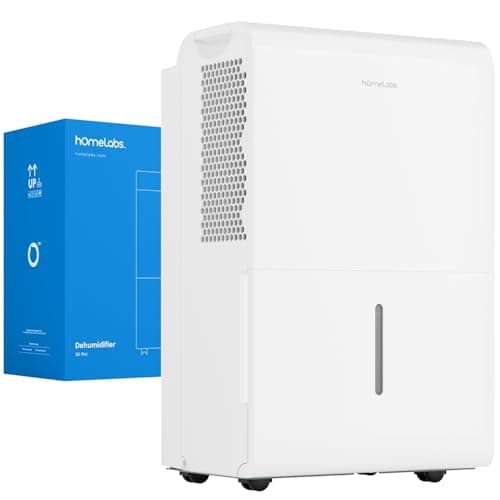
The best-selling 50-pint dehumidifier on Amazon and our top overall pick for mold prevention. Set your target humidity (aim for 45-50%) and the built-in humidistat cycles the compressor to hold it. A rear hose port allows continuous gravity draining into a floor drain, and turbo mode speeds up moisture removal after water events. Energy Star certified to keep 24/7 running costs reasonable.
Pros
- 50-pint capacity handles basements and large rooms up to 4,500 sq ft
- Built-in humidistat holds your target humidity automatically
- Continuous-drain hose port for set-and-forget operation
Cons
- No built-in pump — gravity drain or bucket emptying only
- 1.6-gallon bucket fills every 6-8 hours in very damp spaces
- Fan is audible on turbo mode
Pro Breeze Electric Mini Dehumidifier
Pro Breeze
$35–50
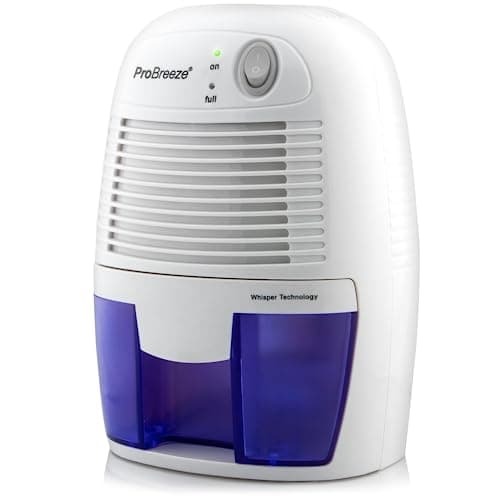
A compact thermoelectric (Peltier) dehumidifier for small enclosed spaces prone to condensation and musty smells. It won't dry out a basement, but for a windowless bathroom, closet, or boat cabin it quietly pulls enough moisture to keep surfaces below the humidity mold needs. No compressor means near-silent operation and low power draw.
Pros
- Whisper-quiet thermoelectric design with no compressor
- Small footprint fits bathrooms, closets, and RVs
- Auto shut-off with indicator when the tank is full
Cons
- Only effective in small spaces up to ~215 sq ft
- Thermoelectric units lose effectiveness below about 59°F
- 17-ounce tank needs frequent emptying in damp rooms
AlorAir Sentinel HD55S Crawl Space Dehumidifier
AlorAir
$450–550
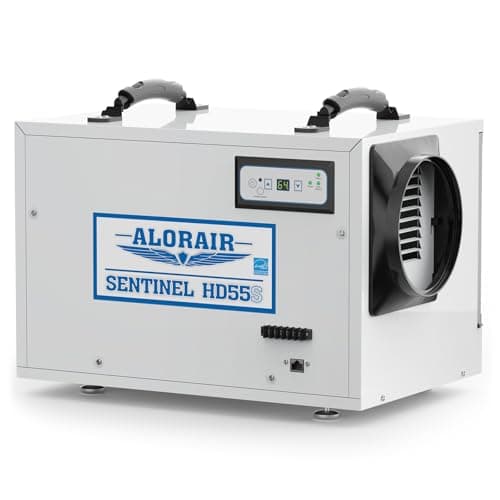
A commercial-grade crawl space dehumidifier engineered for the low temperatures and horizontal clearances portable units can't handle. Hot-gas auto defrost keeps it running down to 36°F, and its epoxy-coated coils resist the corrosion that kills consumer units in damp crawl spaces. The standard choice for crawl space moisture control after encapsulation.
Pros
- Purpose-built for crawl spaces — operates down to 36°F with auto defrost
- 120 pints per day saturation capacity, Energy Star certified
- 5-year warranty and ductable design for sealed installs
Cons
- Significant investment compared to portable units
- Gravity drain only on this model — pump version costs more
- Requires proper crawl space placement and clearance
For a closet, a gun safe, or a spot with no outlet, skip the compressor entirely — a refillable desiccant absorber holds a small enclosed space under the line with zero power. It won't touch a basement, but it's the right tool where a machine is overkill.
DampRid Hanging Moisture Absorber (3-Pack)
DampRid
$12–18
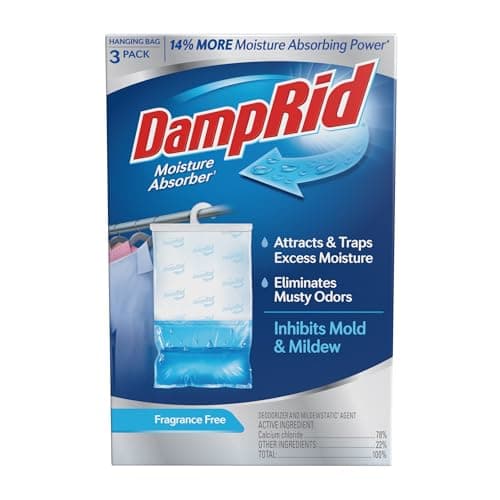
Passive calcium-chloride moisture absorbers that hang from a closet rod and pull humidity out of enclosed spaces without power. They won't fix a damp basement, but inside a closet, wardrobe, or stored vehicle they keep trapped air dry enough to stop mildew on clothes, leather, and linens. Each bag lasts roughly 45-60 days before the crystals fully dissolve.
Pros
- No electricity needed — works anywhere you can hang it
- Calcium chloride crystals absorb moisture for up to 60 days each
- Fragrance-free version won't add perfume to enclosed spaces
Cons
- Cannot meaningfully lower whole-room humidity
- Bags must be replaced once the crystals dissolve
- Collected brine must be handled carefully when disposing
Where to run it, and at what setting
Owning the right unit and running it wrong is common. Four things decide whether it actually holds the line:
- Set the humidistat to 50%, not "continuous." Running continuous wastes power and over-dries; 50% gives you the EPA buffer and lets the unit cycle. If yours has only on/off, a cheap plug-in humidistat does the same job.
- Put it where the air moves, not in a corner.Central in the space, a foot or two off the walls so it can pull from the whole room. Tucked behind boxes in the dampest corner, it "satisfies" locally and leaves the rest of the room humid.
- Plumb the drain if you can. A bucket you forget to empty shuts the unit off for days — which is exactly when a humid spell seeds mold. Run the hose to a floor drain or sump, or buy a model with a built-in pump so it can push water up to a sink. This is the single biggest reason prevention setups fail: the machine was fine, the bucket was full.
- Give it air, not a sealed closet.A dehumidifier needs to circulate the room's air through itself. Shut it in a cabinet and it just dries its own little box.
The fall-and-winter humidity transition — why now
Indoor humidity doesn't sit still across the year, and the shoulder season is when prevention setups get caught out. Through summer, your air conditioner is also your dehumidifier — every cooling cycle wrings water out of the air as a side effect. Then the weather cools, the AC stops running, the windows close, and the house traps the moisture that cooking, showers, laundry, and breathing put into the air with nowhere to vent. Meanwhile the exterior walls and basement slab are getting cold, so the dew-point math from the top of this page turns against you: the same humidity that was fine in July condenses on cold surfaces in November.
That's the practical takeaway for the fall-and-winter window: don't unplug the dehumidifier when the AC shuts off for the season — that's precisely when a standalone unit starts earning its keep. Keep it running (at 50%) through the closed-up months, and watch the hygrometer in the coldest corner, not the thermostat's reading. Homes in genuinely cold climates can over-correct — drop below ~30% and you get static, cracked wood, and dry sinuses — so the 30-to-50% band is a floor as well as a ceiling.
Keep the dehumidifier itself from growing mold
The irony nobody warns you about: a dehumidifier is a cold, wet box with a fan, which is a decent description of a mold habitat. A neglected unit becomes the thing seeding spores into the room it's supposed to protect — and a musty machine is the most common reason a prevention setup starts smelling worse, not better.
- Empty and wipe the bucketeven if you rarely use it — standing water in the tank grows biofilm fast. If you're plumbed to a drain, flush the tank occasionally anyway.
- Rinse the air filter every few weeks in a dusty basement; a clogged filter chokes airflow and traps damp dust against the coil.
- Keep the coils clear.Vacuum the intake/exhaust grilles so dust doesn't cake on the cold coil and turn into a food source.
- If it already smells musty,that's a cleaning problem, not a humidity reading — a dirty unit can smell while the RH looks perfect.
One more honest note on what a dehumidifier is not: it controls moisture, it doesn't filter the air. If your goal includes catching spores and the musty smell during or after a mold problem, that's an air purifier's job, and the two do different work — the dehumidifier removes the cause (moisture), the purifier removes the symptom (airborne spores). If you can only buy one for prevention, buy the dehumidifier. Dry air is what actually stops mold; a purifier in a 65%-humidity basement just filters spores while new ones keep growing.
That's the entire prevention playbook: see the number, hold it under 50%, size the machine honestly, drain it so it never stops, and keep the machine itself clean. The homes that never get mold aren't the dry ones by luck — they're the ones where somebody's watching a dial.
Frequently Asked Questions
What humidity level prevents mold?
Should I run a dehumidifier all the time to prevent mold?
Dehumidifier or air purifier to prevent mold?
Will a dehumidifier prevent basement mold?
Related Articles
Best Dehumidifiers for Mold Prevention & Removal (2026)
Best Crawl Space Dehumidifiers That Actually Work (2026)
Best Air Purifiers for Mold Spores & Musty Odors (2026)
How to Get Rid of Mold in Your Basement (2026 Guide)
Musty Smell in House? Here's How to Find & Fix the Source
Crawl Space Encapsulation: The Complete Cost & DIY Guide (2026)
Dealing With Mold Right Now?
Our step-by-step mold removal guide walks you through testing your home, choosing the right products, and knowing when a job is too big for DIY.
Read the Removal Guide