Air Scrubber for Mold: Do You Actually Need One (and How It Differs From an Air Purifier)
Out of the Mold Editorial Team
Our guides are research-backed and cite EPA, CDC, and peer-reviewed sources. Product reviews are based on hands-on testing, not manufacturer claims. Read our editorial standards.
Affiliate Disclosure: Out of the Mold is reader-supported. As an Amazon Associate, we may earn a commission when you buy through links on this page — at no extra cost to you. Our picks are based on independent standards, manufacturer specifications, and published research, not commissions.
Key Takeaways
- An air scrubber is a high-CFM HEPA machine for running during active remediation — it captures airborne spores and creates negative pressure; it is not a room air purifier.
- Most small jobs don't need one: the EPA's 10-sq-ft DIY threshold plus containment and a HEPA vacuum is enough. Buy/rent one for larger, dust-making, basement, or crawl-space jobs.
- Size it, don't guess: room volume (cu ft) × ACH ÷ 60 = required CFM. The IICRC S520 standard targets 4–6 ACH; 550 CFM is the home-remediation sweet spot.
- A scrubber captures spores but does not fix mold — the moisture fix and physical removal still have to happen.
- Rent for a one-time job; buy if you'll use it again (landlords, flippers, chronically damp basements). Add an activated-carbon stage only if odor is part of the job.
An air scrubber is a high-airflow HEPA machine you run during active mold removal to capture spores you're knocking loose and to hold the work area under negative pressure so contaminated air doesn't drift into the rest of the house. It is not a room air purifier, which is for everyday air afterthe job. Most small jobs — under about 10 square feet — don't need one. Larger remediation, anything where you're sanding or tearing out moldy material, and basements or crawl spaces do. And it bears repeating up front: a scrubber captures airborne spores, it does not fix the mold. The moisture and the material still have to go.
Search this and you land on a Reddit thread asking whether an "air scrubber" is worth it for moldy ducts, surrounded by vendor pages that all answer "yes, buy ours." Of course they do. The honest version — do you even need one, and if so, what size — is the question nobody selling a $400 machine wants to answer. So let's answer it in order: first whether, then which, then how big.
When a mold job actually calls for an air scrubber
Start with the gate, because for a lot of people the honest answer is "you don't need one." The EPA's rule of thumb is that "if the moldy area is less than about 10 square feet (less than roughly a 3 ft. by 3 ft. patch), in most cases, you can handle the job yourself." For a job that small, containment plus a HEPA vacuumfor the settled dust is enough — buying a 550 CFM scrubber to wipe one bathroom wall is overkill, and it's loud, expensive overkill at that.
You actually want a scrubber when:
- The affected area is larger than that 10-square-foot line, or spans multiple surfaces.
- You're creating dust— cutting out moldy drywall, sanding framing, pulling up subfloor. That's when spore counts in the air spike, and that's exactly what a scrubber is for.
- It's a basement or crawl space — enclosed, humid, poorly ventilated spaces where airborne spores linger and spread. See basement mold removal and crawl space encapsulation.
- You need containment — you want to seal off the work zone and keep its air from migrating into living space, which means running the scrubber as a negative-air machine.
Air scrubber vs. air purifier vs. HEPA vacuum
This is the confusion the whole search results page leaves unresolved. Three tools, three jobs, and they are not interchangeable:
| Tool | What it does | When you use it |
|---|---|---|
| Air scrubber (negative air machine) | High CFM; pulls airborne spores through HEPA, can duct exhaust out to create negative pressure | During the job — while you disturb mold and make dust |
| Air purifier | Lower CFM, quiet, continuous; cleans room air over time | After the job — living with good air day to day |
| HEPA vacuum | Captures settled spores and dust off surfaces | Cleanup — the dust on the floor, not the air |
The simplest way to keep them straight: a scrubber works the air during demolition, a purifier works the air after, and a vacuum works the surfaces. They all use true HEPA filtration — which captures 99.97% of particles down to 0.3 microns, well below the 1-to-30-micron size of a mold spore — but the airflow, the ducting, and the noise are built for completely different moments. Buying a jobsite scrubber to run quietly in your bedroom forever is as wrong as expecting a bedroom purifier to protect the rest of the house while you rip out a moldy wall.
And the honest caveat a vendor won't lead with: an air scrubber does not "kill" mold or remediate the source. It captures what's airborne and controls where the air goes. The moisture fix and the physical removal — the real work in our mold removal guide — still have to happen, or the mold is back regardless of how clean the air reads.
Sizing a scrubber — the part buyers get wrong
People buy on brand and price and ignore the one number that matters: airflow relative to room size. Professionals size by air changes per hour(ACH) — how many times the machine cycles the room's entire air volume in an hour. The restoration standard, IICRC S520, sets a minimum of 4 ACH in a remediation zone, with 6 ACH the practical working target and more in active-contamination areas.
The math is simple enough to do on a napkin:
Room volume (cubic feet) × ACH ÷ 60 = the CFM your scrubber needs.
Worked example, because that's what the other pages never give you. Say you're remediating a 15 ft × 20 ft basement with 8-foot ceilings:
- Volume: 15 × 20 × 8 = 2,400 cubic feet
- At 6 ACH: 2,400 × 6 ÷ 60 = 240 CFM needed
A single 550 CFM portable scrubber clears that with room to spare — which is why 550 CFM is the sweet-spot size for home remediation: it covers a typical basement, a couple of average rooms, or a crawl-space zone at the 4–6 ACH target. Only big, open, multi-room jobs push you toward 1,000+ CFM or a second unit. It's the same "size it, don't guess" principle we use for purifiers — purifiers just measure it as CADR instead of raw CFM.
Buy vs. rent — and which units are worth it
If this is a one-time job, rent. Home-improvement and tool-rental outlets rent HEPA air scrubbers by the day, which usually beats buying for a single weekend of demolition. Buyif you'll use it more than once — landlords, flippers, and anyone with a chronically damp basement that keeps throwing mold jobs. At that point the machine pays for itself against a couple of rentals, and you have it on hand the day a pipe lets go.
If you're buying, here are the three that make sense, cheapest first. The value pick does everything a DIY remediation needs:
VEVOR 550 CFM 3-Stage HEPA Air Scrubber
VEVOR
$270–320
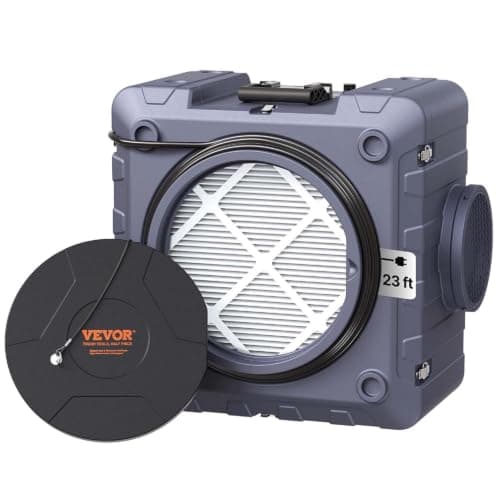
A 550-CFM portable HEPA air scrubber with three-stage filtration, used during active mold or water-damage work to pull airborne spores out of the air and — when ducted out of a sealed zone — create the negative pressure that keeps contaminated air from spreading. It is remediation equipment, not a room air purifier: run it while you disturb mold, not as a permanent fixture.
Pros
- 550 CFM with 3-stage filtration (pre-filter → MERV → HEPA) covers most home remediation zones
- Stackable and ducting-capable, so it doubles as a negative-air machine for containment
- Cheapest honest entry into jobsite-grade air filtration — well below the name brands
Cons
- Generic brand; filters and support aren't as established as AlorAir/Abestorm
- Loud at full speed — this is jobsite equipment, not a living-room purifier
- Overkill (and overloud) for a single small bathroom wall
Step up to the restoration-brand workhorse if you'll run it more than once and want a unit — and filters — that are easy to live with for years:
AlorAir CleanShield HEPA 550 Air Scrubber
AlorAir
$380–430
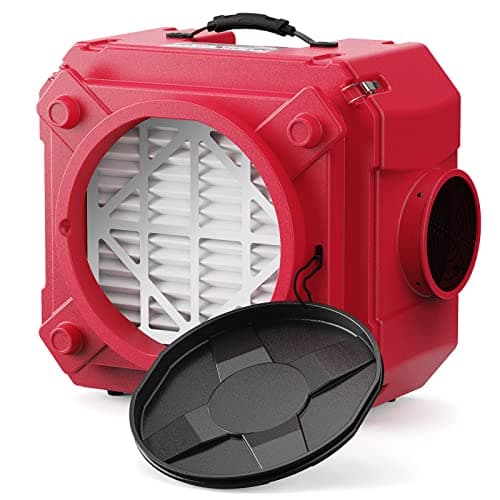
The restoration-industry workhorse: a 550-CFM three-stage HEPA air scrubber from a brand pros actually use, backed by a 10-year limited warranty and widely stocked filters. The True HEPA stage captures 99.97% of particles down to 0.3 microns, well below the 1–30 micron size of mold spores, and the unit stacks and ducts for negative-air containment on larger jobs.
Pros
- Established restoration brand with a 10-year limited warranty and easy-to-source filters
- True HEPA stage captures 99.97% of particles at 0.3 microns — far below spore size
- Stackable with a daisy-chain port for multi-unit or negative-air containment setups
Cons
- Costs more than a generic 550 CFM unit
- Still jobsite-loud; not a continuous living-space device
- Replacement HEPA filters are an ongoing cost on big or repeat jobs
And if the complaint is the smell as much as the spores — a musty basement or a post-flood crawl space — spend up for the carbon stage. Plain HEPA passes the microbial VOCs that make the odor; activated carbon is what actually adsorbs them:
Abestorm 550 HEPA Air Scrubber with Activated Carbon & UV-C
Abestorm
$460–520
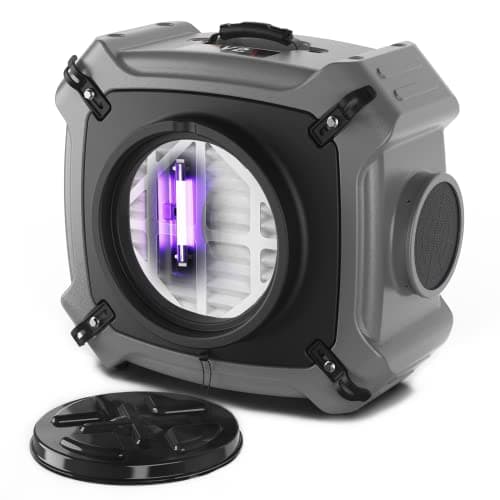
A 550-CFM HEPA air scrubber that adds an activated-carbon filtration stage on top of the MERV-10 pre-filter and True HEPA — the version to buy when the job is as much about the musty smell as the spores, because activated carbon adsorbs the microbial VOCs that HEPA filtration passes straight through. GFCI-protected and stackable for crawl-space and basement containment.
Pros
- Adds an activated-carbon stage that HEPA alone can't do — targets the musty VOC odor, not just spores
- MERV-10 pre-filter extends HEPA life; optional UV-C stage
- 550 CFM, stackable, GFCI-protected for damp basements and crawl spaces
Cons
- Most expensive of the three — only worth it if odor is part of the job
- Carbon filter is a consumable you'll replace on heavy odor work
- UV-C adds marketing more than measurable spore kill at these contact times
Whichever you run, treat it as one tool in a workflow, not a cure. The scrubber cleans the air while you work; a fogger or a disinfectant handles treatment, a HEPA vacuum gets the settled dust, and proper PPEkeeps the spores you're stirring up out of your own lungs. The machine earns its keep on the jobs that genuinely make dust — and sits in the garage, honestly, on the ones that don't.
Frequently Asked Questions
Do I need an air scrubber for mold removal?
What's the difference between an air scrubber and an air purifier for mold?
Do air scrubbers kill mold?
What size air scrubber do I need?
Related Articles
Best Air Purifiers for Mold Spores & Musty Odors (2026)
HEPA Vacuum for Mold: Why a Regular Vacuum Makes It Worse
Mold Air Purifier: Does It Work, and When Is It Worth It?
How to Get Rid of Mold in Your Basement (2026 Guide)
Crawl Space Encapsulation: The Complete Cost & DIY Guide (2026)
Best Mold Removal Products: What Works for Every Surface & Situation
Dealing With Mold Right Now?
Our step-by-step mold removal guide walks you through testing your home, choosing the right products, and knowing when a job is too big for DIY.
Read the Removal Guide