Ozone Generator for Mold: Does It Actually Kill It?
Out of the Mold Editorial Team
Our guides are research-backed and cite EPA, CDC, and peer-reviewed sources. Product reviews are based on hands-on testing, not manufacturer claims. Read our editorial standards.
Affiliate Disclosure: Out of the Mold is reader-supported. As an Amazon Associate, we may earn a commission when you buy through links on this page — at no extra cost to you. Our picks are based on independent standards, manufacturer specifications, and published research, not commissions.
Key Takeaways
- The EPA says ozone 'does not effectively remove viruses, bacteria, mold, or other biological pollutants' at concentrations within public-health limits.
- To kill mold, ozone would have to run 5–10× higher than safe-to-breathe limits — a dose that attacks your lungs before it dents the spores.
- Ozone can't reach mold inside porous materials (drywall paper, ceiling tile, carpet) and never fixes the moisture source, so the mold regrows.
- California's CARB rule (0.050 ppm emission cap, since 2010) effectively bars ozone generators from being sold as air cleaners there.
- What works instead: pull humidity under ~50% with a dehumidifier, physically remove the growth, and trap airborne spores with true-HEPA filtration.
An ozone generator will not safely rid your home of mold. The EPA is direct about it: at any concentration you could breathe, ozone "does not effectively remove viruses, bacteria, mold, or other biological pollutants." To actually kill mold, the ozone level would have to run 5 to 10 times higher than public health standards allow — a level that attacks your lungs before it touches the spores. And even then it does nothing for the moisture that grew the mold, so it comes back.
Search "ozone generator for mold" and you'll find a wall of listings promising a $90 box will nuke the mold out of your whole house overnight. The pitch is seductive because it sounds like a cheat code — no scrubbing, no demolition, just run a machine and walk away. The problem is that the one federal agency with no product to sell has looked at exactly this claim and found it doesn't hold up. Here is what the EPA actually found, why the physics can't be beaten, and the thing that does work.
What the EPA actually found
The EPA's assessment of ozone generators sold as air cleaners is one of the bluntest documents the agency publishes. Three findings matter for mold:
- At safe concentrations, ozone "does not effectively remove viruses, bacteria, mold, or other biological pollutants." Not "works a little" — doesn't effectively work.
- To decontaminate air, "ozone concentrations would have to be 5 – 10 times higher than public health standards allow." That's the whole ballgame: the dose that kills mold and the dose that's safe to breathe don't overlap.
- Even cranked up, "ozone may have no effect on biological contaminants embedded in porous material such as duct lining or ceiling tiles." Household mold lives in exactly those porous materials — drywall paper, grout, wood, carpet backing.
The EPA's summary line is that these machines "have little potential to remove indoor air contaminants." A gas that struggles to reach mold on a surface has no path at all to the colony rooted a quarter-inch inside the material.
Why it can't work at a level you can breathe
Ozone (O₃) is a powerful oxidizer — that's the real property behind the marketing. In theory, pump enough of it into a sealed room and it will oxidize the surface of whatever it contacts, mold included. The catch is "enough" and "whatever it contacts."
First, dose. Breathing-safe limits sit around a tenth of a part per million (more on the exact numbers below). The concentration that reliably kills mold is several times that — the range where ozone starts chewing on your airway lining too. You cannot be in the room, and neither can pets or plants.
Second, reach. Ozone is a gas moving through air; it only acts on surfaces it directly touches. It doesn't soak into the paper face of drywall where mold roots, it doesn't travel behind a baseboard, and it won't find the colony in a wall cavity. So even in the best case it bleaches the visible surface and leaves the living root system.
Third — and this is the part every sales page skips — ozone does nothing about water. Mold is a moisture problem wearing a mold costume. If the humidity, the leak, or the condensation that fed the colony is still there, the mold regrows on schedule, ozone or no ozone. It also doesn't remove the stain or the dead-spore and allergen load that a knocked-back colony leaves behind. You've spent an afternoon evacuated from your home and the problem is still on the wall. Our mold removal guide walks the remove-and-fix-the-source process that ozone skips.
The health risk you'd be signing up for
Ozone isn't a gentle sanitizer that's merely ineffective indoors — it's a regulated respiratory irritant. The EPA notes that even "relatively low amounts can cause chest pain, coughing, shortness of breath and throat irritation," and that exposure can "worsen chronic respiratory diseases such as asthma." Inhaled, the agency says plainly, "ozone can damage the lungs."
Here's how low the official exposure ceilings are — and remember the EPA says mold-killing concentrations run 5–10× above them:
| Standard | Ozone limit | What it covers |
|---|---|---|
| FDA | 0.05 ppm | Max for indoor medical devices |
| EPA (NAAQS) | 0.08 ppm | Max outdoor 8-hour average |
| OSHA | 0.10 ppm | Workplace 8-hour average limit |
| NIOSH | 0.10 ppm | Upper limit, not to be exceeded |
(Figures from the EPA ozone-generator assessment, which compiles the FDA, OSHA, NIOSH, and EPA limits.) The reason this table matters: a consumer ozone generator run long enough to dent mold pushes a room well past every one of these numbers. The people most likely to reach for an air gadget — folks with asthma or allergies reacting to the mold — are exactly the people ozone hurts most.
It's effectively illegal to sell as an air cleaner in California
Most buyers never learn this, and it's the clearest tell of all. In 2010 California's Air Resources Board regulation (from AB 2276) put a hard ceiling on how much ozone an indoor air cleaner may emit: 0.050 parts per million(50 ppb). Any air cleaner sold in or shipped to California has to be certified under it, and corona-discharge ozone generators are explicitly named as covered devices. A machine whose entire function is producing ozone can't meet a 0.050 ppm emission cap — so selling one as an air cleaner in the country's largest market is essentially off the table.
When a whole state bars a device from being sold as an air cleaner, and the EPA says it has "little potential to remove indoor air contaminants," the burden of proof is on the $90 listing, not on you.
The one job ozone can actually do
To be fair to the technology: ozone has a narrow, legitimate role, and pretending otherwise would be as dishonest as the hype. Fire- and water-damage restoration crews sometimes run high-ozone "shock" treatments to knock out stubborn odors — smoke, decomposition, a deep musty funk — in a structure that has been fully vacated and sealed, then thoroughly aired out before anyone goes back in.
Notice what that is and isn't. It's a deodorizing step on an already-emptied space, run by people with monitors and PPE — not mold remediation, and not something you do in an occupied home with the cat in the next room. And if it's used on a mold problem whose moisture hasn't been fixed, the musty smell comes right back, because the source came right back. Ozone can temporarily oxidize the odor molecules; it can't evict the tenant making them.
What actually clears mold — and the air
If you came here because the air in a room smells moldy and you want a machine to fix it, the honest machine isn't an ozone generator — it's the boring combination that works:
- Find and kill the moisture. A dehumidifier that holds the room under ~50% relative humidity is the single highest-value purchase in this whole category, because it removes the thing mold needs. A cheap moisture meter tells you where the water actually is.
- Physically remove the growth. Mold has to come off the surface or out of the material — oxidizing gas is no substitute. Our step-by-step black mold removal guide covers the DIY line (roughly under 10 sq ft of hard surface) and when to call a pro.
- Clean the air of spores with real filtration. For airborne spores, a true-HEPA air purifier — or, for an active remediation, an air scrubber — captures the particles instead of trying to oxidize them in mid-air.
For the room air, a well-sized true-HEPA unit does what ozone can't — it physically traps mold spores rather than reacting with them and leaving the debris airborne:
Coway Airmega AP-1512HH True HEPA Air Purifier
Coway
$200–260
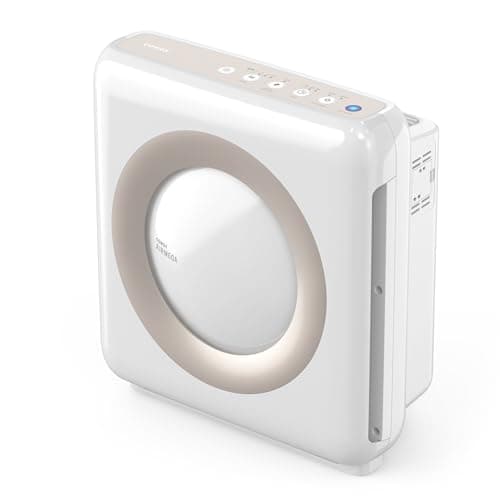
The long-standing benchmark for HEPA air purifiers. A four-stage system — pre-filter, deodorizing activated-carbon filter, True HEPA, and an optional ionizer — pulls mold spores, pollen, and musty odor out of rooms up to 1,748 sq ft. The pollution sensor ramps the fan when spore counts spike (say, right after you disturb growth during cleanup), then idles down in Eco mode. Independent testing sites have ranked it a top performer for years.
Pros
- True HEPA captures 99.97% of particles down to 0.3 microns — well below mold spore size
- Dedicated activated-carbon layer handles the musty VOCs HEPA can't
- Covers up to 1,748 sq ft; air-quality sensor auto-adjusts fan speed
Cons
- Ionizer mode is on by default — turn it off (produces trace ozone, no mold benefit)
- Replacement filter sets run ~$40–60 a year
- No app control on the base model
And before you buy anything, confirm where the water is. A moisture meter turns "I think that wall feels damp" into a reading you can act on:
Klein Tools ET140 Pinless Moisture Meter
Klein Tools
$45–60
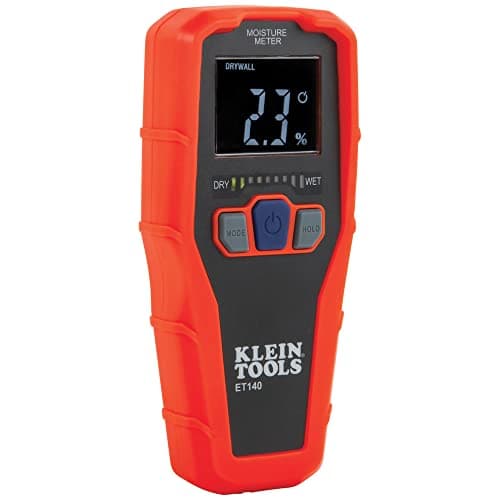
A professional-grade pinless moisture meter that detects hidden moisture in drywall, wood, and masonry without leaving holes. Uses electromagnetic sensor technology to measure moisture content up to 3/4 inch below the surface. Essential for identifying moisture problems before mold develops.
Pros
- Non-invasive pinless technology, no holes in walls
- Detects moisture up to 3/4 inch deep
- Visual and audible moisture alerts
Cons
- Less precise than pin-type meters on exact moisture percentage
- Battery not included
- Can give false readings on metallic or foil-backed surfaces
The pairing that replaces the ozone fantasy — trap the spores, pull the humidity — is the setup actual remediation leans on:
If the smell is coming from the HVAC rather than a visible patch, the fix lives in our mold in air ductsguide, and the other "does this device even work" question — UV light for mold — gets the same dose-and-reach honesty treatment.
Common questions
Will an ozone generator kill mold?Not at any level you can safely be around. The EPA found ozone would need to run 5–10× above public-health limits to decontaminate air, and even then has "no effect" on mold embedded in porous materials like drywall and ceiling tile. It also never fixes the moisture, so whatever it bleaches on the surface grows back.
Is it safe to be in the house during an ozone treatment? No — people, pets, and plants all have to be out. Ozone is a respiratory irritant that causes chest pain, coughing, and throat irritation at exposures well below the mold-killing range, and the EPA warns it can worsen asthma. The space has to be sealed, then ventilated before re-entry.
Does ozone get rid of the musty mold smell? Only temporarily, and only in an empty space. Ozone can oxidize odor molecules for a while, but the musty smell returns because the mold and the moisture making it are still there. Removing the growth and drying the source is what actually ends the smell — see our musty smell in the house guide.
The practical rule: if a contractor or a product proposes an ozone generator as thefix for your mold, treat it as a reason to get a second opinion — a crew that reaches for ozone instead of finding the water source is selling the easy story, not the real one. Hired someone who ran an ozone machine and the mold or the smell came back? Tell us what they did and what returned — that's exactly the pattern we're tracking.
Frequently Asked Questions
Will an ozone generator kill mold?
Is it safe to be in the house during an ozone treatment?
Are ozone generators legal?
Does ozone get rid of the musty mold smell?
Related Articles
Best Air Purifiers for Mold Spores & Musty Odors (2026)
Air Scrubber for Mold: Do You Actually Need One (and How It Differs From an Air Purifier)
UV Light for Mold: Does It Actually Work (and Where It's Just Hype)
Best Dehumidifiers for Mold Prevention & Removal (2026)
Mold in Air Ducts: How to Detect, Remove & Prevent HVAC Mold
Best Mold Removal Products: What Works for Every Surface & Situation
Dealing With Mold Right Now?
Our step-by-step mold removal guide walks you through testing your home, choosing the right products, and knowing when a job is too big for DIY.
Read the Removal Guide