Mold on Plywood & OSB: Is It Mold or Kiln Stain, and When the Sheet Has to Go
Out of the Mold Editorial Team
Our guides are research-backed and cite EPA, CDC, and peer-reviewed sources. Product reviews are based on hands-on testing, not manufacturer claims. Read our editorial standards.
Affiliate Disclosure: Out of the Mold is reader-supported. As an Amazon Associate, we may earn a commission when you buy through links on this page — at no extra cost to you. Our picks are based on independent standards, manufacturer specifications, and published research, not commissions.
Key Takeaways
- Dark marks on plywood/OSB often aren't mold — kiln/tannin staining and OSB's own resin flakes are routinely mistaken for it.
- Two quick ID tests: surface mold smears when wiped and fades under a dab of diluted bleach; stain and resin flecks stay put because they're in the wood.
- The decision is tactile: firm wood with surface staining can be cleaned; soft, spongy, or delaminated wood is rot and the sheet must be replaced.
- Clean in order — fix the water, contain, HEPA-vacuum, scrub with a penetrating (non-bleach) cleaner, then dry to a verified low moisture-meter reading before sealing.
- EPA guidance: mold over about 10 square feet is past comfortable DIY and usually signals a bigger moisture problem behind the panel.
Dark marks on plywood or OSB often aren't mold at all — kiln staining and OSB's own dark resin flakes get blamed on mold constantly. The test that actually decides what to do is tactile, not visual: if the wood is firmwith only surface staining, you can clean, dry and seal it. If it's soft, crumbling, or the plies are peeling apart, that's rot, and the sheet has to come out — no cleaner fixes delaminated engineered wood.
Pull up a carpet, open an attic hatch, or flip a stored sheet of plywood and find it speckled with dark spots, and the instinct is to reach for the bleach. Hold on. A lot of the "mold" on engineered wood isn't mold at all, and the growth that is real splits into two very different problems — one you wipe away in an afternoon, one that means cutting out a subfloor panel. Figuring out which is which is the whole job, so start there, before you buy a single thing.
Is it even mold? The 30-second check
Plywood and OSB get stained three ways that all look vaguely like black mold from across the room:
- Mold or mildew — fuzzy, powdery or slimy to the touch, sits on the surface, often smells musty, and tends to be irregular and blotchy. It shows up where the wood got and stayed wet: a roof leak, condensation, poor ventilation.
- Kiln or tannin staining— flat, baked into the grain, and common near knots and panel seams. It was there before the sheet was ever installed. It doesn't wipe off because it isn't growing; it's discoloration in the wood.
- OSB's own dark flakes — oriented strand board is pressed from wood strands and resin under heat, and the dark wax and resin flecks in the strand pattern are just what OSB looks like. New, dry OSB with scattered dark marks is almost always this, not mold.
Two quick tests separate them. First, run a gloved finger or a damp rag with a little detergent across a spot: surface mildew smears and partly lifts, while kiln stain and resin flecks stay put because they're in the material. Second, dab a little diluted household bleach on a hidden patch — if the dark mark fades within a minute or two, it was biological (mold or mildew); if it doesn't budge, you're looking at staining, not growth. A musty smell tilts it toward mold too; our guide on what mold smells like covers that tell, and a cheap moisture-and-mold check helps when your nose is unsure.
Firm or soft: the decision that actually matters
Once you've confirmed it's mold, the next question isn't "what do I spray" — it's whether the sheet is still sound. Engineered wood is porous and held together by glue, and that changes the rules. Surface mold on an intact panel is cosmetic. Mold that came with weeks of moisture has usually taken the structure with it.
Press on the stained area with a screwdriver or your thumb:
| What you feel | What it means | Do this |
|---|---|---|
| Firm, solid; staining only on the surface | Cosmetic surface mold | Clean, dry, and seal it (below) |
| Spongy, soft, or the screwdriver sinks in | Rot — the wood fibers are gone | Replace the sheet |
| Plies peeling apart, or OSB edges swollen and crumbly | Delamination — the glue bond has failed | Replace the sheet |
| Black all the way through a cut edge | Mold has penetrated the porous wood | Replace the affected section |
Why so strict with plywood and OSB when you'd happily clean mold off a joist? Because engineered wood is only as strong as its glue lines and intact fibers. Once water has broken the bond or softened the strands, the panel has lost the load rating it was installed for — and no amount of cleaning brings that back. The pressure test is the honest line between a cleaning project and a carpentry one. A pin-type moisture meter turns that judgment into a number: wood reading above roughly 20% has an active moisture problem you have to solve before anything else.
Klein Tools ET140 Pinless Moisture Meter
Klein Tools
$45–60
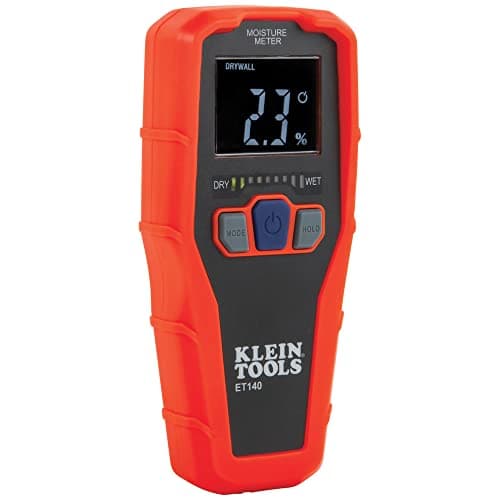
A professional-grade pinless moisture meter that detects hidden moisture in drywall, wood, and masonry without leaving holes. Uses electromagnetic sensor technology to measure moisture content up to 3/4 inch below the surface. Essential for identifying moisture problems before mold develops.
Pros
- Non-invasive pinless technology, no holes in walls
- Detects moisture up to 3/4 inch deep
- Visual and audible moisture alerts
Cons
- Less precise than pin-type meters on exact moisture percentage
- Battery not included
- Can give false readings on metallic or foil-backed surfaces
Cleaning surface mold off plywood and OSB
If the panel passed the press test, here's the sequence. Do it in order — skipping the moisture step is why mold comes back on wood that was "cleaned."
- Fix the water first.Find and stop the leak, condensation, or ventilation problem that wet the wood. Clean before this and you're just resetting the clock.
- Contain and protect yourself.Close the area off, wear an N95 and gloves, and don't dry-brush — that launches spores.
- HEPA-vacuum the loose growth. A true-HEPA vacuum lifts surface mold without spreading it; a regular shop-vac just blows spores back into the room. Our HEPA vacuum guide covers why the filter rating matters here.
- Scrub with a wood-safe mold cleaner. On porous engineered wood, a no-bleach cleaner that can soak in beats straight chlorine, which mostly stays on the surface and bleaches the stain without reaching the growth. A borax solution is the cheap DIY route; a ready-to-use product like Concrobium is the grab-and-go one:
Concrobium Mold Control (32 oz Spray, 2-Pack)
Concrobium
$34–40 (2 bottles)
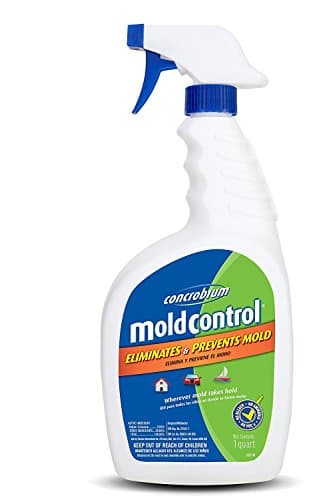
A patented, EPA-registered mold control solution that kills mold without bleach, ammonia, or VOCs. The tri-salt polymer formula crushes mold spores as it dries and leaves an invisible antimicrobial barrier to prevent regrowth. Safe for indoor use on virtually any surface.
Pros
- Non-toxic, no bleach or ammonia
- Kills mold and prevents regrowth
- Safe for use around children and pets
Cons
- Does not remove existing mold stains
- Takes longer to work than bleach-based products
- May require multiple applications for severe infestations
Then dry it completely— fans, a dehumidifier, time — and don't move on until the moisture meter reads back down in the normal range (roughly 7–12% for interior wood, and in any case well under 20%). Sealing or covering damp wood traps the moisture and grows the mold right back. A faint gray shadow left in the grain after cleaning is usually dead stain, not live mold; if the wood is firm and dry, that's cosmetic.
When the sheet has to come out
Replacement isn't a failure — on engineered wood it's often the correct, cheaper-in-the-long-run call. Cut out and replace the panel when the pressure test found soft or delaminated wood, when the staining goes through a cut edge, or when the moldy area is simply large. The EPA's guidance is that mold covering more than about 10 square feet (roughly a 3-by-3 patch) is past comfortable DIY territory and worth bringing in a professional — both for the containment and because an area that big usually signals a bigger water problem behind it.
Moldy subfloor and roof or wall sheathing are the classic replace-the-sheet jobs, and they rarely show up alone. If you found it under a bathroom or against a foundation wall, read our basement mold guide for the moisture side, and size the job honestly with our mold removal cost and inspection cost breakdowns before you decide DIY-versus-pro. Two more sibling surfaces behave the same way worth comparing against: our mold on wood flooring and mold on drywall guides use the same clean-or-replace logic for their materials.
Sealing cleaned wood and stopping regrowth
Cleaned-but-stained plywood that's firm and dry can be sealed. A mold-killing or mold-resistant primer locks down the surface, hides the residual stain, and gives mold a less hospitable face to land on. It is not a substitute for fixing the moisture — primer over a wall that still gets wet just grows mold on top of the paint — but once the water is handled, it's the finishing step:
Zinsser Mold Killing Primer (Quart, 3-Pack)
Zinsser
$55–65 (3 quarts)
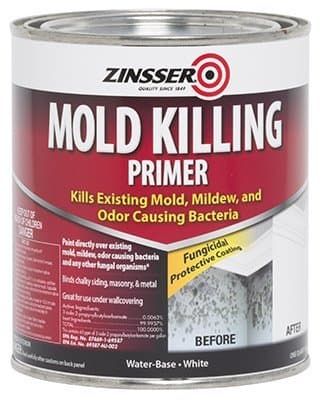
An EPA-registered fungicidal primer that kills existing mold, mildew, and odor-causing bacteria on contact. Creates a mold-resistant barrier on interior and exterior surfaces including drywall, wood, concrete, and masonry. Essential for mold remediation projects before applying topcoat paint.
Pros
- Kills existing mold on contact while priming
- EPA-registered fungicidal protective coating
- Bonds to all interior and exterior surfaces
Cons
- Strong odor during application, requires ventilation
- Water-based formula can raise grain on bare wood
- Must be topcoated with paint for lasting protection
The real prevention, though, is boring and permanent: keep the wood under the moisture threshold. Ventilate the attic or crawl space, run a dehumidifier where humidity sits high, and deal with leaks the day you find them. Our mold-resistant paint guide goes deeper on the sealing products, and the mold removal guide covers the moisture-control playbook that keeps any of this from coming back.
Short answers
Are black spots on OSB always mold?No — often they're the board's own dark resin and wax flecks or factory/kiln staining, especially on new, dry OSB. Mold is fuzzy or slimy, smears when wiped, and shows up where the board got wet. If a dab of diluted bleach makes the spot fade, it was biological; if it stays put, it's staining.
Can you save moldy plywood subfloor? Only if it passes the press test — firm, solid, with staining on the surface only. If a screwdriver sinks in, the plies peel, or the OSB edges are swollen and crumbly, the structure is gone and that section has to be replaced, not cleaned.
Does bleach work on plywood mold?Poorly. Chlorine bleach lightens the stain but mostly sits on the surface of porous engineered wood instead of reaching the mold's roots, and the water it adds can feed regrowth. A cleaner that penetrates — a borax solution or a product like Concrobium — plus fixing the moisture does more than bleach on this material.
Found dark marks and not sure if it's mold or just OSB being OSB? Tell us the surface, whether it smells musty, and what a moisture meter reads — those three answers usually settle it faster than another photo ever could.
Frequently Asked Questions
Are black spots on OSB always mold?
Can you save moldy plywood subfloor?
Does bleach work on plywood mold?
Related Articles
Mold on Wood Floors: Remove It, Refinish, or Replace?
Mold on Drywall: Should You Clean It or Replace It?
How to Get Rid of Mold in Your Basement (2026 Guide)
Moisture Meter for Mold: Finding Hidden Mold Before You See It
Does Borax Kill Mold? What It Does, What It Doesn't, and the Right Mix
Mold-Resistant Paint: How It Works, When to Use It, and What It Can't Do
Dealing With Mold Right Now?
Our step-by-step mold removal guide walks you through testing your home, choosing the right products, and knowing when a job is too big for DIY.
Read the Removal Guide